

OPW Airbag Fabric Market: Size, Technology & Trends 2026
OPW stands for One-Piece Woven, a seamless airbag manufacturing technology where the entire cushion is woven as a single textile structure on a jacquard loom. The OPW airbag fabric market is growing at 8-10% annually and is projected to reach 3.9billionto3.9billionto12.7 billion by the mid-2030s, depending on scope definition.
The global OPW airbag fabric market is projected to more than double by 2035. Yet most procurement managers cannot explain what “OPW” actually means, let alone how it differs from the cut-and-sew airbags that dominated the industry for decades. If you source materials for automotive safety systems, you understand that airbag specifications are non-negotiable. What is less obvious is why OEMs are increasingly specifying OPW construction, which suppliers dominate this segment, and how to evaluate OPW fabric quality during supplier qualification.
This guide delivers the technical and market intelligence you need to evaluate OPW technology, understand the competitive landscape, and make informed procurement decisions. You will learn how OPW weaving works, why side curtain airbags rely on it, how the market is segmented by region and application, and what to look for when qualifying OPW fabric suppliers.
Key Takeaways
- OPW (One-Piece Woven) technology weaves the entire airbag structure in a single loom operation, eliminating sewn seams and reducing assembly steps by up to 40%.
- The OPW airbag fabric market is growing at 8-10% CAGR, with side curtain airbags driving the majority of demand due to rollover protection requirements.
- Hyosung Advanced Materials (through Global Safety Textiles) leads the OPW segment with 32% market share, followed by Toray Industries and Toyobo.
- OPW fabric requires specialized jacquard looms capable of multi-layer weaving with integrated X-tethers and chamber structures.
- Procurement teams should evaluate OPW suppliers on weaving pattern capability, coating uniformity on 3D structures, and batch consistency data.
Need guidance on OPW airbag fabric specifications for your program? Our engineering team can review your OEM requirements and recommend the right fabric technology for your application. Contact us for a technical consultation.
What Is OPW (One-Piece Woven) Airbag Fabric?
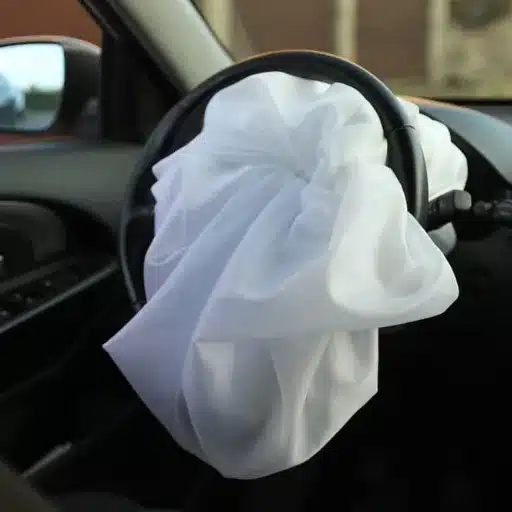
One-Piece Woven (OPW) airbag fabric is a seamless textile structure manufactured on a specialized jacquard loom that weaves multiple fabric layers simultaneously. The resulting airbag blank requires no sewing of peripheral seams. Inflation chambers, structural tethers, and edge boundaries are all integrated during the weaving process.
Traditional airbags are cut from flat woven fabric rolls, coated, and then sewn together along their edges. Each sewn seam creates a potential gas leak path and adds manufacturing steps. OPW eliminates both problems by forming the airbag’s three-dimensional geometry directly on the loom.
OPW airbag fabric is woven as a single textile structure in which upper and lower fabric layers are interwoven at selected connection points to form inflatable chambers, while X-tethers woven between layers control expansion geometry during deployment.
When Elena Park joined the procurement team at a Tier 1 airbag module supplier in Seoul, her first RFQ review included a specification for “OPW side curtain fabric with three-layer construction and integrated X-tether series.” She had sourced flat woven nylon 6,6 for years. OPW was new territory.
The specification called for a fabric that would form a 2.8-meter side curtain with six internal chambers, all woven in one continuous piece. Her supplier evaluation checklist, built for cut-and-sew fabrics, did not cover weaving pattern capability or multi-layer coating uniformity. She needed to rebuild her qualification framework from the ground up.
For readers new to airbag material composition, our guide on what airbags are made of provides a complete breakdown of fabric, coating, and inflator components. LY TRUSTLINK welcomes inquiries from global clients seeking innovative products and long-term cooperation opportunities. Contact us today for more details.
How OPW Technology Works
OPW technology represents a fundamental shift from assembly-based manufacturing to integrated textile engineering. The process requires specialized equipment, precise warp preparation, and sophisticated loom control.
The Weaving Process
OPW airbag fabric is produced on jacquard-controlled rapier or air-jet looms capable of managing multiple warp systems simultaneously. The typical process involves:
Warp thread preparation. Separate warp beams supply threads for each fabric layer. A three-layer side curtain OPW requires three distinct warp sets: upper fabric, middle connection layer, and lower fabric. Each warp set has its own tension control and feeding system.
Multi-layer weaving. Weft threads are inserted across all layers in a single pick. The jacquard system controls which warp threads interlace with the weft at each point. In chamber-forming regions, upper and lower layer warps do not interlace, creating separable pockets. In edge and tether regions, threads interlock to form structural bonds.
X-tether integration. X-shaped tether series are woven between fabric layers by exchanging warp threads between adjoining layers at programmed intervals. These tethers limit how far the upper and lower layers separate during inflation. They define the final three-dimensional shape of the deployed airbag.
Inflow region design. A critical first partial region near the gas generator inlet uses “floating” middle-layer threads that are not interwoven with upper or lower layers. This allows inflation gas to flow into the main chambers with minimal resistance.
From Loom to Finished Airbag
After weaving, the OPW blank is a continuous length of multi-layer fabric containing multiple airbag units in sequence. Post-weaving operations include:
- Coating application. Silicone coating is applied via knife-over-roll or dip methods to control gas permeability. Coating uniform thickness across the 3D woven structure is technically demanding.
- Laser cutting. Individual airbag units are separated using precision laser cutting systems that adapt to fabric distortions in real time.
- Inflator attachment. The generator mouth region is prepared and the inflator is mounted.
- Folding and packaging. The airbag is folded into its deployment module.
For details on coating line equipment used in post-weaving operations, see our article on airbag coating line systems.
OPW vs. Traditional Sewn Airbags: A Technical Comparison
OPW and cut-and-sew airbags serve the same safety function but differ fundamentally in manufacturing method, performance characteristics, and cost structure.
| Factor | OPW (One-Piece Woven) | Cut-and-Sew |
|---|---|---|
| Manufacturing method | Single weaving process on jacquard loom | Cut from rolls, coat, then sew edges |
| Assembly steps | Weaving only (40% fewer steps) | Cut, coat, sew, inspect (multiple stages) |
| Labor intensity | Low (highly automated) | High (manual sewing operations) |
| Seam integrity | No sewn seams; no leak paths | Dependent on seam quality and sealing |
| Gas retention | Superior (extended inflation possible) | Standard (limited by seam permeability) |
| Material waste | ~15% lower (optimized nesting) | Higher (pattern cutting losses) |
| Inflation duration | Extended (5+ seconds for rollover) | Standard duration |
| Weight | Lighter (no seam bulk) | Heavier (seams add mass) |
| Design flexibility | Moderate (loom-pattern dependent) | High (easy prototyping changes) |
| Capital investment | High (specialized looms) | Lower (standard equipment) |
The choice between OPW and cut-and-sew depends on application requirements and production volume. Side curtain airbags, which must remain inflated for extended periods during rollover events, almost universally use OPW construction. Driver and passenger frontal airbags, where inflation duration is shorter and design changes are more frequent, still use a mix of both technologies.
Understanding the manufacturing differences between OPW and cut-and-sew is essential for procurement teams evaluating total cost of ownership. Request a technical consultation to discuss which technology fits your specific airbag program requirements.
OPW Airbag Fabric Market Size and Growth
Market Size Estimates
The OPW airbag fabric market size varies significantly depending on whether analysts measure OPW-specific woven fabric value or include downstream module assembly. Key estimates include:
- Global Market Statistics: 1.58billion(2026),projectedtoreach1.58billion(2026),projectedtoreach3.91 billion by 2035 at 35.3% CAGR
- Market Research Future: 6.50billion(2024),projectedtoreach6.50billion(2024),projectedtoreach12.71 billion by 2035 at 6.28% CAGR
- Data Insights Market: $7.74 billion by 2033 at 14.87% CAGR
The wide range reflects differences in scope. Narrow definitions measuring only OPW woven fabric blank production cluster toward the lower end. Broader definitions that include coating, cutting, and module assembly value approach the higher estimates.
Growth Drivers
Five primary forces are expanding the OPW airbag fabric market:
1. Regulatory mandates. Governments worldwide are increasing minimum airbag requirements. India now mandates dual front airbags on all passenger vehicles. The European Union requires side-impact protection. These mandates expand the addressable vehicle fleet.
2. Rising airbag count per vehicle. Economy vehicles historically carried 2-3 airbags. Premium vehicles now deploy 8-12 units, including side curtains, knee airbags, and center-mounted units. Each additional airbag represents fabric demand.
3. Side curtain and rollover protection. OPW technology is essential for side curtain airbags that must retain inflation pressure for 5+ seconds during rollover events. Regulatory adoption of rollover standards in North America and Europe directly drives OPW demand.
4. Electric vehicle adoption. EV manufacturers prioritize weight reduction to maximize range. OPW airbags are lighter than cut-and-sew equivalents. The shift to electric powertrains accelerates OPW specification.
5. OEM cost reduction pressure. OPW reduces assembly steps by up to 40% and material waste by approximately 15%. These efficiency gains translate to lower per-unit manufacturing costs at volume.
Regional Breakdown
| Region | Market Share | Key Characteristics |
|---|---|---|
| Asia-Pacific | 55-65% | China, Japan, South Korea dominate manufacturing; fastest-growing demand |
| Europe | ~18% | Stringent rollover regulations; mature OEM supply chain |
| North America | ~12% | High per-vehicle airbag count; strong safety standards |
| Rest of World | ~10% | Emerging markets in India, Southeast Asia, Latin America |
When Marcus Reeves, a quality engineer at an airbag module plant in Michigan, reviewed deployment test data from a new side curtain program, he noticed inconsistent inflation geometry across production lots. Some units inflated into flat, wide cushions. Others formed narrow cylinders.
Root cause analysis traced the variation to X-tether weaving patterns. One supplier had modified the tether exchange frequency to increase loom throughput. The change was invisible to standard permeability and tensile tests. Only deployment geometry testing revealed the problem.
His experience illustrates why OPW quality verification requires testing beyond conventional fabric parameters.
Key Players and Competitive Landscape
The OPW airbag fabric market is moderately concentrated, with the top three players holding slightly above half of total revenue.
Fabric Manufacturers
| Company | Headquarters | Market Position | OPW-Specific Strength |
|---|---|---|---|
| Hyosung Advanced Materials / GST | South Korea / Germany | #1 global (22% overall, 32% OPW) | 10 production plants worldwide; extensive OPW patent portfolio |
| Toray Industries | Japan | Top 3 overall | Vertical integration from polymer to fabric; strong R&D |
| Toyobo | Japan | Top 3 overall | Advanced textile technology; long history in airbag fabrics |
| Teijin Limited | Japan | Major player | High-performance materials; sustainability focus |
| Kolon Industries | South Korea | Significant | Strong regional OEM relationships |
| Milliken & Company | USA | Specialty | Sustainable fabric development |
| Porcher Industries | France | European leader | Advanced technical textiles |
| HMT (Xiamen) | China | Growing | Lightweight, eco-friendly focus |
Tier 1 Module Integrators
Fabric manufacturers supply Tier 1 integrators who assemble complete airbag modules. The module market is more concentrated than the fabric market:
- Autoliv (Sweden): ~40% global airbag module market share
- ZF (Germany, via TRW acquisition): Major global presence
- Joyson Safety Systems (China): Growing through acquisition
- Continental (Germany): Strong European OEM relationships
The relationship between fabric makers and Tier 1 integrators is critical. OEMs typically approve fabric suppliers at the module level, meaning Tier 1s must qualify and maintain approved fabric sources. This creates significant barriers to entry for new fabric manufacturers.
OPW Manufacturing: Equipment and Process Requirements
OPW production demands specialized capital equipment and process expertise that differentiate it from conventional textile manufacturing.
Specialized Loom Technology
OPW airbag fabric is woven on jacquard-controlled rapier or air-jet looms with multi-layer capability. Key equipment specifications include:
- Multi-layer weaving capability: 2-4 fabric layers woven simultaneously
- Jacquard control system: Individual warp thread control for pattern definition
- Multiple warp beam system: Separate tension control for each layer’s warp set
- High insertion rate: Rapier or air-jet weft insertion for production efficiency
Leading loom suppliers for OPW applications include Picanol (Belgium), Dornier (Germany), and Tsudakoma (Japan). These manufacturers provide specialized configurations for multi-layer airbag weaving.
Post-Weaving Operations
After weaving, OPW blanks require several processing steps:
Coating application. Silicone coating is applied to control gas permeability. Coating uniform thickness across the 3D woven structure is more challenging than coating flat woven fabric. Knife-over-roll and dip coating methods are both used.
Laser cutting. OPW blanks are separated into individual airbag units using laser cutting systems. Advanced systems like those from Lectra achieve up to 20% greater productivity than mechanical cutting, with approximately 15% reduction in cutting cost per bag.
Quality inspection. Visual and automated inspection checks for weaving defects, coating uniformity, and dimensional accuracy.
Quality Challenges Unique to OPW
OPW fabric introduces quality concerns that do not exist in cut-and-sew production:
- Weaving defects: Broken warp threads, incorrect tether exchanges, or float errors create weak points
- Coating uniformity: Achieving consistent coating thickness across raised chamber regions is difficult
- Foldability: Multi-layer OPW fabric must fold compactly into modules without creasing or delamination
- Dimensional stability: Heat-setting must control shrinkage without altering chamber geometry
For a deeper understanding of the material properties that affect OPW performance, refer to our guide on airbag material properties.
Procurement and Supplier Considerations
Specifying OPW Fabric
A complete OPW fabric specification should include:
- Base material: Nylon 6,6 denier (typically 420D-630D), yarn specifications
- Weave structure: Number of layers, chamber configuration, tether pattern
- Coating: Silicone type, add-on weight, permeability target
- Dimensional requirements: Finished blank dimensions, tolerances
- Performance requirements: Tensile strength, tear resistance, deployment geometry
Supplier Evaluation Criteria
When qualifying an OPW fabric supplier, assess:
Weaving capability. Does the supplier operate jacquard looms with multi-layer capability? Can they produce your specific chamber and tether configuration? Request sample blanks and deployment test results.
Coating technology. Coating uniformity on 3D woven structures is critical. Ask for coating thickness mapping data across chamber and flat regions.
Pattern design support. OPW requires loom pattern programming for each airbag design. Evaluate the supplier’s engineering team’s ability to support pattern development and prototyping.
Batch consistency. Request statistical process control data for key parameters across 12+ months of production. Coating weight, permeability, and tensile strength should show controlled variation.
Automotive certifications. IATF 16949 certification is mandatory. PPAP submission capability is required for new programs.
Cost Factors
OPW fabric typically commands a higher unit price than flat woven fabric for equivalent area. However, total cost of ownership often favors OPW due to:
- Elimination of sewing labor and equipment
- Reduced material waste from optimized nesting
- Lower defect rates and rework costs
- Higher production throughput
When David Okonkwo, operations director at a European module assembly plant, analyzed total cost per side curtain module, he found that OPW fabric eliminated three production stations and reduced in-process inventory by 60%. The fabric unit cost was 15% higher than flat woven alternative.
The manufacturing cost savings more than offset the difference. His analysis demonstrates that procurement decisions should evaluate total module cost, not fabric unit price alone.
Evaluating OPW suppliers requires looking beyond fabric price to weaving capability, coating quality, and pattern engineering support. Contact our engineering team for guidance on OPW supplier qualification and specification development.
Future Trends in OPW Technology
The OPW airbag fabric market is evolving in response to vehicle electrification, sustainability mandates, and new safety requirements.
External and Pedestrian Protection Airbags
Next-generation vehicle safety systems include external airbags that deploy before impact to protect pedestrians and cyclists. These systems require large, rapidly inflating cushions with complex geometries. OPW technology is well-suited to these applications due to its ability to weave large seamless structures with integrated chambers.
Lightweighting for Electric Vehicles
EV manufacturers are pushing for lighter safety components to offset battery weight and maximize range. OPW fabric manufacturers are responding with lower-denier yarns, reduced coating weights, and optimized weave structures that maintain performance with less mass.
Sustainable Fabric Development
Recycled nylon 6,6 and bio-based fiber alternatives are entering the airbag fabric market. Toyobo and Teijin have announced development programs for recycled-content airbag fabrics. OPW construction, which already minimizes material waste, aligns well with sustainability goals.
Smart Airbag Integration
Research is underway on sensor-integrated OPW fabrics that can detect occupant position and adjust deployment force. While still emerging, this technology could create new requirements for OPW fabric conductivity and sensor accommodation.
For a visual overview of advanced airbag fabric manufacturing technology, see the demonstration below:
[YouTube Embed: Airbag Fabric Manufacturing and OPW Weaving Process, Technical Overview]
Conclusion
OPW technology has transformed airbag manufacturing from a cut-and-sew assembly process into an integrated textile engineering discipline. The OPW airbag fabric market is growing at 8-10% annually, driven by regulatory mandates, rising airbag counts per vehicle, and the unique performance advantages of seamless woven construction for side curtain and rollover protection applications.
For procurement teams, the critical considerations are weaving capability, coating uniformity on 3D structures, and batch consistency data. The fabric unit cost of OPW is typically higher than flat woven alternatives. The total manufacturing cost often favors OPW due to eliminated sewing steps, reduced waste, and lower defect rates.
Hyosung Advanced Materials leads the competitive landscape with 32% OPW market share, followed by Toray Industries and Toyobo. The market remains moderately concentrated, with significant barriers to entry created by OEM qualification requirements and specialized equipment needs.
As electric vehicles, external airbags, and sustainability requirements reshape automotive safety, OPW technology will continue to gain share. Procurement teams that understand the technology, the supplier landscape, and the qualification requirements will be best positioned to source these critical safety materials effectively.
If your team is evaluating OPW airbag fabric suppliers or developing specifications for an upcoming program, contact our engineering team for a technical consultation. We can review your OEM requirements, discuss OPW technology options, and provide guidance on supplier qualification.
Related reading: Explore our comprehensive automotive airbag fabric market guide for market sizing, material specifications, and procurement strategies across the full airbag textile supply chain.