

Airbag Material Selection Guide for Engineers: A Procurement-Centered Spec Sheet
The right airbag material is selected by mapping six fabric properties (tensile strength, tear strength, air permeability, heat resistance, elongation at break, and aging stability) to the airbag type, regulatory requirements, and supplier qualification criteria. Get any of those mappings wrong, and the fabric may pass every individual test yet still fail in the module.
Last quarter, a Tier-1 supplier received three airbag fabric quotes that all claimed “automotive grade” nylon 6,6. Only one included SAE J2052 aging data. Two months into validation, the two low-budget samples showed coating delamination after thermal cycling. The RFQ saved 8% on unit cost but cost six weeks in program delay.
If you have ever compared airbag fabric quotes, you know the spec sheet is where the decision is actually made or missed. This airbag material selection guide gives procurement and engineering teams a decision framework that connects each material property to a supplier requirement. We will cover the six properties, how they vary by airbag type, material options, supplier qualification checkpoints, and the red flags that should disqualify a quote. Contact LY TRUSTLINK for reliable airbag fabric solutions engineered for safety and consistency.
Key Takeaways
- Tensile strength, tear strength, air permeability, heat resistance, elongation, and aging stability are the six non-negotiable properties on every airbag fabric spec sheet.
- Nylon 6,6 remains the baseline for ~95% of automotive airbags because it absorbs more thermal energy before failure than polyester.
- Coated fabrics (silicone, 40–80 g/m²) deliver lower permeability and built-in heat shielding; uncoated fabrics trade packability for controlled leakage.
- Supplier qualification must include IATF 16949, PPAP capability, batch traceability, and deployment test data, not just unit price.
- A spec sheet without test methods, acceptance ranges, or aging data is an incomplete basis for an RFQ.
Why Material Selection Is a Supply Chain Decision, Not Just an Engineering One
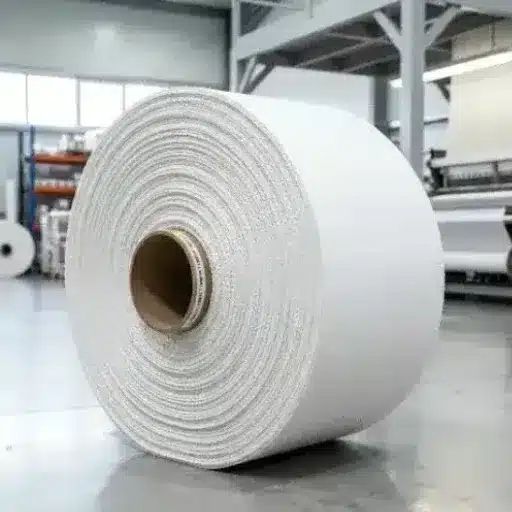
An airbag module is a system. The inflator, cushion, seams, cover, and sensors are engineered together, but the fabric is the component that physically contains the gas and manages the occupant interaction. When it fails, the failure mode is rarely isolated to the textile.
For procurement teams, this means the fabric quote cannot be evaluated on price per square meter alone. The total cost of ownership includes validation time, scrap rates, assembly efficiency, warranty exposure, and the risk of a line shutdown. A fabric that costs 5% more upfront but ships with complete PPAP documentation and stable batch performance is usually the lower-cost choice over the program lifecycle.
LY TRUSTLINK treats airbag fabric selection as a shared engineering and procurement exercise. Our team supports programs from initial concept through certified delivery, because the specification is only as reliable as the process that produces it.
Airbag Material Properties and Fabric Specifications Every Spec Sheet Must Quantify
Every airbag fabric specification should present the same six properties with test methods and acceptance ranges. If a supplier lists only a single number or omits the standard, the data is not comparable.
Tensile Strength and Elongation at Break
Tensile strength measures the fabric’s resistance to rupture under load. For woven nylon 6,6 airbag fabric, warp-direction values typically fall between 2,000 and 3,000 PSI when tested per ASTM D5034 (grab method) or ASTM D5035 (strip method).
Elongation at break is the companion value. Airbag fabric typically shows 180–250% elongation. Too little elongation and the cushion tears at the seam or fold line; too much and the bag balloons beyond its designed geometry.
When reviewing quotes, confirm that tensile and elongation values come from the same test method. A grab test and a strip test will not produce identical numbers, and mixing them invalidates the comparison.
Tear Strength and Edge Integrity
A small nick in the fabric can propagate under deployment stress. Tear strength measures how well the material resists that propagation. Typical acceptance values range from 80–130 N via ASTM D1424 (Elmendorf) or ASTM D2261 (trouser tear).
Ripstop weaves improve tear resistance by interrupting tear paths with heavier reinforcing yarns. This construction is common in side-curtain and rollover airbags, where the cushion is large and the consequences of a tear are severe.
Air Permeability and Deployment Dynamics
Permeability controls how the cushion holds pressure during inflation and occupant ride-down. Too much permeability and the bag deflates before it can protect; too little and internal pressure can spike beyond seam capability.
For silicone-coated fabrics, the typical target is <1 cm³/sec/cm² measured per ASTM D737 or ISO 9237. Premium grades target <0.5 cm³/sec/cm². Uncoated fabrics are intentionally more permeable and are selected when controlled leakage is part of the design.
Always verify the test pressure. Permeability values measured at 125 Pa and 500 Pa are not interchangeable.
Heat Resistance and Thermal Stability
Inflator gas can reach localized temperatures well above the base fabric melting point during deployment. Nylon 6,6 has a melting point of roughly 255–265°C, but its advantage over polyester is not just the melting point; it is the higher energy absorption before thermal failure. For a deeper look at how silicone coating contributes to heat resistance, see our silicone coating for airbag fabric technical guide.
Silicone coatings act as the primary thermal barrier. Coated fabrics are tested for flame and heat exposure per ISO 6941, with peak resistance values up to 800–900°C in some specifications. The coating also prevents the folded fabric from sticking to itself, which can cause asymmetric deployment.
Aging and Environmental Degradation
An airbag may sit unused for 10–15 years. During that time, the fabric must survive heat, humidity, thermal cycling, and UV exposure without significant degradation.
SAE J2052 is the standard accelerated-aging protocol for restraint-system textiles. A complete aging study should report retention of tensile strength, tear strength, and permeability after the aging cycle. If a supplier cannot provide SAE J2052 data, the material has not been qualified for long-term automotive service.
Coating Performance
When the fabric is coated, the coating has its own mechanical requirements. Typical silicone coating properties include:
- Tensile strength: 4–6 MPa
- Elongation at break: 700–1,600%
- Tear strength: ≥30 kN/m
- Service temperature: −50°C to +250°C
- Coating weight: 40–80 g/m² depending on airbag type
Coating adhesion and uniformity are just as important as the base values. A coating that delaminates during folding or deployment cannot protect the base fabric.
Mapping Properties to Airbag Types
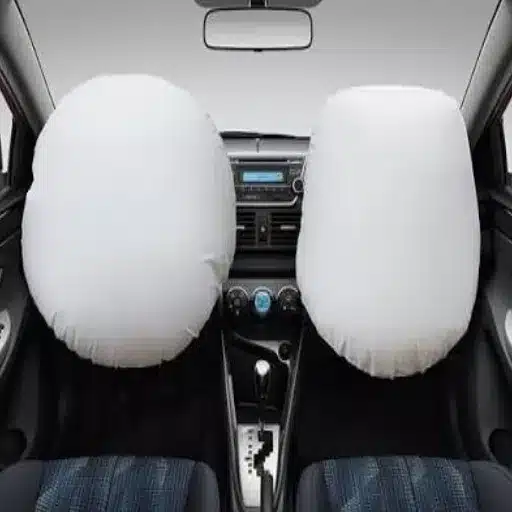
Not every airbag places the same demand on the fabric. The property priorities shift with pack volume, inflation pressure, and geometry.
Driver Frontal Airbags
Driver airbags deploy from a small steering-wheel module at high pressure. The fabric must pack tightly and withstand high gas temperature. Coated nylon 6,6 with 50–60 g/m² silicone coating and low permeability is the standard.
Passenger Frontal Airbags
Passenger cushions are larger and operate at lower pressure. Some designs use uncoated fabric to manage ride-down through controlled leakage. The tradeoff is a larger pack volume and the need for a separate heat shield.
Side Curtain and Rollover Protection
Side curtains remain inflated longer to protect occupants during rollover events. Tear strength and coating uniformity are critical because the cushion is long and narrow. Coating weights often run 65–80 g/m², and ripstop constructions are common.
Knee and Rear-Seat Airbags
These smaller modules require flexible folding and fast deployment. Coating weights of 45–55 g/m² balance heat protection with packability.
One-Piece Woven (OPW)
OPW airbags are woven as a single piece with integrated seams, eliminating sewn joints. The property requirements shift from seam strength to woven-junction integrity. Tear resistance at the woven transition zones becomes a key qualification point. For procurement-specific OPW guidance, see our OPW airbag fabric procurement guide.
Material Options: Nylon 6,6, Polyester, and Emerging Alternatives
| Property | Nylon 6,6 | Polyester | Nylon 6 |
|---|---|---|---|
| Melting point | ~255–265°C | ~260°C | ~220–230°C |
| Energy to melt | Higher | Lower | Moderate |
| Moisture absorption | 4–4.5% | 0.4% | 4–4.5% |
| Typical use | Driver/passenger/side curtain | Exterior/long-storage | Cost-sensitive side impact |
Nylon 6,6 dominates automotive airbags because it absorbs roughly 30% more thermal energy before melting than polyester at a comparable melting point. Polyester is sometimes chosen for dimensional stability and low moisture absorption in non-deployment-critical applications. Nylon 6 offers cost savings but lower heat resistance. If you are evaluating base yarn options, our airbag nylon guide compares the grades used in restraint systems.
For electric vehicles, lightweighting is pushing some programs toward finer-denier yarns and thinner coatings. These materials can reduce pack volume and weight, but they must still meet the same thermal and mechanical thresholds. Work with LY TRUSTLINK for customized airbag fabric solutions built around performance.
Airbag Supplier Qualification: What the Data Sheet Won’t Tell You
A complete spec sheet is necessary but not sufficient. The supplier’s ability to produce that fabric consistently is what protects the program.
Certification and Quality Systems
Automotive airbag fabric suppliers should hold IATF 16949 certification as a baseline. This confirms that quality management systems meet OEM expectations. Additional ISO certifications for environmental and laboratory management add confidence.
Testing and PPAP Capability
The supplier must be able to support Production Part Approval Process (PPAP) submissions, including dimensional results, material performance data, process flow diagrams, and control plans. Full-scale deployment testing with production inflators is often required before final approval.
Traceability and Process Control
Every roll should be traceable to the yarn lot, coating batch, and production line. Statistical process control (SPC) data for coating weight, permeability, and tensile strength over 12+ months demonstrates that the quoted values are representative, not peak results.
Spec Sheet Red Flags That Should Stop the RFQ

Some spec sheet issues are warning signs that the supplier is not prepared for automotive qualification:
- No test method listed. A tensile strength value without ASTM or ISO reference is meaningless.
- Single-point values instead of ranges. Production variation exists; acceptance ranges are required.
- Missing SAE J2052 aging data. Long-term performance is unproven.
- No coating adhesion value. Delamination is a common field failure mode.
- Permeability without test pressure. Values at different pressures cannot be compared.
- Vague claims like “automotive grade.” This is not a standard.
When Maria, a senior buyer at a seating supplier, added these six checkpoints to her RFQ template, she eliminated two of five respondents before the sample stage. The remaining suppliers submitted complete data packages, and her qualification timeline shortened by four weeks. Contact LY TRUSTLINK to develop durable airbag fabrics for demanding automotive applications.
Airbag Fabric Procurement: Building the RFQ Template
A well-structured RFQ accelerates supplier response and reduces back-and-forth. Include the following:
- Application and airbag type: driver frontal, passenger frontal, side curtain, knee, OPW
- Material and construction: base yarn, denier, weave type, coating type and weight
- Performance targets: tensile, tear, elongation, permeability with test methods and acceptance ranges
- Environmental requirements: aging standard, temperature range, humidity exposure
- Regulatory standards: FMVSS 208, ECE R94/R95, GB standards as applicable
- Documentation expectations: PPAP level, test reports, SPC data, batch traceability
- Volume and timing: annual volume, ramp schedule, lead time, packaging requirements
Frequently Asked Questions
What is the most important property of airbag fabric?
There is no single most important property. Tensile strength, tear strength, air permeability, heat resistance, elongation, and aging stability must all meet application-specific targets. A weakness in any one can cause deployment failure.
Can I use polyester instead of nylon 6,6 for airbag fabric?
Polyester is used in some specialty applications, but nylon 6,6 is preferred for deployment-critical cushions because it absorbs more thermal energy before failure. The choice should be validated through full-scale deployment and aging tests.
How do I verify aging performance?
Require SAE J2052 accelerated-aging test data with post-aging retention values for tensile strength, tear strength, and permeability. Real-world aging validation from field returns is also valuable.
What does “automotive grade” mean?
“Automotive grade” is not a defined standard. It should be replaced with specific requirements: IATF 16949 certification, applicable ASTM/ISO test methods, and OEM or FMVSS/ECE performance criteria.
How long should airbag fabric qualification take?
Qualification typically takes 12–18 months for a new supplier, including material submission, component testing, full-scale deployment validation, and PPAP approval. Existing qualified suppliers can often support engineering changes faster.
Conclusion
This airbag material selection guide is the point where engineering requirements become procurement requirements. The spec sheet numbers only matter if they are tied to the right test methods, the right airbag type, and a supplier capable of reproducing them on every roll.
LY TRUSTLINK supplies airbag fabrics engineered to the standards that protect occupants and programs. If you are building your next RFQ or refreshing a supplier qualification process, our engineering team can provide a technical specification package tailored to your application. Explore our full range of automotive airbag fabric solutions or contact us directly.