
How to Repair a Bounce House: Costs & When to Replace
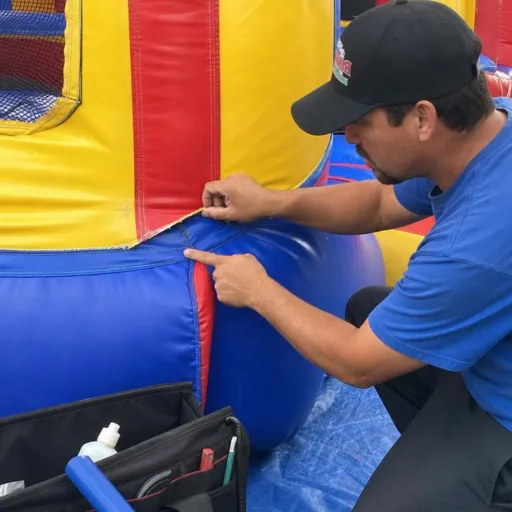
A puncture in a commercial 18 oz PVC bounce house is a 10 to 15 minute field repair with a vinyl patch kit that costs about $25. A seam split on lighter 15 oz material usually means a re-stitch and re-weld toward $500 and days out of service. Which repair you face is decided at the factory, by the material grade the unit was built from.
That’s the part most guides leave out. Search “how to repair bounce house” and you’ll find the same procedure on a hundred retailer blogs: clean, glue, press, cure. It’s right for a puncture and nearly useless for a seam failure.
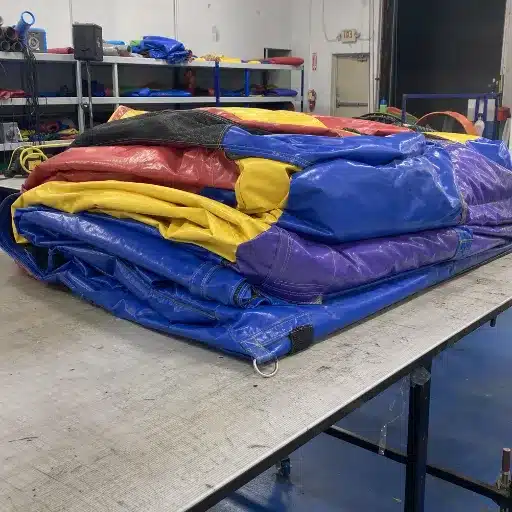
We manufacture commercial PVC inflatable fabric, testing every batch for tensile strength, tear resistance, and coating adhesion. You’ll learn which kit works on PVC, how to patch a tear, how to handle a seam split, and when to stop patching. Start with our guide to what bounce houses are made of.
Key Takeaways
- A puncture in 18 oz PVC is a 10 to 15 minute DIY repair with a ~$25 kit; a seam split on 15 oz material runs $500 and needs a re-stitch plus re-weld.
- The material decides the repair. 18 oz PVC patches easily; 15 oz PVC fails at seams; nylon and Oxford panels are often unrepairable.
- Use the 3-point check before buying glue: brittle or thinned material, structural failure, or a seam that keeps failing all mean replace, not patch.
- The right adhesive is vinyl cement (SX-69 or HH-66). Super glue, duct tape, and acetone all make repairs worse.
- A ~$3 preventive-maintenance return per $1 spent means the routine that prevents repairs pays better than the repairs.
The Short Answer: Bounce House Repair by Damage Type
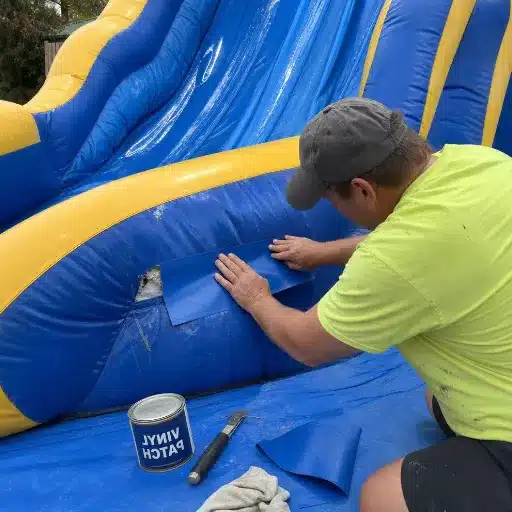
How you repair a bounce house depends on the damage, and most damage falls into six categories. It’s the table our engineering team uses when operators send us a damaged unit.
| Damage Type | DIY or Pro? | Method | Typical Cost | Cure / Downtime |
|---|---|---|---|---|
| Puncture or small tear (under 1 in) | DIY | Vinyl patch + SX-69/HH-66 cement | $25-50 kit | Cure 24 h, back same day |
| Tear (1-6 in) | DIY | Rounded patch with 1-2 in overlap | $25-50 | 24-48 h |
| Large tear (over 6 in) | Pro | Industrial sewing or factory rebuild | $300-600+ | Days |
| Seam split or weld failure | Pro | Re-stitch + re-weld, or hot-air reseal | ~$500 | Days |
| Blown baffle or structural damage | Factory | Rebuild or replace | $500-800+ | Variable |
| Blower failure | DIY | Replacement blower | $80-300 | Minutes |
One rule applies across all six rows: if the material is brittle, chalky, or so thinned you can see the weave, no patch will hold. That’s a replace, not a repair.
Why the Repair Method Depends on Your Material
The material grade sets the failure mode, and the failure mode sets the repair. A manufacturer’s answer to “how to repair bounce house” differs from a retailer’s: we know which grade holds a patch and which one splits again.
18 oz PVC (Commercial Baseline)
18 oz PVC, about 610 gsm over a 1000D polyester scrim, is the commercial standard and the easiest material to repair. A puncture stays a localized hole because the continuous coating spreads the load, so a patch holds for years. These units run about 3 to 5 repair incidents per 10 units per year, nearly all surface patches cured in an afternoon. See our bounce house fabric guide.
15 oz PVC (Light Commercial)
15 oz PVC, about 510 gsm, fails differently. The lighter coating and thinner scrim stretch at stress points, so failures show up at the seams, not as punctures. A 15 oz seam split means a re-stitch and re-weld that runs toward $500 and takes the unit out of service for days. These units log 12 to 16 repair incidents per 10 units per year, three to four times the 18 oz rate. See our 15 oz vs 18 oz PVC vinyl guide.
Nylon and Oxford (Residential)
Residential units made of nylon or Oxford cloth are the hardest to repair. The woven surface and PU coating don’t take a vinyl patch the way PVC does, and a torn Oxford panel is often unrepairable. On a $250 backyard unit, replacement is usually the honest answer.
Marcus learned what grade means for a repair ledger the expensive way. He runs a 12-unit rental fleet outside Columbus, and one season he ran two near-identical combo units: an 18 oz and a 15 oz unit bought the same month. The 18 oz took one small D-ring patch, cured in an afternoon, and never missed a booking. The 15 oz logged four repair events, including a seam re-stitch and re-weld that kept it in the shop for 11 days. Same operator, same season, two very different repair bills.
Choosing the material for your next unit changes how often you’ll have this article open. Our engineering team supplies certified 18 oz and 20 oz PVC inflatable fabric and will send production-line samples before you commit. Request a sample order.
Repair vs Replace: When a Patch Won’t Hold
Before you buy glue, run the 3-point check. If any point flags, the repair won’t hold and you’re throwing money at a unit that needs replacing.
- Is the material degraded? Bend the fabric near the damage. Stiff, brittle, or chalky material, or weave visible through the coating, means the substrate lost the strength a patch depends on.
- Is the failure structural? A ripped load-bearing seam, loose baffles, or a deformed D-ring anchor are not surface repairs. They carry the structural load, and a field patch on a structural seam is a liability.
- Has it failed before? If the same seam split twice in a season, or the floor already carries two or more patches, the material is telling you it’s done.
A $200 repair on a $200 residential unit is a write-off; the same money buys a new one. An $80 patch on an 18 oz unit with three seasons left is a no-brainer. When repair cost approaches replacement cost, or the unit is past its rated lifespan, replace. Our bounce house lifespan guide has the grade-by-grade numbers.
Safety is part of the decision. ASTM F2374, the US standard for inflatable amusement devices, expects operators to maintain units so repairs don’t compromise structural requirements. Running an unrepaired unit, or stacking field patches on a structural seam, is how a unit becomes an incident. See our bounce house safety standards guide, or read ASTM F2374 and EN 14960 directly. The CPSC publishes recall and safety guidance.
The Right Bounce House Repair Kit: What Actually Works on PVC
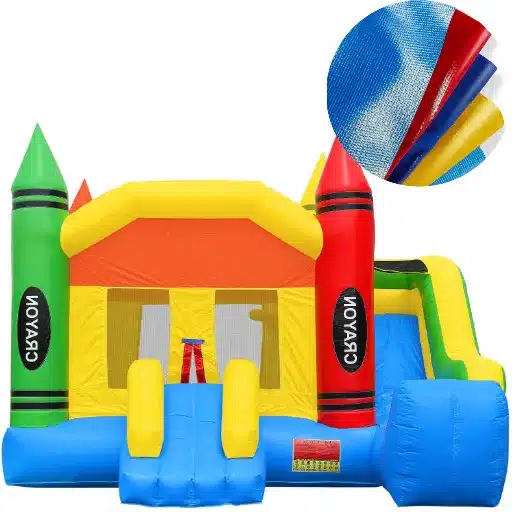
A good repair comes down to the right adhesive, the right patch, and the right prep.
- Adhesive: vinyl cement. Use a PVC-compatible vinyl cement like SX-69 or HH-66. It’s waterproof, stays flexible after curing, and bonds for years. Super glue cracks, duct tape fails under pressure, and household epoxies don’t flex.
- Patches: PVC material matching your unit. Cut patches from PVC-coated vinyl matching the unit’s weight, rounded, not square, because corners lift. Tear-Aid Type B works as a quick temporary fix.
- Prep and tools: Rubbing alcohol, a seam roller or credit card, sharp scissors, a heavy weight or wax paper, and mild dish soap. Avoid acetone; it degrades PVC.
- What you’ll pay: Basic kits run $5 to $15, commercial kits with cement and patches run $20 to $50, and premium kits with 16 patches plus 16 oz of cement run about $130. For a fleet, the commercial kit turns a $500 seam rebuild into a same-day patch.
The cost argument follows the material. A $25 kit patches an 18 oz unit in 10 to 15 minutes; a 15 oz seam failure takes the unit out of service and runs toward $500. See our 15 oz vs 18 oz comparison.
How to Patch a Puncture or Tear, Step by Step
This is the field procedure we give operators. Follow it in order.
- Locate the leak. Inflate the unit, listen for hissing, and run a soapy-water mix, one part dish soap to six parts water, over the suspect area. Bubbles mark the leak. Check seams and the bounce floor first.
- Mark and deflate. Circle the leak with a marker, then fully deflate before you touch the material.
- Move to a clean, flat surface. A dirty or uneven workspace compromises the bond.
- Clean and dry the area. Wash with mild soap, rinse, wipe with rubbing alcohol, and dry completely. Moisture left under the patch is the most common cause of peeling.
- Cut a rounded patch. Cut PVC patch material 1 to 2 inches beyond the damage on every side, corners rounded.
- Apply cement to both surfaces. Brush vinyl cement on both surfaces, then wait 30 seconds to 4 minutes until tacky. A lighter, even coat bonds stronger.
- Press center-out and roll. Press from the middle toward the edges to push out air, then roll with a seam roller or credit card. For large patches, place wax paper under a heavy weight.
- Cure and re-test. Cure a full 24 hours, 48 for larger tears or water slides. Reinflate, re-apply the soapy water, and confirm the leak is gone.
Pro tip: when the damage is accessible, patch from the inside so air pressure seats the patch against the material. Harder to reach, but worth it for bounce floors and slide beds.
How to Repair a Seam Split or Weld Failure
Seam failures are not punctures, and treating them the same way is the most common repair mistake. A seam is a structural joint, created on commercial units by high-frequency (RF) or hot-air welding that fuses the PVC coatings into a bond stronger than the fabric itself. On cheaper units it’s stitched, and every needle hole is a stress point and potential micro-leak.
For a surface weld separation, where the weld has lifted but the material is sound, a hot-air welding gun re-seals the seam by re-melting the two coatings together. It works on PVC that’s still flexible, with the right nozzle, temperature, and roller to re-fuse the seam while the coating is hot.
For a seam split, the protocol is stitch-and-patch. Align the torn edges, re-stitch with UV-resistant polyester thread extending 2 centimeters beyond each end so the new stitch anchors in sound material, then bond a PVC reinforcement patch over the stitch with at least 3 centimeters of overlap. For a load-bearing seam, use a sandwich configuration, patching inside and out through the zipper opening.
Send it to the factory when the failure is structural: load-bearing seams, blown baffles, deformed D-rings, or any unit that’s been through water. Water slides need a two-part PU adhesive and a 48-hour cure most field kits can’t deliver. A professional rebuild is the difference between a safe unit and a liability. Our engineering team provides factory welding and rebuild services and will tell you honestly whether a unit is worth rebuilding.
Repair Costs by Damage Type and Material Grade
Repair cost is not one number. It tracks the damage type and the material grade, and it shows up twice in your P&L: the invoice and the downtime.
| Material Grade | Repair Incidents (per 10 units/yr) | Typical Repair | Real Cost |
|---|---|---|---|
| 20 oz PVC | 2 to 4 | Surface patch | $25-50, back same day |
| 18 oz PVC | 3 to 5 | Surface patch | $25-50, back same day |
| 15 oz PVC | 12 to 16 | Seam re-stitch + re-weld | ~$500 + days out of service |
| Nylon / Oxford | Not rated | Often unrepairable | Replacement usually cheaper |
Market rates from repair shops line up: basic patching runs $20 to $150, seam repair $60 to $600, and baffle repair $100 to $800. The hidden cost is the bookings a unit misses while it sits in the shop.
Dana learned the lesson running a 40-unit fleet in Michigan. Her 15 oz units consumed more in repairs and downtime than the upfront savings had ever been worth. She replaced them with 18 oz units, and her repair spend dropped to roughly a third.
The Maintenance Routine That Prevents Repairs
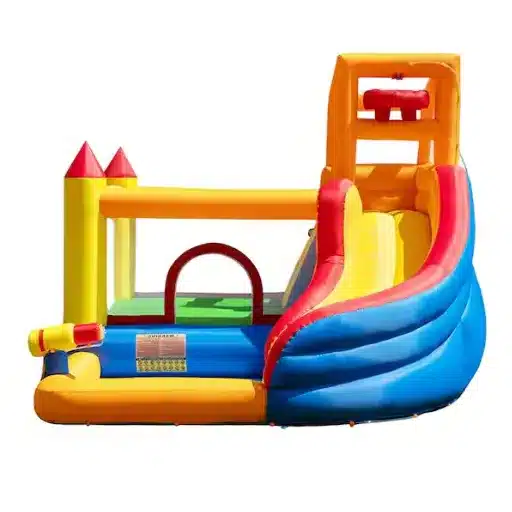
The best repair is the one you never need. Most repairs trace back to preventable causes: damp storage, UV exposure, undersized blowers, and deferred fixes.
- Clean after every event. A 15-minute wipe-down removes abrasive dirt and debris.
- Dry fully before storage. Never store a damp unit. Moisture is the number one cause of mold, and no patch can fix it.
- Store cool, dark, and dry. UV exposure degrades PVC even in storage, and heat accelerates it.
- Use a correctly rated blower. A continuous-duty commercial blower rated for 8+ hours protects the unit; an undersized one overheats and under-pressurizes the fabric.
- Rotate units in your fleet. Spread peak-weekend demand across your inventory.
- Inspect weekly. Check seams, stitching, and D-rings; feel for soft spots (blown baffles).
- Patch small tears immediately. A 25fieldpatchondayonepreventsa25fieldpatchondayonepreventsa500 seam rebuild on day sixty.
- Keep an inspection log. Track repairs per unit so you know when one approaches the replace threshold.
The return is measurable. Operators report roughly 3 in avoided emergency repairs for every $1 spent on preventive maintenance, and hidden annual operating costs run $15,000 to $25,000 beyond equipment. Units that last 5 to 7 seasons aren’t luckier; they’re maintained. Our bounce house lifespan guide details the math.
When a unit is past repair, the material you buy next determines whether the cycle repeats. We manufacture certified 18 oz and 20 oz PVC inflatable fabric that patches cleanly and rarely needs it. Talk to an engineer or request a quote on commercial inflatable fabric.
How to Repair a Bounce House: Frequently Asked Questions
Can you repair a tear in a bounce house?
Yes, if the material is sound. A tear up to a few inches in 18 oz PVC patches cleanly with vinyl cement and a rounded patch. If the material is brittle or the tear is structural, call a pro or replace it.
How much does it cost to repair a bounce house?
A surface patch costs $25 to $50 and takes 10 to 15 minutes. Seam repair runs $60 to $600, baffle repair $100 to $800, and a 15 oz seam rebuild runs about $500 plus downtime.
What glue do you use on a bounce house?
Vinyl cement such as SX-69 or HH-66. It’s waterproof, flexible after curing, and bonds to PVC. Don’t use super glue, duct tape, or epoxy, which harden or fail under pressure.
How long does a bounce house patch last?
A properly applied vinyl patch on sound 18 oz PVC holds for years. It fails early only when the surface wasn’t cleaned and dried, the material was degraded, or the patch was undersized.
Can you fix a hole in a bounce house without a patch kit?
Not permanently. Tear-Aid Type B works as a temporary fix to finish an event, and PVC plus vinyl cement can improvise a repair, but a proper fix needs the right adhesive and an overlapping patch.
When should you replace a bounce house instead of repairing it?
Replace it when the material is brittle or thinned, when the failure is structural, when the same seam keeps failing, or when repair cost approaches replacement cost. Two or more flags means stop patching.
How do you find a leak in a bounce house?
Inflate the unit, listen for hissing, then apply soapy water, one part dish soap to six parts water, to the suspect area. Bubbles mark the leak. Check seams and the bounce floor first.
Can you repair a seam on a bounce house?
Yes, but it’s a different repair from a puncture. A surface weld separation can be re-sealed with hot-air welding. A seam split needs re-stitching with UV-resistant thread and a PVC reinforcement patch over the stitch. Structural seams should go to a factory.
Do I need a professional to fix a bounce house?
For punctures and small tears on 18 oz PVC, no. For structural seams, blown baffles, or any load-bearing failure on a commercial unit, yes. A bad structural repair is a liability, and it can void the unit’s compliance.
Conclusion
How to repair a bounce house comes down to one question: what is the unit made of? On commercial 18 oz PVC, a puncture is a 10 to 15 minute field patch that costs about $25 and returns the unit to service the same day. On 15 oz material, the seams fail instead, and a repair runs toward $500 plus days of downtime. On nylon and Oxford, replacement is usually cheaper than repair.
Run the 3-point check before you buy glue: degraded material, structural failure, or a seam that keeps failing all mean replace, not patch. When you do repair, use vinyl cement and a rounded patch, cure a full 24 hours, and re-test with soapy water. The maintenance routine pays back roughly three times its cost.
Our engineering team manufactures certified 18 oz and 20 oz PVC inflatable fabric and will send production-line samples and batch test reports before you commit. Start with our bounce house fabric guide or the commercial PVC inflatable fabric range, then request a quote. The material that patches cleanly is the material that stays on your schedule.