
Bounce House Safety Guidelines: Setup, Supervision, Wind Limits & Checklist
Bounce house safety guidelines come down to five rules: anchor every point, supervise continuously, cap occupancy, stop for wind, and inspect before and during use. Everything else in this guide is the practical detail that turns those five rules into decisions you can make in the field.
Here is the uncomfortable part. Most bounce house injuries are not caused by a faulty unit. They are caused by decisions made in the fifteen minutes before a child steps inside: where the inflatable was placed, how it was anchored, who was watching, and whether anyone checked the forecast. The Consumer Product Safety Commission (CPSC) attributed an estimated 113,272 emergency-room injuries and 12 deaths to inflatable attractions between 2003 and 2013, and the leading cause was not equipment failure. It was a lack of trained supervision, followed by overloading, improper anchoring, wind, and blower failure.
Those five failure points are almost entirely under your control, whether you run a rental business, manage a venue, or simply rent a unit for a party. This guide gives you the guidelines that rental companies, insurers, and standards bodies converge on, written from the perspective of the people who make the fabric: what to check, the numbers that matter, and a checklist you can hand to an attendant. Source reliable inflatable castle tarpaulin from LY TRUSTLINK.
Key Takeaways
- Five rules prevent nearly every bounce house incident: anchor every point, supervise continuously, cap occupancy, stop for wind, and inspect before and during use.
- Stop operation at roughly 15 mph sustained wind, or the manufacturer’s lower limit, and watch gusts rather than averages because an inflatable is a sail.
- Group jumpers by age and size, stay at or below the manufacturer’s occupancy limit, and treat 70% of rated capacity as the safe operating ceiling.
- Anchor every point every time: metal stakes at least 18 inches long driven at a 45-degree angle on soil, or rated ballast on hard surfaces.
- A five-minute pre-use inspection, done consistently, is the cheapest insurance a rental operation can buy.
The Five Rules That Prevent Nearly Every Bounce House Injury
Every serious guideline in this article traces back to one of five controls.
- Anchor every point, every time. Partial anchoring is the same as no anchoring. A single unsecured corner is where a unit lifts.
- Supervise continuously. One dedicated adult, stationed at the entrance, with no other job. Collecting tickets is not supervising.
- Cap occupancy and group by size. Overcrowding and age-mixing cause the collisions that break bones.
- Stop for wind. Set a hard cutoff and enforce it before conditions arrive, not after.
- Inspect before and during use. Tears, loose seams, failing anchors, and a sagging unit are signals to stop.
Notice what is not on the list: the material. That is deliberate. A correctly operated unit fails in the same ways whether it is commercial or residential. The difference is margin. A heavier, properly specified fabric tolerates more abuse before it tears, which is why material grade changes how much operational discipline you actually need.
Preparing a specification or sourcing inflatable fabric? Our bounce house safety standards guide breaks down ASTM F2374, EN 14960, and NFPA 701 clause by clause. Start there if you need to verify what a supplier’s certification actually covers.
Consider a rental operator we will call Dana. She set up a 15-by-15 combo unit for a Saturday event, anchored it with the four stakes that came with the rental, and moved on to the next delivery. The morning forecast had been calm. By early afternoon, gusts climbed past 20 mph. The unit lifted on one unsecured corner, slid across the grass, and tipped with two children inside. The incident was preventable twice over: the anchor count was half of what the manufacturer specified, and nobody had re-checked the anchors or the wind since setup.
Setup and Anchoring Guidelines: Site, Surface, and Stakes
Setup is where most of the risk is created or eliminated. Get the site and the anchoring right, and you have removed the two causes behind the most serious incidents.
Choose a flat, level site with clear space on all sides. Manufacturer manuals and insurer bulletins typically call for at least 7 to 10 feet of clearance, plus generous overhead clearance. Keep clear of power lines, tree branches, pools, roads, and heat sources, and never set up on slopes or inclines. A tilted unit loads one side of the fabric and one set of anchors far beyond spec.
Prepare the ground before inflation. Remove rocks, sticks, pine cones, glass, and debris that can puncture or cut. A ground cover under the unit extends fabric life, and impact-absorbing mats at the entrance and slide base soften the spots where children land most often.
Match the anchoring to the surface. On grass or soil, use metal stakes driven to full depth at roughly a 45-degree angle. On hard surfaces, stakes cannot hold, so use rated ballast such as sandbags or water barrels at the weight the manufacturer specifies. Never anchor to a motor vehicle or a loose object, and never use a non-load-bearing positioning loop as a tie-down.
Use every anchor point. A typical commercial unit has a minimum of six, and larger units have more. Using half of them halves your margin. Re-check anchors during use: stakes work loose, kids lean on walls, and wind works on corners.
Treat the blower as a safety system too. Plug into a GFCI-protected outlet with a properly rated cord, guard the blower from public reach, and route generator exhaust away from the unit to avoid carbon monoxide exposure. Explore tailored tarpaulin solutions for inflatable castles with LY TRUSTLINK.
Supervision Guidelines: Who Watches and Where
If anchoring is what you control before the event, supervision is what you control during it. It is also the single most cited root cause in incident reporting.
A trained adult must watch the inflatable continuously, from the moment it is inflated until it is deflated and taken down. Two clarifications matter in practice: a person collecting money or checking tickets cannot also supervise, and an inflated unit is never left unattended, even briefly.
Position the attendant at the entrance with a clear view of the interior. From there they control who enters and exits, watch for rough play, and intervene quickly. Rotate attendants every 30 to 45 minutes, because attention fades and a fatigued spotter misses the moment that matters. Larger and multi-element units need more than one attendant, and insurers increasingly want documented evidence that attendants were trained on this specific unit and these rules.
One reason guidance gets ignored is that nobody is assigned to it. Draw the lines explicitly: the rental company owns site selection, anchoring, inspection, and documentation; the on-duty attendant owns supervision, occupancy control, rider rules, weather monitoring, and evacuation; and the parent confirms their child is within the age limits and stays on site.
Building or sourcing a rental fleet? Commercial duty cycles punish thin material. Our commercial-grade bounce house material guide explains the 18 oz, 1000D baseline that separates a unit built to be rented from one built to be used a handful of times, and how to verify a supplier’s claim before you buy.
Capacity and Age Limits: The Occupancy Rules
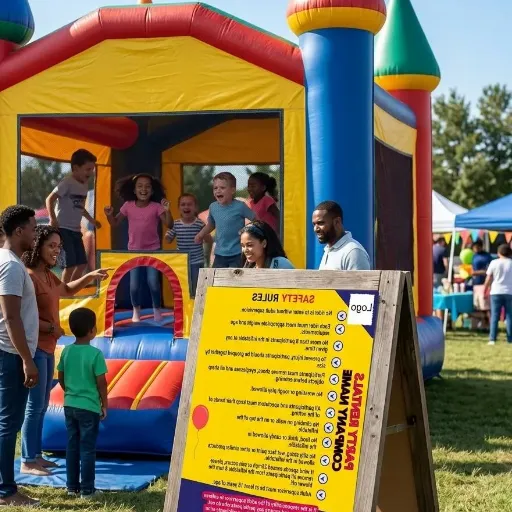
Overcrowding is the second leading cause of injury, and age-mixing drives most of the collisions.
| Unit size | Typical safe occupancy | Notes |
|---|---|---|
| 13 × 13 standard | 4 to 6 children | Similar size and age only |
| 15 × 15 combo | 6 to 8 children | Includes slide or obstacle elements; follow the placard |
| Larger / multi-element | Per manufacturer | May require multiple attendants |
Treat these as safe working figures and never exceed the manufacturer’s placard, which is the governing limit. As a rule of thumb, keep operations at or below 70% of rated capacity, a margin that accounts for the reality that children do not bounce in neatly spaced lanes.
Never mix toddlers with older children, because a large child landing near a small one is the classic fracture scenario. Children under three should use toddler-specific units with a parent inside, and standard units are not built for them. Rotate groups in short shifts, five minutes in and five minutes out, to keep units uncrowded and give the attendant a natural reset point. Above all, never exceed the manufacturer’s maximum load: a unit rated for eight children means eight of the intended size, not eight of any size.
At a birthday party, a parent we will call Marcus decided to let the older kids and the toddlers share one bounce house so nobody felt left out. Ten minutes later, a seven-year-old landed on a three-year-old. The unit was rated for eight children; there were eleven inside, spanning five years of size difference. The fabric and the blower were fine. The occupancy and grouping rules were not.
Rider Rules: What Goes In and What Stays Out
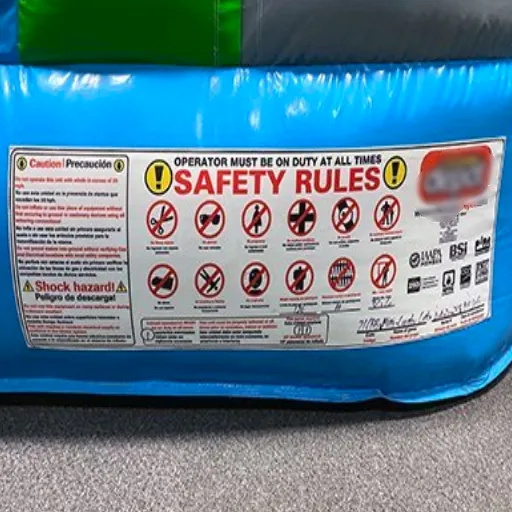
Rider rules are the ones an attendant enforces verbally, dozens of times an event. Post them on signage and repeat them at entry.
Remove before entering: shoes, sandals, and cleats; glasses and sunglasses; jewelry, hard hair clips, and belt buckles; and anything from pockets such as phones, keys, coins, and pens.
Never allow inside: food, drinks, gum, candy, silly string, or confetti; toys or any hard, sharp object that can puncture the fabric; and water or wet clothing on a dry-only unit.
Never permit during use: flips, somersaults, wrestling, pushing, or piling on; hanging or climbing on walls, netting, or the entrance; lying down while others are bouncing; entering or exiting over the sides; and more than one child on a slide at a time, or any child head-first.
Bouncing on the feet, one age group at a time, is the whole discipline. Attendants who enforce it early rarely have to enforce it twice.
Weather Guidelines: Wind, Rain, and Heat
Weather is the variable operators most often underestimate, and wind is the one that gets people hurt. An inflatable is a large, lightweight sail with a high center of gravity. When it lifts, it does not lift gently.
Published guidance on wind conflicts, so reconcile it into one rule you can act on. The CPSC cites a 20 mph ceiling, several state and provincial safety authorities cite 15 mph, and some park-district policies allow up to 25 mph. The operating rule: stop at 15 mph sustained, or the manufacturer’s limit, whichever is lower, and watch gusts rather than averages. A unit can be stable in a 10 mph average with 22 mph gusts, and the gust is what flips it. If tree tops are swaying and loose items are blowing across the ground, shut it down rather than wait to see if it settles.
Rain is a separate hazard: wet vinyl is slick and wet fabric is heavier. Evacuate and deflate in rain, then wait until the unit is fully dry before resuming. Never use a dry-only unit in wet conditions.
Heat and cold stress different parts of the system. Extreme heat softens coatings and stresses seams, so many guidelines advise caution above roughly 90°F and recommend shade or cooler hours. Cold makes standard PVC stiffen and crack, a behavior driven by the plasticizer system in the coating, which is a material specification rather than an operating one. Our notes on what a bounce house is made of cover the construction behind it.
Decide your weather plan in advance: who deflates the unit, where the blower gets unplugged, and what wind reading triggers the decision. A plan made beforehand takes thirty seconds to execute. A decision made in the moment, with children inside, takes far longer.
Inspection and Maintenance Guidelines
Inspection is the cheapest safety measure you have.
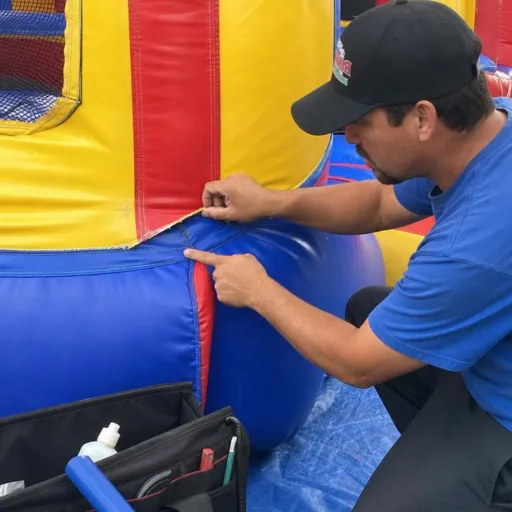
Before every use, check for tears, holes, loose seams, and worn anchor points. Confirm the blower runs, its intake is clear, and the inflation tube is attached. Watch the unit inflate evenly; sagging or a unit that will not hold air is a stop signal.
During use, re-check anchors and weather periodically. If the unit begins to deflate or lose air, evacuate calmly and immediately rather than trying to finish the session.
After the season, clean and fully dry the fabric before storage, inspect coating and seams for wear, and store it out of direct sun. For a realistic picture of lifespan by material grade, see how long a bounce house lasts.
Emergency Response Guidelines
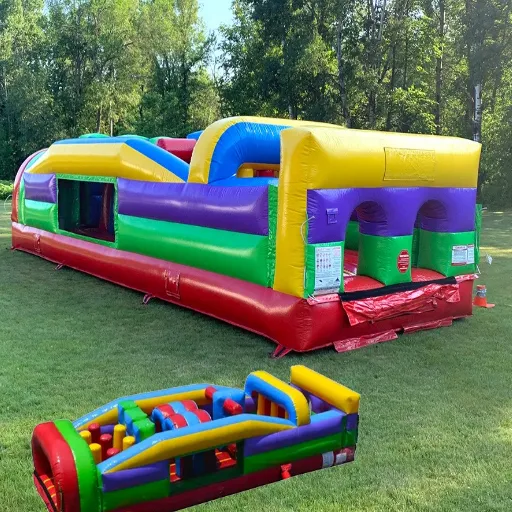
Have a plan and the supplies to execute it. If the unit deflates, loses power, or the blower fails, tell children to stay calm and stop bouncing, then assist them out through the entrance one at a time. Do not let them climb over the sides. If wind rises during use, evacuate immediately and deflate; wind is not a reason to wait for a lull.
For injuries, match the response to the severity. Clean and bandage minor scrapes and notify the parent or guardian. For heat illness, move the child to a cool area, cool them down, and call 911 if symptoms are serious. For serious injury, activate emergency services, notify the parent or guardian, and document what happened. Report significant inflatable injuries to the local or state authority and to the CPSC at SaferProducts.gov, and keep a first-aid kit and fire extinguisher on site.
The Bounce House Safety Checklist
Print this and hand it to every attendant.
- Pre-setup: flat, level site with 7 to 10 feet of clearance on all sides; no overhead lines or drop hazards; ground cleared of rocks, sticks, glass, and debris; GFCI-protected power with cords routed away from walkways.
- Setup: every anchor point used, with 18-inch-plus stakes at 45 degrees or rated ballast on hard surfaces; blower guarded and out of public reach; inflation tube secured; impact mats at entrance and slide base; warning signage posted, including “NO FLIPS.”
- Operations: trained, dedicated attendant at the entrance; rotation schedule set and larger units staffed accordingly; occupancy at or below the placard limit and no more than 70% of rated capacity; jumpers grouped by age and size.
- Rider rules: shoes, glasses, jewelry, and sharp objects removed; no food, drink, toys, or water on dry-only units; no flips, wrestling, pushing, or climbing on walls.
- Weather: sustained wind under 15 mph with no gusts approaching the cutoff; no rain, and the unit dry before use; decision trigger agreed in advance.
- Emergency readiness: evacuation procedure known to all attendants; first-aid kit and fire extinguisher on site; incident reporting contact on hand.
For a commercial operation, add documentation to the same page: inspection log, attendant training record, insurance certificate, and any required permit.
Frequently Asked Questions
What are the basic bounce house safety guidelines?
Anchor every anchor point, supervise continuously with a dedicated trained adult, cap occupancy at or below the manufacturer’s limit and group jumpers by age and size, stop operation at roughly 15 mph sustained wind or the manufacturer’s lower limit, and inspect before and during use.
What wind speed is too high for a bounce house?
Stop at 15 mph sustained wind, or the manufacturer’s limit, whichever is lower. Published guidance ranges from 15 mph to 25 mph, so the conservative figure is the correct operating rule. Watch gusts, not averages, because a gust is what lifts a unit.
How many children fit in a bounce house?
A 13 × 13 standard unit safely holds 4 to 6 similar-size children, and a 15 × 15 combo holds 6 to 8. Never exceed the manufacturer’s placard, and treat 70% of rated capacity as the safe operating ceiling.
How do you anchor a bounce house safely?
Use every anchor point. On grass or soil, drive metal stakes at least 18 inches long to full depth at a 45-degree angle. On hard surfaces, use rated sandbags or water ballast at the manufacturer’s specified weight. Never anchor to vehicles or loose objects.
Are bounce houses safe for toddlers?
Not on standard units. Children under three should use toddler-specific units with a parent inside. On any unit, never mix toddlers with older children, because size mismatches cause the collisions that break bones.
Can a bounce house blow away in high wind?
Yes. An inflatable is a large, lightweight surface with a high center of gravity, and high winds can lift or tip it even when it is anchored. Proper anchoring at every point and a hard wind cutoff are the two controls that prevent it.
Conclusion
Bounce house safety guidelines are not complicated, and that is exactly why they get skipped. Anchor every point, supervise continuously, cap occupancy, stop for wind, and inspect before and during use. Everything else in this guide is detail that supports those five rules.
The strongest operations treat safety as a process, not a pep talk. A rental company in the Midwest built a five-minute inspection into every delivery: seams and anchor points before the unit leaves the warehouse, and again on-site before inflation. In a single season, that routine caught eleven failing anchor points before a customer ever saw the unit. The cost of the checks was minutes. The cost of one anchor failure at an event was a lawsuit and a lost contract.
If you operate or source inflatables, the fabric underneath these guidelines matters too. A unit built with an 18 oz, 1000D PVC and welded seams tolerates far more use before it fails than a thin consumer-grade cover, which is the margin that buys you time to enforce the rules. Explore our PVC inflatable fabric range to see the material behind commercial duty cycles, or start with our broader bounce house fabric guide for the full material picture.
Sourcing fabric for an inflatable product line or a rental fleet? Request a specification sheet or sample order and our engineering team will match weight, coating, and certification to your operating conditions.