
Pool Tarp vs Pool Cover: Manufacturer’s Guide
It is important to remember that a swimming pool solar blanket and a swimming pool cover are not the same, despite the fact that many home owners, contractors and some pool service companies use these terms interchangeably. This one single mistake can be very costly in terms of identifying the need for premature replacement of equipment, the presence of the people in the pool, or customer dissatisfaction.
You understand that there are different classes of fabrics suitable for different uses. The same piece of polyethylene purchased from a local building supply store, does not have the same effectiveness as a green colored pool cover, which is designed to have several decades of expected lifetime and pass the ASTM F1346-23 tests at the same time. For anyone involved in the swimming pools industry, these distinctions are not irrelevant, but compulsory. These describe the difference between dependability that provided by a transitory solution and the reliability of an investment over the years.
In this manual we will give an overview of the technical aspects of tarp covers, mesh safety covers and solid PVC pool covers. It will be further supplemented with a discussion of the materials used for this purpose in – depth discussion including some examples of specifications of materials for commercial use, relevance of certification, and why companies would rather invest in custom roam than factory manufactured products.
What Is a Pool Tarp? (And How It Differs From a Safety Cover)

When most people search for a pool tarp, they are looking for one of three distinct products. Each serves a different purpose, lasts a different length of time, and carries a completely different safety profile.
Tarp-Style Winter Covers
These are the low-grade option of pool equipment. The tarp-style winter cover is commonly composed of a single-layer polyethylene or light PVC sheet with edge grommets, which is used for protection from leaves and dirt during the winter months. The most important feature of this pool cover is that it is lighter, and not of a strong structure to be able to carry out severe tasks i.e. someone sitting on top of it, standing or etc
These last between one and three years on average. The cover starts to crack due to UV exposure. Wind easily tears the grommets. Moreover, the drawback of having the surface in water is that because of the design, if rain gets inside, it does not drain out. When there is a water pool tied tarp somewhere, and a child or a pet walks up to that area including the concentrated zones, they may fall into the liquid and the water might even prove to be fetid and unsuitable for the consumption purposes.
Want to see how commercial-grade alternatives perform under real stress? Explore our heavy duty waterproof tarpaulin testing standards →
Mesh Safety Covers
Mesh safety covers are engineered textiles, usually woven polypropylene, designed to meet strict load and drainage standards. They allow rain and melted snow to pass through while blocking debris and supporting significant weight.
Because water drains through the weave, mesh covers require no pump. They typically last 10 to 15 years. The trade-off is that fine silt and sunlight can pass through, which means the pool water may need more attention at opening.
Solid Safety Covers
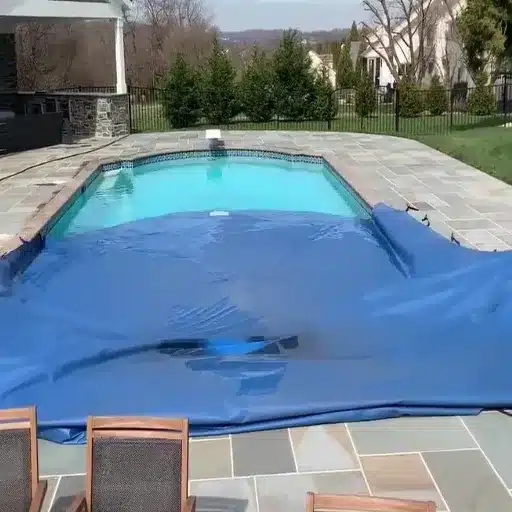
Durable safety screens come with a laminated PVC covering or robust vinyl sheeting and offer 100% protection from the sun. They protect against almost every need to clean up dirt and leaves. They do not allow the inflow of water, which means it is only the case of solid covers alone. A pool cover pump should be fitted to pool cover in order to provide effective removal of rain and melting snow.
It is most common for solid PVC pool covers to give between 7-11 years life. They are the best option for consumers that will settle for nothing less than perfectly clear spring water.
In 2023, a pool cleaning company in Florida called Coastal Pools experienced both in pool safety net and safety pool cover business. They stopped buying away made polyethylene covers and ordered professionally done 27 milimeter covers from scratch. Their percentage of the winter cover and the customer is 60 %. Better than that, they had it manufactured under their name and they increased the charge every time they put one in.
Commercial Pool Cover Materials: A Technical Breakdown
Most buying guides stop at “mesh vs. solid.” They never explain what the fabric actually is. As a pool tarp manufacturer or distributor, you need to speak the language of materials.
PVC Coated Polyester vs. Polypropylene Mesh
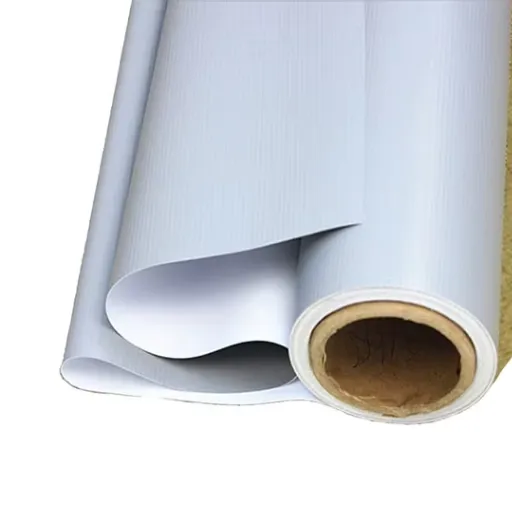
PVC coated polyester begins with a high-tenacity polyester base fabric. The weave is coated on both sides with liquid PVC, then cured to create a waterproof, UV-stable membrane. This construction is used for solid safety covers, reinforced pool liners, and heavy duty commercial applications.
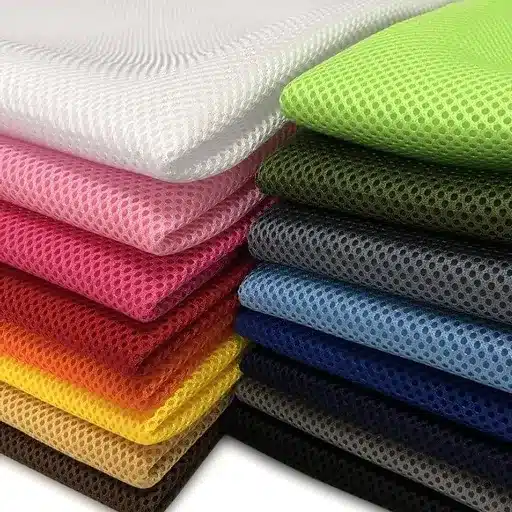
Polypropylene mesh is a woven thermoplastic fabric. It is lighter than PVC polyester and inherently breathable. The open weave allows water to filter through while the tensile strength of the yarn supports snow and rescue loads.
| Property | PVC Coated Polyester | Polypropylene Mesh |
|---|---|---|
| Waterproof | Yes | No (drains water) |
| UV Resistance | Excellent | Very Good |
| Typical Lifespan | 7-11 years | 10-15 years |
| Weight Range | 500-1,100 gsm | 250-450 gsm |
| Best Use | Solid covers, liners | Mesh safety covers |
Understanding Mil Thickness and GSM Weight
Mil thickness calculation gives the overall thickness of the material by dividing it into thousandths of an inch. and in simple terms 20-mil liner stands at 0.020 inches. 27-mil cover corresponds to an integer of 0.027 inches. Should I say of that as colors. Additionally, it is better understood than only those vogare standards is class 60 or classification 60 mils is more than 0.060 inches or 1.5 mm which falls within the domain of commercial-grade Reinforced liners can be manufactured.
GSM, short for Grams per square meter, is a measure of fabric mass and density. In the case of the heavy duty pool cover, the fabric is generally between 500 and 1100 GSM. Increase in GSM generally means that there is more PVC coating which make it more resistant to being scratched. The higher is the GSM, the longer is the lifespan if compared to the lower is one.
A simple analogy might be that of the typical polyethylene tarp from a big box store targeted only at the mass market, which may weigh in the range of 90 to 120 gsm. The starting figures for a People’s Republic of China safety covered by a commercial-quality PVC top or even a premium cover applied in heavy-duty circumstances start from five hundred gamma, yet some cases demand concentration levels above fifteen hundred gamma.
Reinforced Scrim: 9×9 vs. 12×12 Weave
The “scrim” is the internal polyester grid that gives coated fabric its strength. It is described by the thread count in the warp and weft directions.
- 9×9 scrim: 9 threads per inch in each direction. Standard for residential solid covers and mid-grade liners.
- 12×12 scrim: 12 threads per inch in each direction. Higher tear resistance and dimensional stability. Preferred for commercial pools, high-traffic facilities, and regions with heavy snow load.
A 12×12 scrim in a 27-mil PVC cover can withstand significantly more abuse than a 9×9 scrim in the same mil thickness. When customers ask why one cover costs more than another, the scrim count is often the answer.
Seamless Widths and Welding Methods
A factory fabricates pool cover fabric in the form of rolls. By some firms and businesses, seamless width up to 5.5 meters can be produced. However, for the wide covering it becomes necessary to weld several parts of the panels.
Next, RF welding (the high frequency welding of plastic fitments) involves to the application of PVC and the transmission of electromagnetic waves to the sheets. This process creates a weld so strong that the seam is indistinguishable from the pool shell. This is practically a guarantee that this liner would never fall out.
Lastly, Welding joints produced with the help of the heat-sealing technology provide a good bond when temperature and pressure are closely controlled. It is better to use the former two joining methods than to resort to stitching or gluing tapes which can allow egress of water and pollutants due to their structural weaknesses.
Mesh vs. Solid Pool Covers: Which One Lasts Longer?
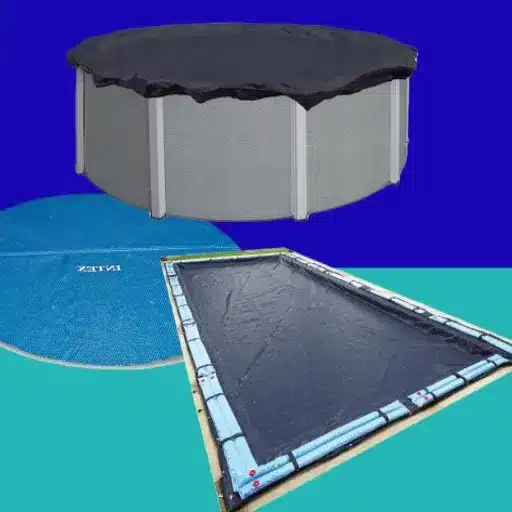
The mesh vs. solid debate is not about which is “better.” It is about which fits the customer’s climate, maintenance habits, and budget.
Lifespan Expectations
Based on industry data and manufacturer warranties:
- Basic winter tarp: 1-3 years
- Solid PVC safety cover: 7-11 years
- Polypropylene mesh safety cover: 10-15 years
Mesh lasts longer because it does not hold standing water. Water is the enemy of most materials. When a solid cover is properly maintained with a working cover pump, it performs excellently. When the pump fails and water sits for weeks, the fabric and seams degrade faster.
Maintenance Differences
Mesh covers are such a hassle. All the rain and snow penetrates thoroughly. And during the autumn and spring months, all that the owners need to do is get rid of the leaves. Moreover as such mesh allows sunshine, algae may appear in the off-season months. Pool opening may require pool shocking and vacuuming as a necessity.
Solid covers differ in that they prevent algae growth in the pool water. Due to the absence of direct sunlight, such growth is domesticated. However, the owner should take special care of the pump cover. If after the collapse there is another down pour and the pump is unable to work within the short period of time, the water is bound to collect in the pool. Such a snap causes sag in the seams, corpus fabric tension and a potential drowning hazard.
A lesson most learned for the community pool in Ohio. “Myths” turned to reality when after heavy snow fell in January 2022 on a basic polyethylene tarp, only eighteen inches of snow caused the cover to fail. The council had to seek a better solution, so the mesh safety cover that also certified to ASTM standards bring a significant resistance to snow was purchased. It has done an amazing job for three consecutive winters without requiring the council to purchase another replacement that could have incurred more costs and more potential liabilities.
Climate Considerations
Heavy snow regions often favor mesh. Water drains through, so there is no standing load to pump off. A quality mesh cover rated for snow load can support the weight of accumulated snow while shedding meltwater.
Warm, sunny climates often favor solid covers. The 100% sunlight blockage prevents algae blooms during long off-seasons. In Florida, Arizona, and Southern California, solid PVC covers are popular because pools are closed less for winter and more for brief maintenance periods.
High wind regions require tight installation regardless of cover type. Solid covers can act like sails if not properly anchored. Mesh covers allow some wind to pass through the weave, which reduces uplift forces.
Safety Standards Every Pool Cover Must Meet
If you sell or install pool covers, you need to understand ASTM F1346. This standard is the benchmark for safety covers in the United States and is referenced by building codes, insurance underwriters, and liability attorneys.
What Is ASTM F1346?
ASTM F1346 is the Standard Performance Specification for Safety Covers and Labeling Requirements for All Covers for Swimming Pools, Spas and Hot Tubs. The latest edition is ASTM F1346-23.
The standard exists to reduce drowning risk. Specifically, it is designed to inhibit access by children under five years of age when the cover is properly installed and used.
The Four Core Tests
To be certified as an ASTM F1346 safety cover, a product must pass four physical tests:
- Static Load Test: The cover must support 485 lbs (220 kg) for at least 5 minutes on pools wider than 8 ft. This simulates the weight of two adults and one child, allowing time for a rescue.
- Perimeter Deflection Test: When loaded, the cover must not sag or gap in a way that creates openings large enough for a child to slip through.
- Surface Drainage Test: The cover must drain substantially all standing water within 30 minutes after rainfall stops.
- Openings Test: Any openings in the cover or at its perimeter must remain small enough and strong enough to prevent a child’s head from passing through.
Why Certification Matters for Commercial Pools
For residential pools, an ASTM-certified cover is a smart safety layer. For commercial pools, it is often a legal requirement. Many state and local codes explicitly mandate that a pool cover used as a safety barrier must meet ASTM F1346.
If a cover is marketed as a “safety cover” but has not been tested and certified, the installer, distributor, and property owner may face serious liability if an accident occurs.
How Fabric Engineering Supports ASTM Compliance
Meeting the 485-pound static load test is not just about the cover material. It is a system requirement. The fabric, the scrim, the perimeter straps, the anchors, and the deck hardware must all work together.
From a manufacturing perspective, this means:
- Using high-tenacity polyester scrim (9×9 minimum, 12×12 preferred)
- Applying sufficient PVC coating weight to prevent tear propagation
- Welding seams with RF or heat welding to achieve panel-to-panel strength
- Designing strap spacing and anchor layouts that distribute load evenly across the deck
At LY TRUSTLINK, our safety cover fabrics and reinforced pool liners are engineered to meet or exceed ASTM F1346-91 requirements. We supply fabric to manufacturers and distributors who need certified materials they can build into finished cover systems.
Need ASTM-certified fabric for your cover production line? Contact our team for technical specifications and OEM pricing →
How to Install a Heavy-Duty Pool Tarp for Winter
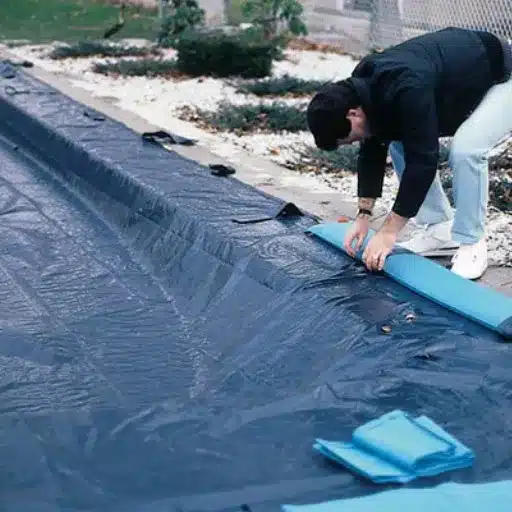
Even the best material fails if it is installed poorly. Whether you are working with a basic winter tarp or a commercial-grade safety cover, proper installation protects the pool, the cover, and the people around it.
Sizing: Why You Need Overhang
A common miscalculation individuals tend to make is when they place orders basing them on the pool’s deck size. The order should exceed the pool deck dimensions otherwise referred to as overhang extension. For pools built into the ground, the cover should be on the pool wobbling line and no less than 12 to 18 inches on the surrounding deck. The additional height is designed to offer all available space of the for the cover towpes, anchors, weights etc. all supporting the cover in place.
In relation to hanging above ground covers on pools, it would be beneficial for the cover to hang over the top rail and overhang several inches down the pool wall. This helps to reduce the potential scenarios of wind getting the bottom part of the cover off.
Securing In-Ground vs. Above-Ground Pools
In-ground pools are typically secured with one of three methods:
- Water bags or water tubes: These are the safest option for winter tarps because they will not damage the deck if the cover shifts. Fill them no more than two-thirds full. Water expands when it freezes, and overfilled bags burst.
- Brass anchors and straps: Used for safety covers. Anchors are drilled into the deck. Spring-loaded straps attach to the cover perimeter and hook into the anchors.
- Cable and winch: Common for above-ground winter covers. A cable threads through grommets in the cover edge and tightens with a ratchet winch.
Above-ground pools rely on the cable-and-winch system or reusable cover clips. Some installers also use cover seals or wall bags to fill the gap between the cover and the pool wall, preventing wind lift.
Common Installation Mistakes That Void Warranties
- Pulling a winter tarp drum-tight: A tarp-style cover should rest on the water surface with some slack. The water inside the pool supports the weight of rain and snow. If the tarp is pulled tight across the deck, all the stress concentrates on the grommets, and they rip out.
- Overfilling water bags: As noted above, frozen water bursts bags. The resulting gaps let wind under the cover.
- Closing the pool too early: If water temperatures are still above 65°F when the cover goes on, algae blooms can thrive in the warm, stagnant water underneath.
- Neglecting the cover pump on solid covers: A solid cover is only as good as its drainage system. A failed pump can accumulate hundreds of pounds of water.
- Improper anchor spacing on safety covers: ASTM compliance depends on proper strap spacing and anchor torque. Skipping anchors or spacing them too far apart can compromise the entire safety system.
When to Choose a Custom-Manufactured Pool Cover
Stock covers work for rectangular pools with standard dimensions. But many pools-and many commercial projects-require custom solutions.
Irregular Pool Shapes and Sizes
Freeform pools, L-shaped pools, and pools with attached spas do not fit off-the-shelf covers. Custom manufacturing allows the cover to be patterned to the exact deck perimeter. This ensures proper anchor placement, even tension, and full coverage.
Commercial Pools and High-Traffic Facilities
Hotels, schools, HOAs, and municipal pools have unique requirements. They need heavier fabrics, tighter warranties, and documentation of ASTM compliance. A custom-manufactured cover from an OEM supplier can be built to the facility’s exact specifications, including logo printing, custom colors, and reinforced high-wear zones.
OEM and Private-Label Opportunities for Distributors
If you are a pool service company or equipment distributor, private-label pool covers can be a significant revenue stream. Instead of reselling a national brand at thin margins, you can source custom-fabricated covers under your own label.
This approach gives you:
- Higher margins: Cut out the middleman brand.
- Brand control: Your name is on the product.
- Customization: Offer sizes and features your competitors cannot match.
- Customer loyalty: Clients come back to you for replacements and referrals.
At LY TRUSTLINK, we specialize in OEM and ODM manufacturing for the pool and marine industries. Our production capabilities include custom vinyl pool liners, reinforced commercial-grade liners with 9×9 and 12×12 scrim, and safety cover fabrics engineered to ASTM standards. We produce seamless widths up to 5.5 meters and weld larger covers with RF seam technology.
Ready to discuss a private-label pool cover program? Request a quote for custom manufacturing →
Conclusion: Invest in the Right Pool Cover From Day One

A pool tarp is a temporary solution. A pool cover is an investment. Understanding the difference protects your customers, your reputation, and your bottom line.
Here are the key takeaways:
- Basic tarps last 1-3 years and offer no certified safety protection. They are fine for debris blocking on a budget, but they are not safety barriers.
- Mesh safety covers last 10-15 years, drain water naturally, and support ASTM F1346 load requirements. They are ideal for snowy climates and low-maintenance customers.
- Solid PVC covers last 7-11 years, block all sunlight and debris, and require a cover pump. They are the premium choice for customers who want pristine water at opening.
- Material specifications matter. Mil thickness, GSM weight, and scrim weave (9×9 vs. 12×12) determine how a cover performs under stress.
- Custom manufacturing unlocks opportunities for irregular pools, commercial facilities, and private-label distributors.
Whether you are a pool service company looking to reduce callbacks, a distributor seeking a private-label partner, or a commercial operator who needs ASTM-certified materials, the right fabric partner makes all the difference. Contact LY TRUSTLINK today to discuss your custom pool tarp and cover fabric requirements.