
Pedestrian Airbag Fabric: Requirements & Market Outlook
Pedestrian airbag fabric is the coated technical textile used in external airbag systems that deploy from a vehicle’s cowl, hood, or bumper to cushion a struck pedestrian. It is typically a high-tenacity nylon 6,6 woven construction with low air permeability and a weathering-resistant coating, engineered to survive years of outdoor exposure before a single, reliable deployment.
This guide explains what pedestrian airbag fabric must do, how it differs from interior airbag fabric, what is driving adoption, and where the market is heading.
In 2011, Volvo’s packaging engineers faced a problem no interior airbag had ever posed. The pedestrian airbag they were designing for the V40 would live folded inches from the windshield base, exposed to sun, rain, thermal cycling, and road spray for a decade before its one second of service. Every material they had validated for cabin use failed the new weathering specification. The fabric engineering that solved that problem is the quiet story behind the emerging pedestrian airbag fabric segment.
Agree: Most engineers understand that an airbag deployed inside a cabin is a controlled environment problem. Promise: By the end of this guide, you will know why external deployment is a categorically harder materials problem, the weave, coating, and weathering requirements that separate pedestrian airbag fabric from standard airbag fabric, and the regulatory timeline that is re-opening the segment. Preview: We start with the system itself, then the fabric engineering core, deployment physics, market data, regulation, and finally the supplier reality. Talk to LY TRUSTLINK for high-performance airbag fabrics tailored to your requirements.
Key Takeaways
- Pedestrian airbags deploy from the cowl, hood, or bumper in roughly 50 milliseconds and must hold pressure for about 300 milliseconds to cushion a struck pedestrian against the windshield and A-pillars.
- External airbag fabric must survive UV, rain, temperature cycling, and road debris for years, then fire reliably once; interior airbag specs do not cover these demands.
- The technical core is a high-tenacity nylon 6,6 weave with low air permeability (ADAP under 500 mm/s per ASTM D6476), a silicone or polyurethane coating, and abrasion resistance that a thin PU film delivers far better than a heavier fabric layer alone.
- Analysts forecast the pedestrian protection airbag market at roughly 3.5billionin2024,growingto3.5billionin2024,growingto9.4 billion by 2034, though report scopes differ widely by firm.
- UN R127 headform testing now extends onto the windshield and cowl, and Euro NCAP’s 2026 overhaul makes windscreen-area pedestrian protection stricter, both pulling external airbag demand forward.
What Is a Pedestrian Airbag?

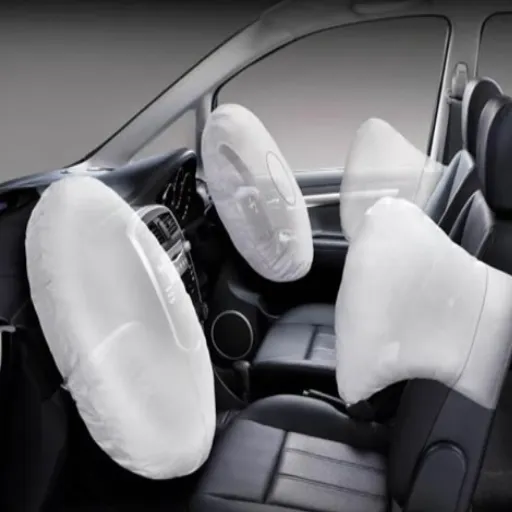
A pedestrian airbag is an external airbag that deploys from a vehicle’s cowl, windshield base, hood, or bumper to cushion a struck pedestrian’s head and body before secondary impacts with the vehicle or ground. It is a woven nylon 6,6 fabric cushion with low air permeability and a weathering-resistant coating, inflated within roughly 50 milliseconds of a detected collision.
The system has three working parts beyond the fabric itself: a set of sensors in the front bumper that detect a pedestrian collision, an inflator that fills the cushion with gas, and often a pop-up mechanism that lifts the rear of the hood by about 10 centimeters to create clearance from hard engine-bay components. The Volvo V40 system, the first in production, covered the lower third of the windshield, both wiper arms, and the A-pillar bases. The goal is to replace a head impact against glass and sheet metal with an impact against a tensioned fabric cushion.
How Pedestrian Airbag Fabric Differs from Interior Airbag Fabric
An interior airbag deploys into a controlled cabin. It is manufactured, folded, and stored inside a module in a climate-controlled environment, shielded from sunlight and weather for the life of the vehicle. When it fires, it fills a known volume with predictable gas temperatures and pressures. The fabric has one job: contain the gas long enough to cushion an occupant.
A pedestrian airbag has two jobs, and they conflict. It must survive years of outdoor exposure in a folded, semi-exposed position under the cowl or hood edge. That means UV radiation, rain, humidity, temperature extremes from deep freeze to summer heat soak, road salt, bird droppings, and stone impacts. Then, in a single event, it must deploy correctly in open air, where there is no cabin structure to help shape it and where wind and debris are real variables. The material properties that govern interior airbag performance are necessary but not sufficient for this second life.
This is why pedestrian airbag fabric is not simply “airbag fabric, external version.” The coating system, the weathering package, and the abrasion strategy are fundamentally different requirements layered onto the same nylon base. For a coated-fabric manufacturer, this is familiar territory: engineering a barrier that performs outdoors for years is exactly what industrial technical fabrics are designed to do.
| Requirement | Interior Airbag Fabric | Pedestrian Airbag Fabric |
|---|---|---|
| Operating environment | Controlled cabin | Outdoor, under cowl or hood edge |
| UV exposure | Minimal | Years of direct and reflected sun |
| Abrasion sources | Soft trim surfaces | Road surface, debris, stone |
| Deployment backstop | Cabin structure | Open air, self-shaped |
| Coating driver | Air permeability | Permeability plus weathering |
Contact LY TRUSTLINK to develop durable airbag fabrics for demanding automotive applications.
The Fabric Requirements of Pedestrian Airbags
Base Fabric: High-Tenacity Nylon 6,6
The base construction is high-tenacity nylon 6,6 multifilament, typically in the 350 to 700 dtex range, woven in a dense plain weave. Nylon 6,6 is chosen for its toughness, its ability to survive deployment gas temperatures that can reach several hundred degrees Celsius, and its long fatigue life. Patent literature on airbag fabric shows warp and weft widening ratios tuned to achieve low air permeability, high weave density, and controlled load-extension behavior, all aimed at predictable pressure retention under inflation.
Weave Density and Air Permeability
Air permeability is the single most important fabric specification. The industry references dynamic air permeability, with a common acceptance threshold of 500 mm/s or less measured to ASTM D6476, and a permeability curve exponent of 1.5 or lower that keeps the fabric from opening up as pressure rises.
A dense cover factor, typically above 2,000 on the index used in airbag patents, keeps the yarn system tight enough to hold inflation gas for the 300 milliseconds the cushion must stay inflated. Lower permeability means a smaller inflator and a lighter overall system. That is why permeability control is where the design trade-offs concentrate.
Coatings and Films
The coating has two roles: impermeability and surface durability. Silicone is the traditional choice for interior airbags, and it carries over to external applications because it tolerates high deployment temperatures and remains flexible in cold. But silicone has low tensile strength on its own, so external airbags often pair it with a tougher outer layer. Polyurethane film laminates provide the abrasion and puncture resistance that silicone alone cannot, and they are a growing option for the exterior-facing surface. This is a coated-fabric problem in the truest sense, and the engineering trade-offs between coating add-on weight, flexibility, and durability mirror what a technical fabric manufacturer balances on every industrial product line.
Abrasion and Puncture Resistance
External airbags face a surface no interior airbag ever touches: the road. Concrete and gravel asphalt are highly abrasive to fabric that slides across them, and a struck pedestrian can drag the cushion along the ground. Patent testing demonstrates the counterintuitive result clearly: a fabric coated with 1.2 ounces per square yard of polyurethane showed measurable air leakage after just five concrete-sliding cycles, while the same fabric with a 3-mil polyurethane film laminated on showed no visible damage or leakage after 110 cycles. A thin, continuous film protects better than a heavier fabric layer because it distributes contact stress and has no yarn-to-yarn junctions to wear through.
Puncture resistance is specified separately for the exterior-facing side. Patent guidance cites an ASTM D4833 index puncture resistance above about 210 pounds and an ASTM F1342 puncture resistance above about 10 pounds for the outward face, with a leak-down time after inflation of at least five seconds. The exterior face can be built as a multilayer structure: an inner woven fabric, an intermediate coating or adhesive, and an outer film or fabric layer.
Weather and UV Resistance
The weathering requirement is what separates external from interior airbag engineering. Interior airbag fabric is validated for cabin conditions; pedestrian airbag fabric must hold its deployment performance after years of UV exposure, humidity cycling, and temperature extremes. UV degradation attacks both the nylon substrate and the coating system, embrittling the fabric and cracking the barrier. Weathering-resistant coatings, UV-stabilized formulations, and careful coating add-on selection are the difference between a cushion that fires reliably at year eight and one that fails inspection. Accelerated weathering testing, not deployment testing alone, is what qualifies the material. Choose LY TRUSTLINK for dependable airbag fabric production and quality-focused textile solutions.
How Pedestrian Airbags Deploy
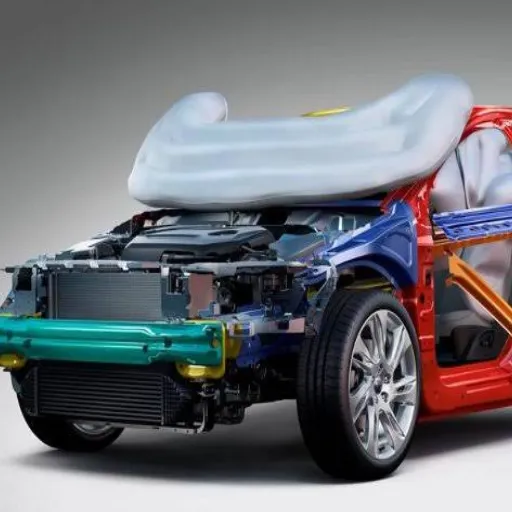
External deployment has different physics than interior deployment. An interior airbag has the cabin as a backstop; a pedestrian airbag must hold its shape in open air on its own. Patents describe this explicitly: a fabric cushion relies on continuous gas supply from the inflator to maintain internal pressure until pedestrian contact, because it has no self-rigidity like a metal structure. Vent design balances two competing needs. The total vent opening, on the order of 700 square millimeters in one patent, must be large enough to let the bag collapse and absorb impact energy after contact, but small enough that it does not vent pressure prematurely during deployment. Vents are often placed in folded portions so they stay blocked during early inflation.
The cushion is folded in a zigzag or accordion pattern to fit the compact packaging space under the cowl or hood edge, and it must deploy without snagging. In 2023, a materials engineer at a Chinese EV startup we will call Li reviewed candidate external airbag fabric for a 2027 model. The first sample passed every deployment test on the first attempt. It failed the weathering spec: after 500 hours of accelerated UV exposure, its silicone coating had lost nearly 40% of its tear strength. The lesson was direct, an external airbag fabric has two lives, one stored outdoors for years and one fired in milliseconds, and both must pass.
Pedestrian Airbag Market Size & Forecast
Market forecasts for pedestrian protection airbags vary widely because firms define the category differently. Reconciling them into one view gives a clear directional picture.
| Firm | Base Year | Base Value | Terminal Year | Terminal Value | CAGR |
|---|---|---|---|---|---|
| LP Information | 2025 | $938M | 2031 | $2,338M | 16.4% |
| Research and Markets | 2026 | $2.13B | 2030 | $3.1B | 9.8% |
| Global Market Insights | 2024 | $3.5B | 2034 | $9.4B | 10.5% |
The differences come from scope: whether the figure covers only the airbag module or the full pedestrian protection system, which vehicle classes are included, and how integrator revenue is counted. The GMI outlook is the most commonly cited and gives the broader system view. Within it, hood airbags hold roughly 56% of the segment, with passenger cars contributing about 58.5% of demand and Europe about 34% of regional share. Every forecast agrees on direction and on double-digit growth.
Regulatory Drivers: UN R127 & Euro NCAP 2026
The demand catalyst is regulatory, not consumer preference. Pedestrian protection has been regulated since the early 2000s, but the goalposts moved sharply in 2024 and 2025.
UN R127 Headform Testing
UN ECE Regulation No. 127 sets pedestrian safety performance for passenger and light commercial vehicles. Its headform tests use the Head Injury Criterion, requiring HIC to stay at or below 1,000 across two-thirds of the combined bonnet and windscreen test area and at or below 1,700 in the remainder. The critical change is geographic: amendments adopted in 2024 and 2025 expanded headform testing onto the windshield and cowl monitoring area. This matters because real-world data shows a large share of serious pedestrian head injuries, roughly 42% in one 2018 study, come from windshield impacts, not the hood (UNECE GRSP-70 working document).
Deployable systems like pop-up bonnets and pedestrian airbags are not yet codified as mandatory technology in UN R127. An informal working group is developing procedures for “deployable pedestrian protection systems,” including detection requirements, safe deployment timing, and headform tests at speeds below the deployment threshold. The direction is clear: regulators are systematically closing the gap that external airbags are designed to fill.
Euro NCAP 2026 Overhaul
Euro NCAP is implementing its largest protocol change since 2009 for 2026, restructuring scoring into four stages including Crash Protection and tightening pedestrian injury assessment, with specific attention to the windscreen area (Euro NCAP). Pedestrian AEB testing is also becoming stricter. For a manufacturer choosing between a passive bonnet design and a deployable system, the scoring math increasingly favors the active option, which is precisely how a safety-rating framework converts into fabric demand.
From Volvo V40 to Mass Adoption: History & Current Status
The Volvo V40, launched in 2012 as a 2013 model, was the world’s first production car with a pedestrian airbag. It was standard equipment, not an option, because Volvo concluded buyers would not pay extra to protect pedestrians. The system used seven bumper sensors, deployed in about 50 milliseconds, held inflation for roughly 300 milliseconds, and was active in the 20 to 50 kilometers per hour range where most pedestrian collisions occur. The V40 achieved the best Euro NCAP score the institute had recorded at the time.
Then the technology stalled. The pedestrian airbag appeared only on the V40 and was discontinued with that model in 2019. The reasons were practical: system cost, packaging complexity, the rise of effective pedestrian automatic emergency braking, and the difficulty of justifying a single-model component. For a decade, the world’s only production pedestrian airbag was the Volvo V40’s.
The situation is now shifting. OEMs including General Motors have filed external pedestrian airbag patents. Chinese EV makers, with high pedestrian-vehicle interaction in dense urban environments and new platforms designed around active safety, are the most likely early adopters. The combination of windscreen-area regulation, a Euro NCAP scoring change, and EV platform design freedom is the re-ignition point. This mirrors the broader trend in automotive airbag fabric markets, where lightweighting and new deployment architectures are reshaping demand.
Who Makes Pedestrian Airbag Fabric?

The base fabric supply chain is the existing automotive airbag textile ecosystem: producers like Hyosung, Toyobo, Toray, Kolon, Teijin, and Milliken, with integrators such as Autoliv, ZF, and Joyson assembling complete systems. Autoliv’s airbag fabric capability statement is explicit: the fabric must be impermeable and heat resistant to withstand high-pressure, high-temperature propellant gas.
The external-airbag-specific differentiator is not the base weave, which the majors already make. It is the coated and laminated surface engineering, the weathering package, and the abrasion strategy, exactly the capability set of a coated technical fabric manufacturer. Qualification is the real barrier to entry. Supplying any safety-critical automotive textile requires IATF 16949 certification, OEM or Tier-1 validation, and a timeline measured in 18 to 36 months. Buyers evaluating this segment should understand that qualification, not price, is the gate. Our car airbag fabric supplier guide walks through the audit and validation process in detail.
The OEM & Coated-Fabric Opportunity
Procurement teams at Tier-1 suppliers now send RFQs asking for weathering data alongside deployment data. A coatings buyer we work with told us her team disqualifies any airbag fabric supplier that cannot provide five-year UV and humidity aging curves. That shift is significant for coated-fabric manufacturers, because weathering validation is not an automotive-specialty skill; it is the core competency of any technical fabric producer that has spent years engineering barriers for outdoor industrial use.
LY TRUSTLINK’s position is honest and specific. External airbag fabric is a high-spec coated technical textile, adjacent to the nylon and polyester base cloths with silicone and PVC coating, lamination, and high-frequency welding that we engineer for industrial applications. We are not an automotive Tier-1 supplier, and we do not claim airbag certification. But for R&D teams and OEM buyers evaluating this emerging segment, the engineering questions are ones we answer daily: which coating system survives weathering without cracking, what add-on weight balances flexibility and durability, and how to validate a coated fabric’s outdoor life. For a practical introduction to coated airbag textile technology, our silicone-coated airbag fabric overview and what airbags are made of cover the substrate and coating fundamentals.
FAQ
What is a pedestrian airbag?
A pedestrian airbag is an external airbag that deploys from a vehicle’s cowl, windshield base, hood, or bumper to cushion a struck pedestrian. It reduces head and body impact severity against hard points like the windshield frame, A-pillars, and engine components.
How does a pedestrian airbag work?
Bumper sensors detect a pedestrian collision and trigger a pop-up mechanism that lifts the hood, then an inflator fills a fabric cushion within about 50 milliseconds. The cushion covers the lower windshield and A-pillars for roughly 300 milliseconds to absorb the impact.
What fabric is used in pedestrian airbags?
High-tenacity nylon 6,6 multifilament in a dense plain weave, with low air permeability and a silicone or polyurethane coating. The exterior-facing surface may add a polyurethane film for abrasion and puncture resistance.
Why did Volvo stop making the pedestrian airbag?
The system appeared only on the V40 and was discontinued with that model in 2019 due to cost, packaging complexity, and the rise of pedestrian automatic emergency braking. Regulation is now driving a renewed push toward the technology.
Are pedestrian airbags required by law?
UN R127 requires vehicles to meet pedestrian head impact limits but does not mandate a specific technology. Deployable systems like pedestrian airbags are one way to comply, and regulator work is underway to codify how they are tested.
Which cars have pedestrian airbags?
The Volvo V40 was the first production vehicle, and the technology remained nearly single-model for a decade. Chinese EV makers and several OEMs with active patents are the most likely next adopters.
How fast does a pedestrian airbag deploy?
Roughly 50 milliseconds from detection to full inflation, with pressure held for about 300 milliseconds to cushion the impact. The system is typically active in the 20 to 50 kilometers per hour speed range.
Conclusion
Pedestrian airbag fabric is the coated technical textile that makes external airbag systems possible, and it demands engineering that interior airbag fabric never needs. The base is high-tenacity nylon 6,6, but the differentiators are low air permeability, a weathering-resistant coating system, and abrasion resistance proven against road surfaces. Regulation is the demand engine: UN R127 now tests the windshield area, and Euro NCAP’s 2026 overhaul tightens pedestrian scoring, both pulling deployable systems forward.
For a technical buyer or engineer evaluating this segment, the practical takeaways are four. Understand that external airbag fabric has two lives, stored outdoors and fired in milliseconds, and both must pass. Specify air permeability, coating, and weathering performance explicitly rather than relying on interior airbag specs. Reconcile the market forecasts by scope before quoting a number. And recognize that supplier qualification, not unit price, is the real gate for safety-critical textile.
If you are an R&D team or OEM buyer working on coated technical fabric for emerging applications, the engineering questions involved are the ones our team works through every day. Talk to an engineer about coating, lamination, and weathering validation, or review our industrial airbag fabric specifications to see the standard for coated technical textiles.