

Truck Tarp Regulations: What DOT and State Law Require
No federal rule requires a tarp on every commercial load. What 49 CFR 393.100 requires is an outcome: cargo must not leak, spill, blow, or fall from the vehicle. A tarp is one way to meet that standard. Once you fit one, 49 CFR 392.9 makes the tarp itself regulated equipment.
Truck tarp regulations are not one rule. Ask ten fleets whether DOT requires a tarp and you’ll get ten answers. The federal rulebook never names a cover as a requirement. It describes what must not happen to the cargo.
State legislatures then add cover rules for specific materials. The result reads like a single law. It’s a stack of them.
This guide separates the two federal duties, shows how four states write cover rules in four different ways, and explains what a roadside inspection actually tests. It also covers what to specify so the cover does not become the violation.
This is operational guidance, not legal advice. Verify the current text of any rule before relying on it, and involve counsel for multi-state operations.
Key Takeaways
- No federal regulation requires a tarp on every load. 49 CFR 393.100(b) requires cargo to be loaded and secured so it cannot leak, spill, blow, or fall.
- 49 CFR 392.9(a)(2) separately requires tarpaulins to be secured. A tarp is optional; a loose tarp is its own violation.
- States fill the gap: California uses a 6-inch freeboard test, Florida names a “close-fitting tarpaulin,” Texas requires a cover secured at the front and back, and New York regulates securing rather than covering.
- Sections 393.102, 393.104, 393.106, and 393.110 govern tiedowns and hardware, not fabric. That is why tarp quality becomes a compliance variable.
- EN 12641-1:2019 is a European product standard for tarpaulin strength and attachment. It isn’t the same test as a US outcome rule.
Do Truck Tarp Regulations Actually Require a Tarp?
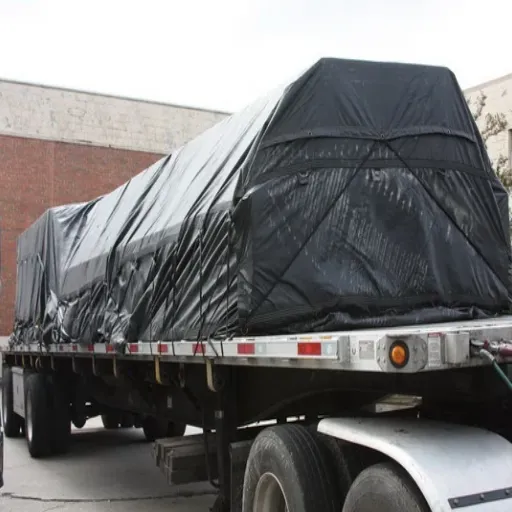
No. No federal regulation requires a tarp on every commercial motor vehicle. 49 CFR 393.100(b) requires the cargo to be loaded and secured so that it cannot leak, spill, blow, or fall from the vehicle. A cover can help meet that standard, but the rule regulates the result, not the product.
The four verbs matter. “Blowing” is the one that catches lightweight, loose, or exposed loads. A load of mulch, sawdust, or empty containers can be chained correctly. It can still fail the outcome test when wind lifts material off the deck.
The rule applies to commercial motor vehicles. State law often reaches further, covering pickups and private vehicles as well.
What the rule does not say is equally important. It does not name a tarp, a fabric weight, a seam method, or a grommet spacing. Those choices are yours. The obligation is to keep the cargo on the truck.
That gap is why the question “are tarps required by DOT?” produces so much disagreement. The answer depends on what you are hauling, where you are driving, and what your customer requires.
For a broader view of how covers fit into fleet procurement, see the complete truck tarpaulin guide.
If you are specifying covers across a mixed fleet, our engineering team can review your routes and cargo types before you order. Talk to an engineer.
The Second Rule Nobody Quotes: Your Tarp Is Regulated Equipment
Most compliance summaries stop at 393.100. The second duty sits in 49 CFR 392.9(a)(2), which requires the tailgate, doors, tarpaulins, spare tire, and the means of fastening the cargo to be secured.
Read that again. The regulation doesn’t require you to fit a tarp. It requires the tarp you fit to stay secured. Those are different obligations, and the second one is where fleets get caught.
A tarp that flaps loose at highway speed is not a weather problem. It is a securement problem. It can obscure lamps or plates, abrade against the load, and put fabric into the air. At that point the cover has become the debris that 393.100(b) prohibits.
The driver’s inspection duty makes this concrete. Under 392.9(b), the driver must inspect the cargo and its securement within the first 50 miles of a trip. The driver must reexamine it at a change of duty status, after 3 hours, or after 150 miles, whichever comes first. A tarp is part of that check.
Consider a fleet we will call Northline. Its compliance manager, Dana, took a call in March about a driver stopped with a tarp flap snapping over the rear lights. The cargo chains were correct. The citation was for the cover.
Dana did not buy a heavier tarp. She changed the hardware standard and added a walk-around check at the 50-mile mark. The next inspection season produced no repeat.
That’s the practical lesson. A cover that stays attached is a compliance control. A cover that fails is a second violation. The test methods that separate the two are covered in our heavy-duty truck tarpaulin specification guide.
The Federal Rulebook, Section by Section
Five sections do most of the work. None of them sets a fabric standard.
| Section | What it governs | What it means for a tarp |
|---|---|---|
| 49 CFR 393.100 | The outcome: no leaking, spilling, blowing, falling, or dangerous shifting | A cover is one way to meet it; the rule does not name one |
| 49 CFR 393.102 | Performance criteria: 0.8 g forward, 0.5 g rearward and lateral at breaking strength; lower limits at working load; at least 20% downward force for cargo not fully enclosed | The securement system, including attachment points, must survive real deceleration |
| 49 CFR 393.104 | Devices in proper condition, no damaged components, edge protection, no knots | Abrasion and cuts matter; a chafed tiedown or tarp edge is a defect |
| 49 CFR 393.106(d) | Aggregate working load limit at least 50% of the cargo weight | Hardware count and rating must add up |
| 49 CFR 393.110 | Minimum tiedown counts by length and weight | One tiedown for loads up to 5 feet and 1,100 pounds; two for longer or heavier loads; two plus one per 10 feet beyond 10 feet |
The numbers are worth knowing because they turn a vague instruction into a checklist. A 24-foot article that is not blocked needs two tiedowns plus one for each additional 10 feet or fraction. That is four. A blocked or immobilized article needs one per 10 feet, or three.
Edge protection deserves more attention than it gets. Section 393.104 requires protection wherever a tiedown could be abraded or cut by cargo. On a tarped load, the same logic applies to the cover: a sharp corner, a rough stake pocket, or a bare steel edge will wear through fabric before it wears through a chain.
What the rulebook does not do is tell you which fabric to buy. That is a specification decision. The tarp fastening systems guide covers hardware selection and working load limits in more detail.
State Tarp Laws: Where the Cover Mandate Actually Lives
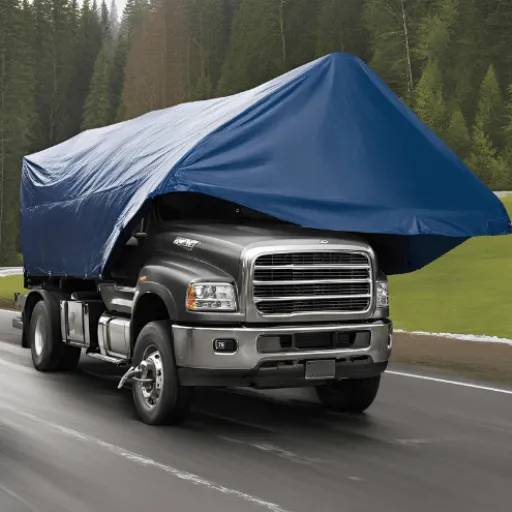
Because the federal rule is silent on covers, states specify. They do it in at least four different ways.
| State | Statute | What triggers the rule | What the rule requires | Notable exception |
|---|---|---|---|---|
| California | Vehicle Code 23114 | Aggregate and any load that could escape | Cover the load, or keep it 6 inches below the container’s upper edge with no peak above it | Asphalt-only loads; specific petroleum coke and hay provisions |
| Florida | Statutes 316.520 | Dirt, sand, gravel, silica, trash, and similar materials | A “close-fitting tarpaulin or other appropriate cover or a load securing device” meeting 49 CFR 393.100 | Agricultural products hauled locally from a harvest site on roads posted 65 mph or less |
| Texas | Transportation Code 725.021 | Loose material that can blow or spill | Cover the load and secure the covering firmly at the front and back, unless fully enclosed or unable to blow over the top | Separate rule for commercial motor vehicles |
| New York | Vehicle and Traffic Law 377 | Logs or materials that may shift or roll | Secure with chains, cables, or other suitable devices | The statute regulates securing, not covering |
Four states, four techniques. California uses a freeboard measurement. Florida incorporates the federal standard by reference and names a tarp.
Texas requires front and back attachment. New York does not require a cover at all.
That last point matters. “Tarp law” is a label people use for a family of load rules. Reading the statute is the only way to know which one applies.
Build a route matrix rather than a policy. List the states on your lanes. For each, record the trigger material, the cover standard, and the exception. Four columns, one page, reviewed annually.
A dispatcher who knows that a California aggregate load and a Texas loose-material load have different attachment requirements will spec the right cover the first time.
Consider a mid-sized carrier running California and Texas lanes. Its dispatcher, Luis, standardized on a containment cover with a reinforced hem and front and back tie-down points. The cover cost more than the flat sheet the fleet had used. It also ended the annual argument about which trailer was legal in which state.
Beyond the US: EN 12641 and Canada
Export buyers ask a different question. EN 12641-1:2019, “Intermodal loading units and commercial vehicles. Tarpaulins. Part 1: Minimum requirements,” sets requirements for the strength and attachment of tarpaulins and their fixing points, with test methods and marking.
That is a product standard. Section 393.100 is an outcome standard. A cover built to pass EN 12641 is not automatically compliant with a US state cover rule. A US cover is not automatically EN-certified.
If you sell into Europe or build curtainsiders for export, ask for both stories. Our curtain-side tarpaulin guide covers the specification side.
In Canada, cargo securement is addressed through the National Safety Code, with Standard 10 covering cargo securement, while load-covering requirements sit in provincial highway traffic law. Confirm the province before you rely on a national summary.
What Truck Tarp Regulations Mean at a Roadside Inspection
A roadside inspection is not a paperwork exercise. The officer looks at the load, the securement, and the cover. Cargo securement defects can place a vehicle out of service under CVSA’s North American Standard Out-of-Service Criteria.
| Rule | What the inspector checks | What you should be able to show |
|---|---|---|
| 393.100(b) | Is anything escaping, flapping, or hanging? | Cover condition, fit, and edge containment |
| 392.9(a)(2) | Is the tarp itself secured? | Attachment method, tension, no loose flaps |
| 393.104 | Are tiedowns damaged, knotted, or abraded? | Inspection log and replacement interval |
| 393.106 and 393.110 | Do tiedown count and aggregate working load limit meet the load? | Hardware spec and count |
| Lighting and plates | Are required lamps, reflectors, and plates visible? | Tarp cut and fit |
The tarp-specific failures are predictable. Grommets tear out. Hems fail.
A loose flap abrades the panel until it splits. A cover that is too short leaves a corner exposed.
None of these require a fabric laboratory to detect. They require a walk-around.
Liability is split. The driver has the inspection duty. The carrier has the operating duty. The shipper or loader may share responsibility for how the load was presented.
Contracts and tariffs allocate who supplies the tarp, who installs it, and who inspects it. Ambiguity in those clauses is the real exposure.
After an incident, the questions are documentary. What cover was specified? When was it purchased?
What test data exists? What inspection record exists? Three documents answer most of them: a specification sheet with test methods, batch or lot traceability, and a dated inspection log. The pillar guide lists the full fleet compliance file.
How to Specify a Tarp That Stays Compliant
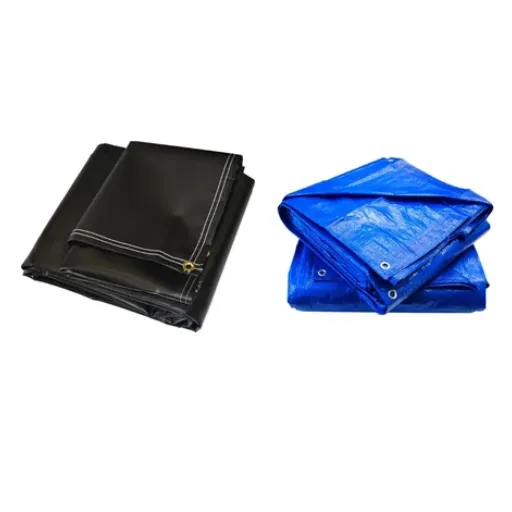
Compliance starts with a design choice: containment or coverage.
A weather cover keeps rain off. A containment cover keeps material on. The difference is a closed perimeter, a reinforced hem, hardware rated for the load, and seams that hold under tension.
Four specifications do most of the work:
- Seam strength. Demand at least 80% of parent-fabric strength, tested on the finished cover rather than roll goods.
- Grommet and attachment durability. Grommet tear-out is the most common field failure. Specify reinforcement, not just spacing. Our grommet installation guide explains the types.
- Hardware working load limit. The aggregate rating must support the load. Count the attachment points and check the rating.
- Edge protection. Reinforce where the cover contacts sharp corners, stake pockets, or bare steel.
Fire performance is a separate question. NFPA 701, EN 13501, and CPAI-84 are usually customer, insurer, or commodity requirements. They are not an FMCSA tarp rule. If your buyer requires them, our fire retardant tarpaulin guide covers the documentation.
Three questions test any specification:
- Does anything leave the truck?
- Does the cover itself stay attached?
- Can I prove both with a document?
If the answer to any is no, the cover is not yet a compliance control. Our team can build a custom truck tarp to the route, cargo, and hardware requirements, with test data attached.
Frequently Asked Questions
Are truck tarps required by DOT?
No federal rule requires a tarp on every load. 49 CFR 393.100(b) requires cargo to be secured so it cannot leak, spill, blow, or fall. A tarp is one way to meet that outcome.
Do flatbed loads have to be tarped?
Not by federal rule. Many receivers, contracts, and state cover laws require it for specific materials. Check the load, the route, and the purchase order.
Which states require tarps on trucks?
Most states regulate load covering in some form. The trigger and the standard vary. California, Florida, Texas, and New York alone use four different approaches.
Does a tarp count as load securement?
No. A tarp is not a substitute for tiedowns. Michigan State Police guidance puts it plainly: a secured tarp is not an acceptable substitute for load securement.
Who is responsible for tarping a load?
It depends on the contract and the parties. The driver has the inspection duty, the carrier has the operating duty, and the shipper or loader may share responsibility for how the load was presented.
Do truck tarps have to be fire retardant?
Not under FMCSA rules. Fire performance is usually required by a customer, insurer, or commodity standard such as NFPA 701 or EN 13501.
How often must cargo securement be checked?
Under 392.9(b), within the first 50 miles, then at a change of duty status, after 3 hours, or after 150 miles, whichever comes first.
Is EN 12641 required in Europe?
EN 12641-1:2019 sets minimum requirements for tarpaulin strength and attachment on intermodal loading units and commercial vehicles. Buyers and regulators may require it. Confirm the destination market’s rules.
Conclusion
Truck tarp regulations are easier to follow once you stop looking for a single tarp rule. There isn’t one.
The federal baseline is an outcome: keep the cargo on the truck. The second duty is equipment: if you fit a cover, secure it. The states add cover mandates for specific materials, and they write them in different ways. The inspection is where all three meet.
The practical response is a specification, not a slogan. A containment cover with a reinforced hem, rated hardware, protected edges, and test data behind it does more for compliance than a heavier fabric with no documentation.
If you are reviewing covers for a fleet or an export program, talk to our engineering team. Bring the routes, the cargo types, and the states. We’ll help you build a cover that stays on the truck, fits the truck tarp regulations on your lanes, and comes with a file that proves it.