
Dump Truck Tarp Systems: Types, Sizing and Tarp Selection
A dump truck tarp system is the hardware that rolls, pulls, or flips a cover over the load. The tarp is the part you replace. That distinction is the whole buying problem, and almost nobody frames it that way.
The arm, the motor, the pivot, and the springs are bought once. They run for years. The tarp is bought again and again, faster on abrasive aggregate, faster still on hot-mix asphalt.
So when a fleet searches for dump truck tarp systems, the question underneath the query is not which arm to buy. It’s which fabric you keep buying, how often, and what each load costs you.
This guide covers both halves. It explains the four system families accurately, then goes where the money and the failures actually live: measuring a replacement, choosing fabric by commodity, understanding why tarps fail, and costing the whole thing per load. For the wider procurement picture, see the complete truck tarpaulin guide.
One thing to state plainly. LY TRUSTLINK engineers and supplies the tarp fabric and finished replacement tarps. The arms, motors, springs, and switches come from system manufacturers. That division matters, because it tells you which part of the system this guide can help you specify.
Key Takeaways
- A dump truck tarp system is capital equipment; the tarp is a consumable replaced several times before the hardware retires. Fabric choice drives cost, not the arm.
- Two published sizing methods disagree: one measures from the bed, the other from the roller. Measure the roller first, because it is the hard constraint.
- The commodity picks the fabric. Aggregate wants heavy PVC-coated mesh; asphalt wants heat-rated vinyl; standard mesh is not rated for asphalt above roughly 150 F.
- Dump tarps fail predictably at the roller, the fold lines, the cross-bar pocket, and the hem. Each failure maps to a specification clause.
- No competitor publishes pricing. Cost per load is the number that decides between a cheap tarp and a specified one.
What Is a Dump Truck Tarp System?
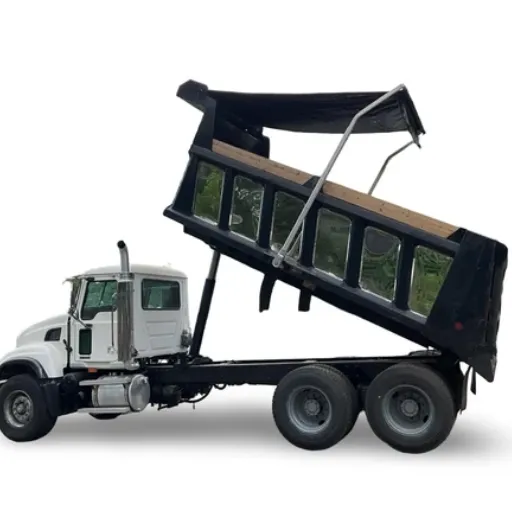
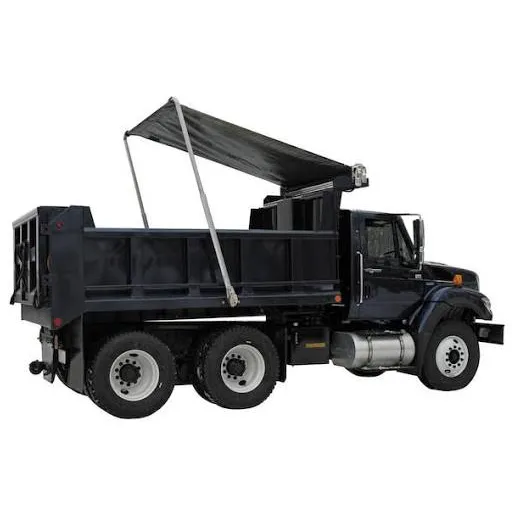
A dump truck tarp system is the mechanism that deploys and retracts a cover over a dump body. It consists of the tarp, a roller or cross-bar, one or two arms, a drive (manual, spring-assisted, or electric), and the controls that operate it. The system contains the load; the tarp is the part that touches it.
Two operating families cover most trucks. Roll systems move the cover front to back over the load on a roller. Flip or side systems swing an arm across the body. Roll-off trucks use a third arrangement, where a standalone tarper covers a container rather than a fixed body.
Why the mechanism matters to a fabric buyer: the roller, the fold lines, and the cross-bar pocket are exactly where a tarp wears out first. A cover specified without reference to the hardware that will carry it is a cover specified blind.
If you are replacing a tarp this season, send us the system make, model, and bed dimensions and we will come back with a fabric recommendation and a finished size.
Dump Truck Tarp Systems Compared
The system type decides how often an operator touches the cover, and that frequency decides how much abuse the fabric takes. The table below compares the four common families on the criteria that affect a purchase.
| System type | How it operates | Typical duty | Published install time | Best for | Watch-outs |
|---|---|---|---|---|---|
| Manual crank or pull | Operator cranks or pulls the cover by hand; no electrical | Light and intermittent | 1 to 2 hours, DIY (American Made Tarps) | Small bodies, landscaping, occasional use | Operator effort; slow at high cycle counts |
| Semi-automatic, spring-assisted | Spring tension assists a ground-level pull; no wiring | Low cycle | 2 to 3 hours (Pulltarps) | Fleets wanting low cost without electrical work | Spring wear; periodic adjustment |
| Electric roll or arm | Motor drives an arm that rolls the cover front to back; cab switch | Five or more cycles daily is the commonly cited threshold (Pulltarps) | 3 to 4 hours (American Made Tarps) to 4 to 6 hours (Pulltarps) | Class 7 to 8 dumps in daily service | Wiring, motor, and switch become service items |
| Electric flip or side-roll | Arm swings the cover across the body | Layout-dependent | Varies by kit | Tight sites and side-loading | Fit depends on body and rack |
The install times disagree between vendors because they are quoting different kits. Treat any figure as a planning estimate and confirm it with the installer before you schedule a truck out of service.
An electric dump truck tarp system is the default for daily hauling. The manual and semi-automatic families exist for lower cycle counts, not as budget versions of the same duty.
One hardware detail is worth noting. Manufacturers publish their own motor ratings, housing gauges, and tarp capacities. Those are product data for one brand, not an industry requirement. Specify to the duty cycle you actually run, then let the hardware follow.
Roll-Off Tarp Systems and Container Covers
Roll-off is its own family, not a variant of a dump body. The cover travels with the container, the sizing references the container rather than the truck bed, and the tarper is often a standalone unit mounted at the rear.
Search demand treats roll-off as a separate category for good reason. A waste hauler running containers has different sizing logic, different cycle counts, and different fabric exposure than a quarry running a fixed dump body. If your fleet is mixed, standardize the fabric across both only after checking that the same construction suits each duty.
Sizing a Replacement Tarp: Two Conventions, One Worksheet
Dump truck tarp size is where most wrong orders begin. Two measurement conventions are in circulation, and they don’t agree. One starts from the bed. The other starts from the roller.
Following the wrong one gives you a tarp that is short at the sides or long at the tail, and an over-long tarp whips, abrades, and wraps the roller.
| Source | Reference point | Width rule | Length rule | What it optimizes |
|---|---|---|---|---|
| Pulltarps | Dump bed | Bed width plus 12 to 18 inches each side | Bed length plus 12 to 18 inches each end | Symmetric side and end coverage |
| American Made Tarps | Roller or axle | Roller width minus 4 inches | Body length plus 2 feet | Heaped loads and roller fit |
Neither method is wrong. They answer different questions. The first assumes you are covering a bed and want even overhang. The second assumes the roller is fixed and the load is heaped.
The Measurement Worksheet
- Measure the roller or axle width first. This is the hard constraint the tarp must wrap.
- Measure the body length from the inside of the headboard to the tailgate.
- Note whether your loads are level or heaped, and by how much.
- Add the side drop you need to contain the load you actually carry.
- Check the cross-bar pocket dimensions against the bar on your system.
- Confirm hem and reinforcement at the tail and the leading edge.
- Record the system make and model on the order, and ask the supplier to state which convention they used.
A worked example makes the difference concrete. A 14-foot bed carrying a level load commonly takes a 7 by 16 foot tarp (American Made Tarps). A heaped load, or a wider roller, changes both numbers. Stock sizes for reference include 14 by 84, 16 by 84, 18 by 88, and 20 by 88 inches (Pulltarps).
The practical rule: measure the roller, size the length to the body plus the heap you actually carry, then confirm the side drop. Get the supplier to confirm their convention in writing. Most dump truck tarp replacement errors are measurement errors, and that one sentence prevents them.
Choosing Fabric by Commodity: Mesh, Vinyl and Heat-Resistant
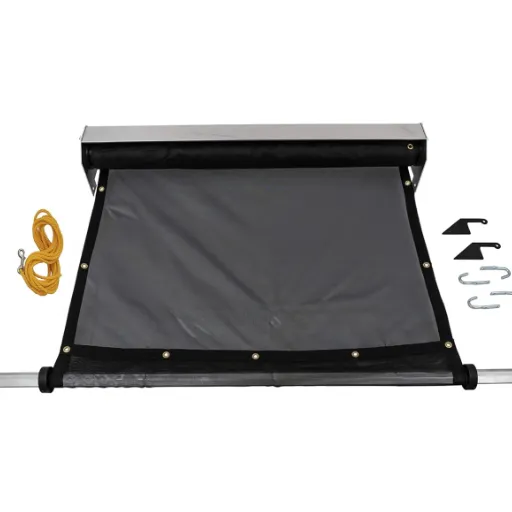
The commodity decides the fabric on a dump truck tarp. Mesh, vinyl, and heat-resistant constructions are not grades of the same thing, and treating them as a price ladder is how fleets end up replacing covers twice a season.
| Commodity | Recommended family | Why | Avoid |
|---|---|---|---|
| Sand, gravel, aggregate, crushed stone | Heavy PVC-coated mesh | Airflow cuts wind load and weight; sheds fines | Solid vinyl, which is heavier and traps moisture |
| Hot-mix asphalt | Heat-resistant vinyl | Sustained contact with mix at roughly 300 to 350 F | Standard mesh, not rated above about 150 F; standard vinyl |
| Demolition debris, C&D | Heavy vinyl or reinforced mesh | Puncture and edge-cut resistance | Light mesh |
| Mulch, topsoil, compost | Mesh or vinyl by moisture content | Containment versus drying | Under-specified light fabric |
| Grain, agricultural | Vinyl if waterproofing matters, mesh if ventilation does | A ventilation decision, not a durability one | Assuming mesh is the cheap option |
| Mixed fleet, unknown duty | Specify by the worst commodity carried | One grade covers the hardest load | Buying the lightest common denominator |
Mesh isn’t the budget option. It’s the ventilation option. A mesh tarp for dump truck work on gravel and sand cuts wind load and lets moisture escape. The same cover on asphalt is a mistake.
The decision between mesh and solid is a ventilation and weight decision, not a durability shortcut.
Heat is the one variable that catches buyers out. Hot-mix asphalt leaves the plant and is placed at roughly 300 to 350 F, depending on the mix and the stage of the journey. The FAA advisory circular on hot-mix asphalt laydown is the reference for placement temperatures. Contact is intermittent and the load cools in transit, but a cover that meets hot mix all day is not a standard vinyl cover.
If you are specifying for asphalt, ask for a stated contact temperature backed by test data, not a label that says “heat resistant.” A supplier that can’t give you a number can’t give you a specification.
For the GSM, denier, tensile, and tear thresholds behind these choices, see our guide to GSM, denier and test methods for heavy duty truck tarpaulins.
Why Dump Truck Tarps Fail
Dump truck tarps fail in predictable places. That is good news, because a predictable failure can be specified against.
| Failure | Root cause | Specification response | Field check |
|---|---|---|---|
| Abrasion at the roller and fold lines | Grit under constant flexing | Heavier coating, abrasion-resistant face, correct tension | Thinning, shine, pinholes at the fold |
| Heat embrittlement | Asphalt contact and plasticizer loss | Heat-rated formulation | Stiffness and cracking near the center |
| Cross-bar pull-out | Pocket and hem construction | Reinforced pocket, welded or double-stitched hem | Pocket stretch, stitch pull |
| Wind whip | Part-rolled travel at highway speed | Correct length, tension, and stowage discipline | Frayed tail, flapping edge |
| UV degradation | Continuous exposure | UV-stabilized coating | Chalking, color fade, tensile loss |
| Loader puncture and edge cut | Machine contact | Heavier base fabric, wear patches | Localized holes at the leading edge |
| Seam failure | Weld or stitch quality | Welded seams with tested strength | Peel at the seam line |
Take a composite example, not a specific customer. An aggregate hauler runs 22 trucks from one yard. Its operations manager, Ray, buys replacement tarps on unit price and tracks every failure date on a whiteboard. The pattern is rarely random: covers fail at the fold line first, often within weeks of each other, and the replacements land in the busiest quarter.
Ray’s fix isn’t a heavier tarp. It’s two changes: a heavier coated face at the fold, and a tension check added to the weekly walk-around. The replacement interval stretches, and the whiteboard stops being a scheduling problem.
The same pattern shows up with asphalt. A paving crew runs standard vinyl covers through one summer and finds them glazed and stiff by August, cracking along the center where the hot mix sits longest. The fix isn’t more vinyl. It’s a heat-rated construction and a stowage rule that keeps the cover off the load while the truck waits at the plant.
Neither pattern is unusual. Both are specification problems that look like bad luck.
One more pattern is worth naming. A large share of searches in this category are repair searches: a spring that won’t retract, a motor that won’t turn, a cover that has come off its arm. Those are system faults, not fabric faults, and they sit outside the scope of this guide.
What matters here is the consequence. A cover removed for a repair is often refitted at the wrong tension, which is why the next failure usually appears at the fold. Connect with LY TRUSTLINK!
Replacement Economics: Cost per Load, Not Sticker Price
A dump truck tarp is priced per unit and costed per load, and the two numbers rarely agree.
The formula is simple:
Cost per load = (tarp cost + fitting labor) divided by loads carried in service life, plus the downtime when a cover fails mid-shift.
Three inputs drive that number. The first is unit price. The second is service life, which depends on commodity abrasiveness, cycle count, climate, and tension discipline. The third is downtime, which is usually the largest and least visible.
On service life, our guide to how long tarpaulins last covers the by-material ranges. Do not assume a single interval across a mixed fleet. A cover on gravel and a cover on asphalt are not on the same clock.
Public pricing is scarce in this category, which is itself informative. No system manufacturer publishes prices; systems are quoted by configuration.
The only benchmark that surfaces in open listings is a wholesale import figure: electric 12V or 24V dump tarp kits at roughly USD 544 to 680 with a ten-piece minimum order. That’s a wholesale import benchmark. It isn’t retail, not installed, and not our pricing.
The useful comparison is not cheap tarp against expensive tarp. It is cost per load, computed with your own cycle counts. A cover that costs less and fails twice as often usually loses, and the loss shows up as labor and downtime rather than as a line item anyone reviews.
For the price-per-square-meter bands and the full total-cost-of-ownership model, see our truck tarpaulin cost analysis.
Covering Rules for Dump and Aggregate Loads
Dump and aggregate loads are the category most often covered by state rules, and the federal rule sets an outcome rather than naming a cover. Under 49 CFR 393.100, cargo must be loaded and secured so it cannot leak, spill, blow, or fall. States then add cover requirements for specific materials. The FMCSA publishes cargo securement guidance for carriers working to that standard.
The practical consequence is that a cover which comes loose becomes the violation, not just a worn part. Containment and attachment are the two things an inspector can see.
We cover the statutes, the state-by-state patterns, and the inspection crosswalk in our guide to truck tarp regulations by state. Read that before you build a compliance file.
Specifying a Replacement Tarp: RFQ Checklist
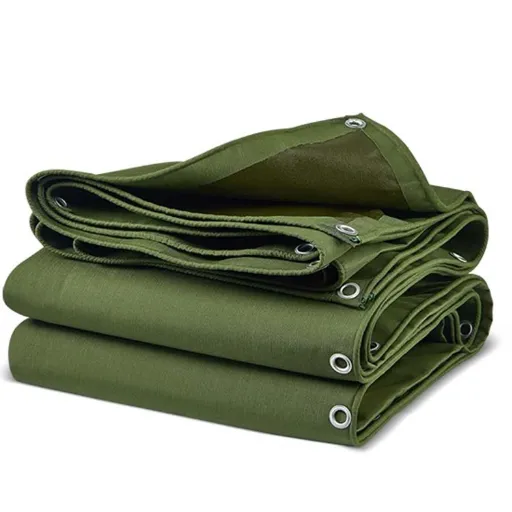
Send these ten fields with any replacement inquiry. A supplier who cannot answer them is guessing.
- System make and model.
- Roller or axle width.
- Body length, inside the headboard to the tailgate.
- Level or heaped load, and by how much.
- Commodity, and the load temperature where relevant.
- Fabric family: mesh, vinyl, or heat-rated.
- GSM or ounces per square yard, with tolerance.
- Coating type and face treatment.
- Hem, pocket, and reinforcement detail.
- Finished dimensions with tolerance, quantity, and required lead time.
Add test reports if the cover is going into a regulated or contracted application. A specification without a test method is an opinion.
If You Build or Distribute Tarp Systems
The tarp is the part of the system your customer actually judges. It is also the part that generates the warranty call.
System builders and distributors buy roll goods to a written specification and put their brand on the finished cover. LY TRUSTLINK supplies coated fabric to that specification, with batch test reports, so the fabric that carries your name matches the fabric you approved.
That is a different conversation from buying finished tarps. It starts with a specification, not a catalog: target weight, coating, dimensions, and volume. Our engineering team responds to specifications, not to browse sessions.
Installation, Maintenance and Retirement
Installation is mostly a fit problem, not a strength problem. Confirm roller alignment, set tension evenly, and dry-fit the cover before the first loaded run. A cover that is correctly tensioned from day one abrades more slowly than one that flutters into shape over a month.
Maintenance is a short monthly routine. Check the roller and fold lines for thinning. Check the cross-bar pocket for stretch. Check the hem and the tail for fraying.
Clean and dry the cover before storage, because trapped moisture and grit accelerate every failure in the table above.
Retirement criteria should be functional, not cosmetic. A cover that no longer contains the load is a compliance problem. A cover that is faded but intact is a maintenance note, not a replacement order.
Frequently Asked Questions
What is a dump truck tarp system?
It’s the mechanism that deploys and retracts a cover over a dump body: the tarp, a roller or cross-bar, arms, a manual, spring, or electric drive, and the controls. The tarp is the consumable part of that system.
Manual or electric: which should I choose?
Electric suits trucks running five or more covering cycles a day; manual and semi-automatic suit light or intermittent duty. The threshold is cycle count and operator time, not truck size.
How do I measure for a replacement tarp?
Measure the roller or axle width first, then the body length, then add the side drop and heap allowance you actually need. Ask the supplier to confirm which convention they used, because published methods differ.
What size tarp fits a 14-foot dump bed?
A 14-foot bed with a level load commonly takes a 7 by 16 foot tarp. A heaped load or a wider roller changes both dimensions, so confirm against your own measurements.
Mesh or vinyl for gravel and aggregate?
Heavy PVC-coated mesh. Airflow reduces wind load and weight, and the open weave sheds fines. Solid vinyl is heavier and traps moisture on the same load.
What tarp should I use for asphalt?
A heat-rated vinyl construction. Standard mesh is not recommended for asphalt above roughly 150 F, and standard vinyl embrittles under sustained contact with mix at 300 to 350 F.
How much does a dump truck tarp system cost?
Systems are quoted by configuration, so there’s no list price. The only public benchmark is wholesale import pricing for electric kits at roughly USD 544 to 680 with a ten-piece minimum. Budget the tarp as a recurring cost, not a one-time one.
How long does a dump truck tarp last?
It depends on commodity, cycle count, climate, and tension discipline. Abrasive aggregate shortens life; so does heat. Track replacement dates by truck rather than assuming a single fleet-wide interval.
Can I replace just the tarp and keep the system?
Yes, and that is the normal pattern. The arms, motor, and pivot outlast several covers. Match the replacement to the system’s roller and pocket dimensions rather than to the old tarp’s worn measurements.
Conclusion
Dump truck tarp systems are two purchases wearing one name. The hardware is capital, bought once and serviced occasionally. The tarp is a consumable, and it is where the cost and the failures concentrate.
Four decisions carry most of the result. Measure from the roller, not the bed, and get the convention confirmed in writing. Match the fabric to the commodity rather than to the price list. Specify against the failure you actually see, whether that is fold-line abrasion or heat embrittlement.
Then cost the cover per load, because the unit price tells you almost nothing.
If you are standardizing covers across a mixed dump and roll-off fleet, bring us the system details and the commodities you haul. We will tell you what the fabric has to do, what we can certify, and what we cannot. Request a replacement tarp quote or talk to an engineer before the next cover fails mid-quarter.