
HDPE vs PVC Pond Liner: Aquaculture Selection Guide
Neither material is the better pond liner. HDPE wins on large in-ground ponds, chemical inertness and a 20-year horizon. PVC wins on framed and collapsible tanks, complex geometry and field repair.
The question in any HDPE vs PVC pond liner comparison isn’t which resin is superior. It’s whether your liner has to hold a shape it was cut to, or hold a shape that was built for it.
Get that wrong and the cost lands later. A shrimp farm that buys thin PVC sheet because it bends replaces it in months. A biofloc operator who buys a stiff geomembrane because it lasts can’t form it into a round tank at all. Both compared the wrong property.
This guide compares the materials the way a fabricator specifies them: construction, seams, cold behaviour, fish-safety verification, and the system each serves. If you’re choosing a grade and a GSM rather than a polymer, the goes further. Have a tank drawing? and we’ll reply with a specification, not a brochure.
Key Takeaways
- Use HDPE for excavated in-ground ponds over roughly 1,000 m²; use PVC coated fabric for framed, collapsible or round tanks and any liner that ships folded.
- HDPE is an unreinforced sheet, so all its strength is resin strength. A PVC pond liner is a polyester scrim, so its strength comes from the weave.
- Seams fail before panels do, and HDPE seams made below freezing lose up to half their stress-crack resistance.
- “Fish safe” is a formulation and documentation claim. Verify the plasticiser, the migration report and the certification listing for either polymer.
The Difference That Decides It: Sheet vs Coated Fabric
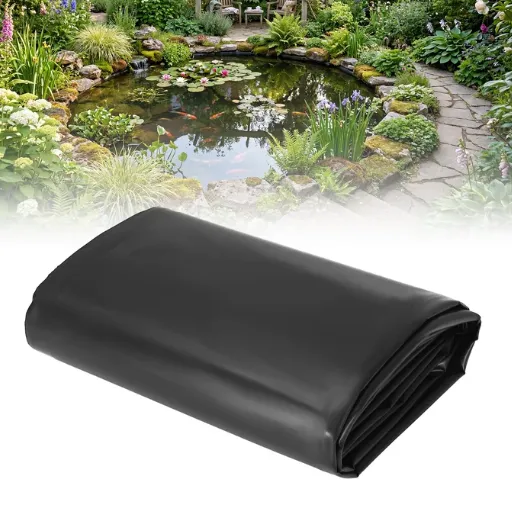
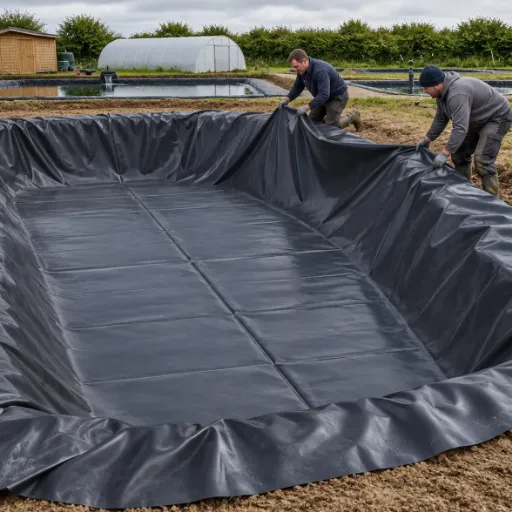
HDPE pond liner is a single extruded polyethylene sheet, usually 0.75 mm to 2.0 mm, with density of at least 0.940 g/cm³. Nothing reinforces it. Its properties come from the resin and the extrusion.
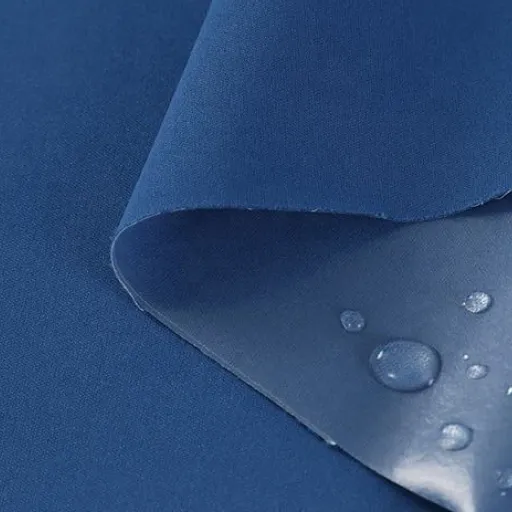
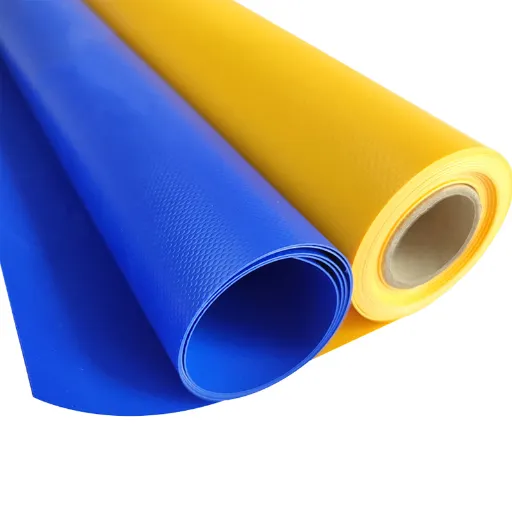
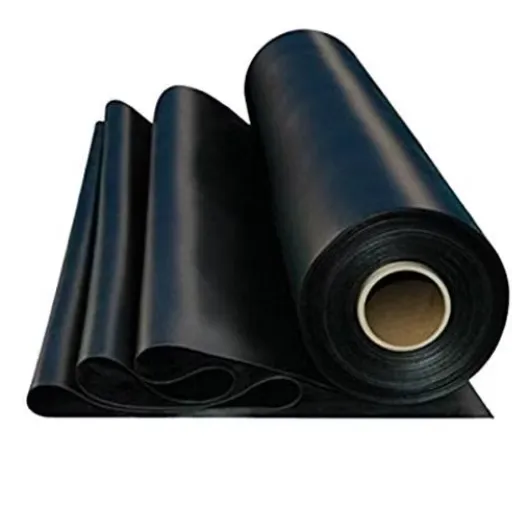
PVC aquaculture liner is a composite. A woven polyester scrim, usually 1000D yarn at 18×17 or 23×23 ends per inch, carries the load. PVC coating on both faces makes it watertight. LY’s tarpaulin range runs from 350 GSM to 1,100 GSM; liner work in aquaculture sits at the top of that range, from 450 GSM for shallow nursery tanks to 900 GSM and above for deep commercial systems, roughly 0.45 to 1.0 mm.
A liner in a supported tank doesn’t need hoop strength. Water pushes the membrane outward, the membrane presses the frame or soil, and the frame or soil pushes back. The liner transmits load rather than resisting it alone.
In that path, a reinforced fabric wins on point loads. The scrim spreads a boot heel or a dropped aeration stone across dozens of yarns before the coating feels it. An unreinforced sheet takes the same load on a small patch of resin and either yields or punctures.
Reverse the setting and HDPE pulls ahead. On an excavated pond the liner rests on prepared subgrade, and the threats are UV, root puncture and chemical exposure. HDPE’s 2–3% carbon black, its density and its welded seams handle all three with less material.
What that means for tank geometry
PVC coated fabric can be high-frequency welded into a three-dimensional shape: a round tank with a welded base, R-angle corners, pre-welded drain boots. It folds flat for shipping and unfolds on site. HDPE sheet is welded flat, doesn’t fold repeatedly without stress cracking, and needs a continuous flat substrate.
The rule: excavated, permanent and large goes to HDPE. Framed, portable, circular or complex goes to PVC coated fabric.
HDPE vs PVC Pond Liner: Specification Comparison
| Property | HDPE geomembrane | PVC coated fabric liner |
|---|---|---|
| Construction | Unreinforced extruded sheet | Polyester scrim + PVC both faces |
| Typical thickness | 0.75–2.0 mm (30–80 mil) | 0.45–1.0 mm (450–1,000 GSM) |
| Reference specification | GRI-GM13 | Mill datasheet to ISO 1421 / DIN 53363 |
| Tensile, 1.0 mm class | 15 kN/m yield, 27 kN/m break | 2,500–4,000+ N/5 cm |
| Tear / puncture | ~125 N / ~320 N at 1.0 mm | 350–650 N tear, scrim spreads point load |
| Seam method | Thermal wedge or extrusion fillet | Hot air, wedge or RF/HF |
| Field repair | Extrusion weld patch, specialist | PVC patch kit, in-house |
| UV package | 2–3% carbon black | 3%+ UV inhibitor, optional PVDF topcoat |
| Service temperature | Stiffens sharply below 5 °C | Typically −30 °C to +70 °C |
| Published lifespan | 20+ years in ground | 5–12 years by GSM |
| Cost basis | Lower material, higher install labour | Higher material, lower install labour |
| Best fit | In-ground ponds, reservoirs, dams | Framed tanks, biofloc, RAS, hatcheries |
HDPE: what a GM13 sheet actually promises
GRI-GM13 is the specification most HDPE geomembrane is bought against, and it’s specific enough to audit. It covers 0.75 mm to 3.0 mm, requires formulated density of at least 0.940 g/ml, and sets values per thickness. At 1.0 mm the common figures are 15 kN/m yield, 27 kN/m break, 125 N tear and 320 N puncture.
GM13 also sets stress-crack resistance by the single-point notched constant tensile load test (ASTM D5397) at 30% of yield stress. The current minimum is 500 hours. That matters more than tensile, because stress cracking, not overload, is what kills HDPE in the field. The specification is free from the .
PVC: what a coated-fabric datasheet actually promises
A PVC datasheet works differently. The line that matters isn’t total GSM but the split between base fabric and coating, plus yarn denier and weave. Two 750 GSM fabrics behave differently if one is 1000D at 18×17 and the other 500D at 30×30.
A 750 GSM mill datasheet typically shows 2,400–2,500 N/5 cm warp tensile, 2,100–2,200 N/5 cm weft, tear around 320–420 N/5 cm, and adhesion near 100 N/5 cm. At 1,050 GSM, tensile rises to roughly 2,800–3,000 N/5 cm.
Those figures aren’t comparable to GM13, because the methods differ. Coated-fabric tensile is a strip test on a composite. GM13 tensile is on a homogeneous sheet and reported per metre of width.
Comparing 2,500 N/5 cm against 27 kN/m is a common and misleading exercise. Compare within material class, then compare installed performance across classes.
Seams Are Where Both Materials Fail
A shrimp-pond review by Ranjan and Boyd in the Responsible Seafood Advocate puts it bluntly: “joint areas are the weakest part of plastic liners.” Every failure investigation reaches the same conclusion. The membrane rarely tears mid-panel.
A pattern worth picturing: a grower replaces a failed liner and finds the panel intact but the seam open along a two-metre length where the sheet contracted on a cold night. The weld was made in the dry season with the panels laid tight, no slack for movement.
The replacement goes down with a 15 cm contraction allowance and holds. The material didn’t fail. The sequence did.
HDPE’s cold-weather penalty
HDPE is joined by thermal wedge or extrusion fillet welding, with trained crews on clean, dry, flat ground. Welds are checked by air lance (ASTM D4437) or destructive samples.
Temperature is the problem. Stress cracking in polyethylene concentrates between 5 °C and −30 °C, mostly on uncovered slopes where the sheet can contract. One sub-zero trial recorded parent-sheet stress-crack resistance of 1,078 ± 83 hours, while dual-track seams lost 46% and extrusion fillet seams lost 56% of that value. An earlier study found 1% of sheet specimens cracked against 38% of seamed specimens.
PVC welding options
PVC coated fabric is joined by hot air, wedge or radio-frequency welding. HF excites the polymer at the joint interface and produces a bond that typically equals or exceeds the parent fabric. It’s what makes three-dimensional tank fabrication possible, because it works around corners and curved bases.
Both methods need clean surfaces. Ink, dust or plasticiser bloom at the seam margin prevents a bond, which is why print and weld are one decision. The covers parameter windows.
| Seam property | HDPE (GM13 class) | PVC coated fabric |
|---|---|---|
| Field method | Thermal wedge / extrusion | Hot air / wedge / HF |
| Destructive test | ASTM D6392 shear and peel | ISO 1421 strip, peel per mill spec |
| Non-destructive test | Air lance (ASTM D4437) | Air-channel dual weld, spark test |
| Cold-weather penalty | Up to 46–56% SCR loss below 0 °C | Fabric stays flexible, window widens |
| Typical failure | Stress crack at seam or tack weld | Peel at contaminated margin |
The Fish-Safety Question: PVC Plasticisers vs HDPE Inertness
This argument decides more purchases than any mechanical property, and it’s usually conducted badly.
Flexible PVC needs plasticisers, because unplasticised PVC is rigid. The common families are phthalate esters, physically mixed into the compound rather than bonded to the chain. Physically mixed additives can migrate, faster in warm water, under UV, and in low-grade compounds.
at all, which is why polyethylene liner vendors call it essentially inert and argue it’s the safer choice for food-fish systems. That’s a fair description of the chemistry.
The counter-case is as real. Fish-grade PVC uses phthalate-free or reduced-phthalate plasticisers and calcium-zinc stabilisers rather than the lead and cadmium compounds phased out in the EU and UK. The same UK technical reference that explains migration notes that fish-grade PVC carries significantly lower leaching risk than general-purpose PVC, and that new liners should off-gas two to four weeks before stock goes in.
Both statements are true. The variable is formulation, and formulation isn’t visible on a product page.
How to verify a food-grade claim
Don’t accept “food grade”, “fish safe” or “non-toxic” as a specification. A genuine claim is a documentation trail. Ask for five things, in order.
- Plasticiser identity. By chemical name, not trade name. Phthalate-free and “non-migratory” are claims; a named compound is a fact you can check.
- The regulation. In the US, food-contact plasticisers are permitted under , which lists each substance with use limits. A 2022 FDA rule removed 23 ortho-phthalates and 2 related substances as abandoned uses, so a pre-2022 certificate may list compounds no longer permitted.
- A migration report, not a safety data sheet. Total and specific migration results against a recognised method, with test conditions stated.
- An NSF/ANSI 61 listing if the water is for drinking or your market is potable-adjacent. It covers liners in contact with drinking water and sits above a general food-safe claim. Search the NSF database rather than trusting a PDF.
- A batch conformance certificate tying the report to the rolls you receive. A factory formulation certificate isn’t evidence about your order.
If a supplier can’t produce items 1, 2 and 5, the material may still be safe, but you can’t demonstrate it to a buyer, auditor or regulator.
We manufacture PVC coated fabric in food-grade formulations on request, and we publish GSM bands, tensile and tear ranges, UV inhibitor content and the operating temperature range on our product pages rather than resting on a label. Ask us for the formulation and compliance documents that apply to your order, and check them against the five items above before you approve production.
Choosing by System: A Decision Table
| System | Material | Grade | Why |
|---|---|---|---|
| Framed round tank (biofloc, nursery) | PVC coated fabric | 550–650 GSM, HF welded | Folds flat, forms to frame, 3D weldable |
| Square framed tank | PVC coated fabric | 650–750 GSM | Corners need welding, not folding |
| RAS tank on steel or concrete | PVC coated fabric | 650–900 GSM, R-angle | Smooth seams for solids removal |
| Hatchery / shallow nursery | PVC coated fabric | 450–550 GSM, food-grade | Low hydrostatic load, compliance first |
| In-ground pond under 1,000 m² | Either | HDPE 1.0 mm or PVC 750–900 GSM | PVC if the site is irregular |
| In-ground pond over 1,000 m² | HDPE | 1.0–1.5 mm GM13 + geotextile | Material cost and seam throughput |
| Reservoir or dam, long service | HDPE | 1.5 mm GM13, exposed or covered | 20-year horizon, UV margin |
| Shrimp pond, brackish | Either | ≥0.75 mm, welded | Both work; capital and cycle time decide |
When each wins
Choose HDPE when the pond is excavated, permanent and large, the site sees high UV and chemical exposure, the horizon is 15–20 years, and you can contract a crew that welds geomembrane for a living.
Choose PVC coated fabric when the liner must be fabricated rather than laid: round tanks, drop-in liners, R-angle corners, pre-welded drain boots, anything that ships folded and assembles in a day. Also when you need patch-kit repair rather than an extrusion welder, or the tank will be relocated.
Chemical exposure from normal farm practice
Neither material is immune to what a farm puts in a pond. Bottom disinfection with burnt lime at 200 g/m² or hydrated lime at 300 g/m² drives soil pH to 11–12 for a period. Calcium hypochlorite at 25–50 g/m² is used on wet areas and at higher rates for refill water. Copper sulphate and formalin appear in bath treatments.
Polyethylene charts generally rate calcium hydroxide, calcium sulphate and copper sulphate as low-effect, and treat aqueous chlorine as the weak point at temperature. PVC coated fabric resists dilute acids and alkalis but is more sensitive to strong oxidisers and concentrated formaldehyde.
Ask for a chemical-resistance chart covering your compounds, concentrations and operating temperature. If it has no entry for hydrated lime, it wasn’t tested for a fish farm.
HDPE vs PVC Pond Liner Cost: Material, Installation, Cost per Year
| Cost element | HDPE | PVC coated fabric |
|---|---|---|
| Material, 2026 factory-direct | 0.75 mm class: low per m² | $2.50–4.50/m² at 500–650 GSM; $4.00–6.00 at 700–900 |
| Seam labour | Skilled crew, contractor rates | Factory HF welded before shipping |
| Site labour | High: deployment, ballast, trench | Low: unfold and fix to frame |
| Underlay | Required on prepared subgrade | Required in-ground, optional on frames |
| Repair | Extrusion patch, specialist | Patch kit, in-house |
| Service life | 20+ years in ground | 5–12 years by GSM |
| Real project capital | Lined shrimp pond $10,000–$100,000+ | Quoted per tank by fabricated area |
What matters is cost per year, not cost per square metre. A 750 GSM liner at $5.00/m² replaced once in ten years costs $0.50/m²/yr. A cheaper 1.5 mm HDPE sheet, plus contract welding, underlay and a 20-year horizon, can land near or below that at scale. Below a few hundred square metres of tank area, the install labour difference usually erases HDPE’s material advantage.
Our factory-direct bands and the per-metre and per-kilogram conversion traps are in the .
HDPE vs PVC Pond Liner Installation and Repair
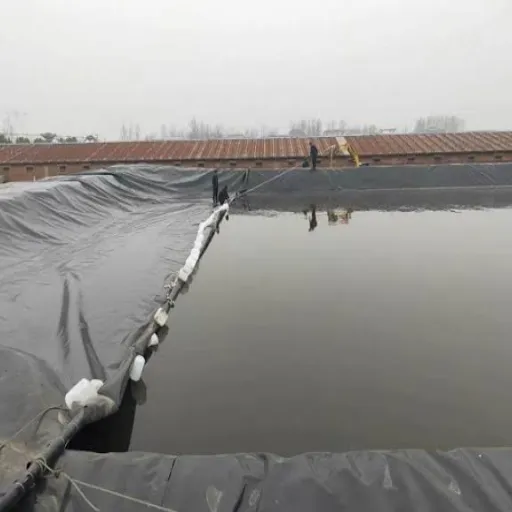
Ranjan and Boyd quantify the benefit of lining at all, independent of material: lined ponds clean and prepare in 4–8 days against 30–45 for an earthen pond, which is what buys an extra crop per year. That gain is common to both. What differs is the labour to get there.
- Anchor trench. Cited shrimp-pond practice is 50 cm deep with a 12–15 cm overlap fold.
- Overlap. Field seams need 12–15 cm to fuse. On a 5,000 m² pond that’s a real material cost, larger for HDPE because more seaming happens in the field.
- Joint count. Shape the pond to minimise panel joints. Every joint is an inspection point and a documented failure location.
- Underlay. A 200–300 g/m² non-woven geotextile is the highest-return single step on stony or rooty ground, for either material.
Repair is where they diverge daily. A punctured HDPE liner needs an extrusion weld patch, a specialist and a dry surface. A punctured PVC tank liner needs a patch, primer and pressure, which a technician can do between cycles.
For a portable tank that gets moved and knocked, that difference outweighs any datasheet margin. The walks through patch selection.
<iframe width=”560″ height=”315″ src=”https://www.youtube.com/embed/7GuCoz-aak0″ title=”POLY POND Construction and Installation for Fish Farming” frameborder=”0″ allow=”accelerometer; autoplay; clipboard-write; encrypted-media; gyroscope; picture-in-picture” allowfullscreen></iframe>
Frequently Asked Questions
Is PVC or HDPE better for a fish pond? For a large excavated pond, HDPE. It lasts longer, resists UV and root puncture with less material, and its lower material cost offsets higher welding cost at scale. For a framed, round or collapsible tank, PVC coated fabric, which is the only one of the two that can be fabricated into that shape and patched on site.
Is PVC pond liner safe for fish? Safety depends on formulation. Phthalate-free, food-grade PVC with documented migration testing is used widely in aquaculture. General-purpose PVC sheet isn’t the same product. Ask for the plasticiser name, the regulation and a migration report before you stock the tank.
How thick should an aquaculture pond liner be? The Responsible Seafood Advocate review recommends at least 0.75 mm for shrimp ponds in either material. In PVC coated fabric that’s roughly 750 GSM and up; in HDPE it’s 30 mil, the usual starting point for an . Shallow hatchery tanks go lighter, often 450–550 GSM.
Does HDPE crack in cold weather? Yes, under the wrong conditions. Stress cracking concentrates between 5 °C and −30 °C, particularly on uncovered side slopes, and seams made below freezing can lose 46–56% of the parent sheet’s stress-crack resistance. Weld in mild weather and leave contraction slack.
Can you weld PVC and HDPE together? No. They’re incompatible thermoplastics with different melting behaviour. A transition needs a mechanical clamp, batten and sealant, or a prefabricated piece. Design the pond so they never meet.
Where do I start if I need both? The product pages split the two cases: for in-ground and large-area work, and for supported structures. The shows current GSM bands and fittings.
Conclusion
The HDPE vs PVC pond liner decision comes down to four questions.
Is the pond excavated or framed? How large is it? How long must it last without replacement? And can you document what the liner is made of?
Answer those and the material usually chooses itself. Large, permanent and excavated goes to HDPE. Framed, portable, fabricated or complex goes to PVC coated fabric. Both then live or die on their seams, which is why the weld specification deserves more attention than the tensile headline.
The question buyers skip is documentation. A “fish safe” label is a marketing claim in either polymer. A named plasticiser, a current regulation reference, a migration report and a batch certificate are evidence. Ask for all four before the purchase order, not after the first mortality event.
Choosing a pond liner takes about four numbers: area, depth, water chemistry and service life. Send us those and we’ll come back with a grade, a seam plan and the documentation to match. or request a sample from the team.