
PVC Coated Fabric: Specifications & Applications Guide
PVC coated fabric is a woven base material saturated with a polyvinyl chloride polymer layer, creating a technical textile delivering waterproofing, UV resistance, and structural load-bearing capacity in a single sheet. The specification you choose — base fabric denier, coating weight in GSM, and surface treatment — determines whether that sheet lasts three years or fifteen in the field.
Procurement managers evaluating PVC coated fabric face a specification maze. One supplier lists 650 GSM with a 1000D x 20 x 20 base. Another offers 750 GSM at 23 x 23 weave. A third quotes 550 GSM without listing the base fabric at all. Without a clear framework for comparing these specifications, buyers default to price. Price alone is a poor predictor of field performance.
This guide provides consolidated specification data, application-matched recommendations, and procurement decision frameworks. You will learn how base fabric construction determines tensile strength, how coating weight maps to application requirements, and which certifications matter.Looking for reliable PVC-coated fabric suppliers? Reach out to LY TRUSTLINK for professional support and competitive manufacturing solutions.
Key Takeaways
- Base fabric denier and weave count determine tensile strength more than coating weight alone — a 1000D x 30 x 30 base delivers roughly 60% higher tensile strength than 1000D x 9 x 9 at the same GSM.
- Match coating weight (GSM) to application stress: 300-450 GSM for temporary covers, 550-750 GSM for transportation and industrial use, 850+ GSM for permanent architectural membranes.
- Surface treatments extend service life dramatically — standard PVC lasts 3-5 years outdoors, while PVDF topcoats extend this to 15-20 years.
- Fire retardancy, food safety, and phthalate-free certifications are not universal — specify exactly which standards your application requires.
- Total cost of ownership favors quality materials over lowest unit price.
What Is PVC Coated Fabric?
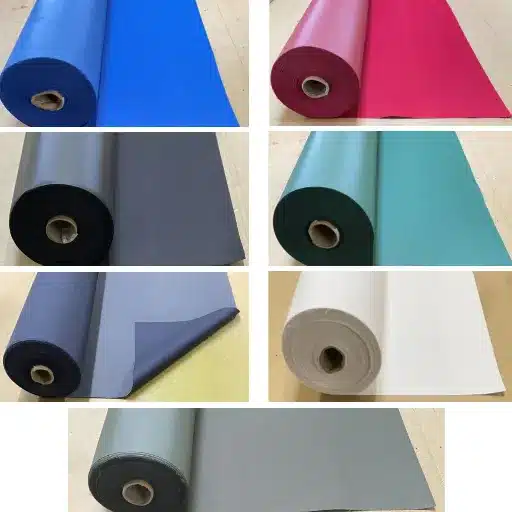
PVC coated fabric is a composite technical textile consisting of a woven base fabric, called the scrim, fully encapsulated in a layer of polyvinyl chloride polymer. The scrim provides mechanical strength. The PVC coating provides waterproofing, chemical resistance, and environmental protection. Together they create a material that outperforms either component alone.
The manufacturing process typically employs knife-over-roll coating. A precisely metered blade spreads liquid PVC compound across the woven base fabric as it passes over a heated drum. The heat partially cures the polymer, bonding it molecularly to the textile fibers. Multiple coating passes build the final weight and thickness.
Unlike laminated fabrics, where separate film layers adhere to the textile surface, PVC coated fabric has the polymer integrated into the fabric structure itself. This creates superior adhesion, better seam weldability, and longer service life under mechanical stress.
PVC Coating vs. Other Coating Types
Polyethylene (PE) coating costs less but lacks the tensile strength, weldability, and chemical resistance industrial applications demand. Polyurethane (PU) offers excellent abrasion resistance but degrades faster under UV exposure and costs significantly more. Silicone provides extreme temperature resistance but carries a premium price point only aerospace and specialized applications justify.
PVC sits in the optimal middle ground. It welds reliably with high-frequency and hot-air equipment. It accepts additives for UV resistance, flame retardancy, and anti-mildew properties. For procurement managers specifying protective fabrics across transportation, construction, agriculture, and marine sectors, PVC is rarely the cheapest option and almost always the correct one.
Understanding PVC Coated Fabric Specifications
Base Fabric (Scrim) Types
The base fabric is the structural skeleton of PVC coated fabric. Most industrial applications use high-tenacity polyester yarn for its strength, low stretch, and strong PVC adhesion.
Denier measures yarn linear density. A 1000 denier yarn weighs 1000 grams per 9000 meters. Industrial fabrics typically use 500D, 1000D, or 1200D yarns.
Weave count measures warp and weft yarns per square inch. A 20 x 20 weave has 20 yarns in each direction. Higher counts create denser, stronger fabric at the same denier.
| Base Fabric Configuration | Typical GSM Range | Tensile Strength (N/5cm) | Primary Applications |
|---|---|---|---|
| 500D x 18 x 17 | 300-450 | 1,400-2,000 | Temporary covers, tents, light agriculture |
| 1000D x 9 x 9 | 450-650 | 1,800-2,400 | General industrial, scaffolding, event tents |
| 1000D x 20 x 20 | 550-750 | 2,200-2,800 | Truck curtains, trailer covers, pond liners |
| 1000D x 23 x 23 | 650-850 | 2,700-3,200 | Heavy-duty transport, industrial enclosures |
| 1000D x 30 x 30 | 750-950 | 3,500-4,200 | Architectural membranes, permanent structures |
| 1200D x 30 x 32 | 900-1,200+ | 4,000+ | Stadium roofing, air domes, maximum load |
Two fabrics both labeled “1000D polyester” can deliver vastly different performance depending on weave count. A 1000D x 30 x 30 base provides nearly double the tensile strength of 1000D x 9 x 9. When evaluating quotes, always verify both denier and weave count. Whether you need PVC coated fabrics for truck covers, tents, tarpaulins, or outdoor products, LY TRUSTLINK is ready to support your business with reliable manufacturing expertise.
Coating Weight (GSM) Explained
GSM stands for grams per square meter, measuring the total weight of finished fabric including base and coating. Coating weight correlates directly with thickness, durability, and cost.
| GSM Range | Approx. Thickness | Typical Applications |
|---|---|---|
| 300-450 GSM | 0.25-0.35 mm | Temporary covers, agricultural shading, tent walls |
| 500-550 GSM | 0.35-0.45 mm | Camping tents, pop-up canopies, light truck curtains |
| 650-750 GSM | 0.45-0.60 mm | Truck covers, boat covers, warehouse dividers, pond liners |
| 850-900 GSM | 0.60-0.80 mm | Industrial curtains, architectural membranes, marine use |
| 1,000-1,200 GSM | 0.80-1.10 mm | Permanent tensile structures, air domes, stadium roofing |
| 1,500+ GSM | 1.10-1.50 mm | Specialized heavy-duty industrial applications |
Industry standard weight tolerance is +/- 10 GSM; premium manufacturers maintain +/- 5 GSM. Batch-to-batch consistency matters as much as absolute specification. A fabric arriving at 740 GSM one order and 760 GSM the next creates problems for fitted covers and tensioned structures.
Surface Treatments and Finishes
The raw PVC coating provides waterproofing and basic UV resistance. Surface treatments extend performance for specific environments.
PVDF topcoat reflects UV radiation and provides self-cleaning properties, extending outdoor service life from 3-5 years to 15-20 years. Acrylic lacquer offers a less expensive alternative at 7-10 years. Anti-mildew additives are essential for pond liners and agricultural covers in humid climates. Flame retardant additives enable NFPA 701 and EN 13501-1 compliance. Anti-static treatments reduce dust accumulation on flex banners.
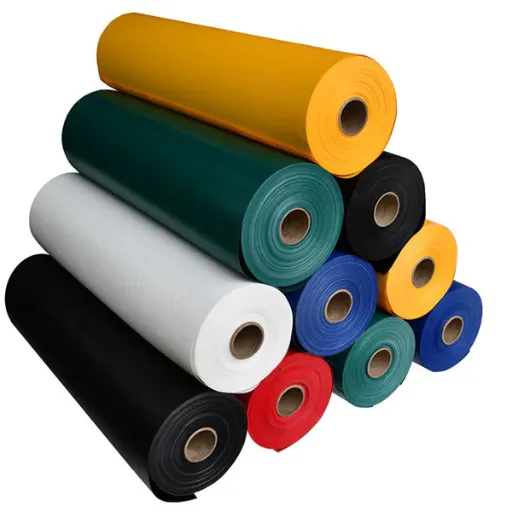
Color matching to RAL or Pantone standards is standard. Custom colors typically require a minimum order of 1,000 linear meters. Contact LY TRUSTLINK today to learn more about our high-performance PVC coated fabric solutions for industrial and commercial applications.
Performance Data: Tensile Strength, Tear Resistance & UV Stability
Tensile Strength by Fabric Configuration
Tensile strength measures the force required to pull a fabric apart. It is the single most important mechanical specification for load-bearing applications. Testing follows ASTM D751 in North America and EN ISO 1421 in Europe, measuring force in Newtons per 5 centimeters of fabric width (N/5cm).
| Base Fabric | GSM | Warp Tensile (N/5cm) | Weft Tensile (N/5cm) |
|---|---|---|---|
| 500D x 18 x 21 | 550 | 1,800-2,200 | 1,600-2,000 |
| 1000D x 18 x 18 | 610 | 2,100-2,500 | 2,000-2,400 |
| 1000D x 20 x 20 | 630 | 2,200-2,600 | 2,100-2,500 |
| 1000D x 23 x 23 | 750 | 2,700-3,000 | 2,500-2,800 |
| 1000D x 30 x 30 | 900 | 3,500-4,000 | 3,200-3,600 |
| 1000D x 30 x 30 | 1,150 | 4,000-4,500 | 3,800-4,200 |
Warp tensile strength typically exceeds weft strength by 5-15% because warp yarns undergo greater tension during weaving. For applications where load direction is predictable, orient the fabric so the warp direction aligns with the primary stress axis.
When Elena Torres, procurement director for a Midwest logistics fleet, switched from 550 GSM curtains with unspecified base fabric to 750 GSM with a specified 1000D x 23 x 23 base, replacement intervals extended from 18 months to 48 months. The per-unit cost increased 35%. The annualized cost dropped 42%.
Tear Resistance and Adhesion
Tear strength measures resistance to propagation once a tear starts. Tear strength for 650-750 GSM fabric ranges from 250-400 N/5cm. Coating adhesion indicates how strongly the PVC layer bonds to the base fabric. Values below 70 N risk delamination under flexing. Quality industrial fabrics achieve 80-100 N adhesion. Heavy-duty fabrics for industrial flooring should exceed 50,000 Martindale abrasion cycles.
UV Degradation and Weathering Performance
Untreated PVC coated fabric in direct outdoor exposure degrades within 3-5 years. UV-stabilized formulations extend this to 7-10 years. PVDF topcoats provide 15-20 years even in extreme UV environments.
Standard temperature range is -30°C to +70°C. Cold-weather formulations maintain flexibility down to -40°C. Applications above 70°C require silicone-coated alternatives.
Waterproofing and Chemical Resistance
PVC coated fabric achieves true waterproofing with hydrostatic head ratings exceeding 10,000 mm. The critical vulnerability is seams — sewn seams create puncture pathways, while welded seams restore integrity. Specify high-frequency (RF) welded seams for any application where waterproofing is essential, and verify your supplier’s welding capabilities.
Chemical resistance covers oils, greases, diluted acids, and alkalis. PVC degrades under prolonged exposure to aromatic hydrocarbons, ketones, and chlorinated solvents. Request compatibility data for industrial environments with specific chemical exposure.
PVC Coated Fabric Specifications by Application
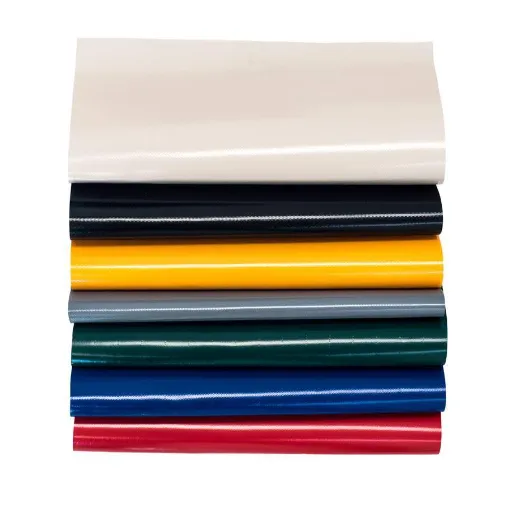
Transportation and Logistics
Truck side curtains must flex repeatedly, face sustained wind loads at highway speeds, and endure temperature swings across routes. Specify 550-750 GSM, 1000D x 20 x 20 or 23 x 23 base fabric, UV-stabilized coating, and welded seams. For northern climates, specify cold-crack resistance to -40°C.
Trailer covers and flatbed tarps require higher tear resistance for cargo contact point loading. Specify 650-750 GSM with 1000D x 23 x 23 base and anti-abrasion treatment. Rail covers and container tarps benefit from 700-900 GSM because they remain tensioned for longer periods.
Construction and Industrial
Scaffolding covers and debris netting must balance visibility, wind load, and fire safety. Specify 450-650 GSM with NFPA 701 or EN 13501-1 certification. Mesh-section designs reduce wind loading.
Temporary construction shelters require 500-650 GSM with anti-mildew treatment. Industrial curtain walls and welding screens demand 650-900 GSM with fire retardant and chemical resistant properties — compromised specification creates liability exposure.
Agriculture and Aquaculture
Pond liners require food-safe certification. Specify 550-750 GSM with phthalate-free, lead-free formulation. Seam integrity is critical — a single failed weld drains the pond.
Crop protection covers and greenhouse shading use 300-450 GSM because they do not bear structural loads. Livestock covers and grain storage tarps specify 500-650 GSM with anti-mildew treatment.
Recreation and Advertising
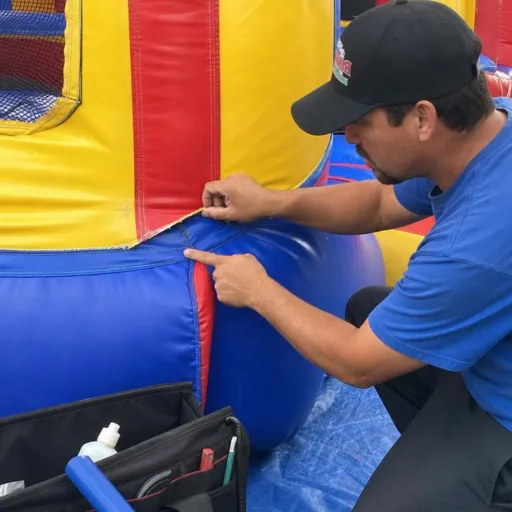
Inflatable structures require weldable, airtight fabric. Specify 300-650 GSM with lead-free and phthalate-free certification for children’s access. Commercial bounce houses typically use 450-550 GSM; high-traffic installations need 650+ GSM.
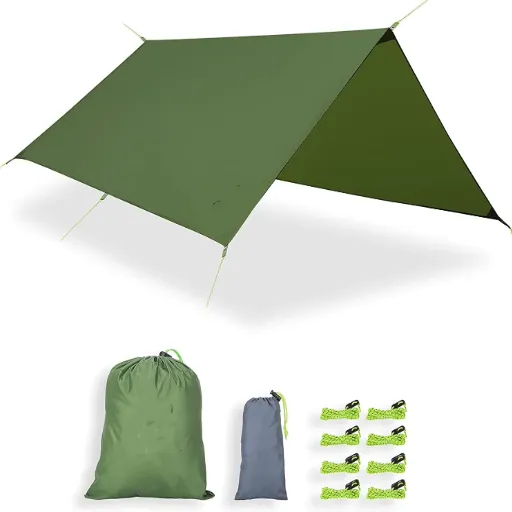
Flex banners specify 350-550 GSM with print-compatible surface — glossy for solvent inks, matte for UV and latex. Event tents require 500-700 GSM with flame retardant certification.
Marine and Pool
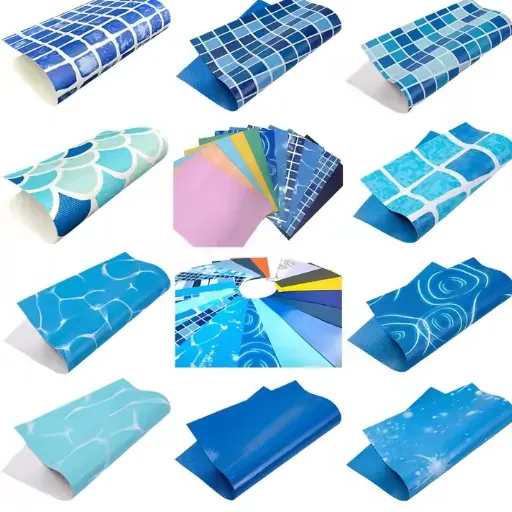
Boat covers face saltwater, UV, and mechanical abrasion. Specify 650-800 GSM with saltwater-resistant formulation and UV stabilizers. Pool liners require 550-750 GSM with chlorine resistance. Dock protection uses 700-900 GSM with maximum abrasion resistance.
Specification Quick-Reference Table
| Application | Recommended GSM | Base Fabric | Key Treatments | Certifications Needed |
|---|---|---|---|---|
| Truck side curtains | 550-750 | 1000D x 20×20 to 23×23 | UV stabilized, cold-crack resistant | EN 12641 (EU) |
| Trailer covers | 650-750 | 1000D x 23×23 | UV stabilized, anti-abrasion | – |
| Scaffolding covers | 450-650 | 500-1000D | FR treatment, anti-mildew | NFPA 701 / EN 13501-1 |
| Pond liners | 550-750 | 1000D x 20×20 | Food-safe, anti-mildew | FDA / EU food contact |
| Bounce houses | 450-550 | 500-1000D | Lead-free, phthalate-free | ASTM F2374, NFPA 701 |
| Flex banners | 350-550 | 500-1000D | Print-compatible, UV stable | – |
| Boat covers | 650-800 | 1000D x 23×23 | Saltwater resistant, UV stable | – |
| Pool liners | 550-750 | 1000D x 20×20 | Chlorine resistant, UV stable | – |
| Architectural membranes | 750-1150+ | 1000D x 30×30+ | PVDF topcoat, FR | NFPA 701, EN 13501-1 |
| Industrial curtains | 650-900 | 1000D x 23×23 | FR, chemical resistant | NFPA 701 |
Certifications and Compliance Standards
Fire Safety Standards
NFPA 701 is the primary US fire safety standard for PVC coated fabrics, testing flame propagation through afterflame time, char length, and flaming debris. Any fabric used in public assembly spaces, temporary structures, or construction sites in the US should carry current NFPA 701 certification.
EN 13501-1 governs EU fire classification with ratings from A1 to F. B-s2,d0 — limited combustibility with low smoke and no flaming droplets — is the typical target for event tents and membranes. CAN/ULC-S109 is the Canadian equivalent. When specifying fire retardancy, request the actual test report with laboratory accreditation and batch identification, not just a supplier claim.
Environmental and Safety Compliance
REACH governs chemical substances in the EU. PVC coated fabrics exported to Europe must comply with REACH restrictions on phthalates and heavy metals. RoHS limits lead, mercury, and cadmium in EU products.
California Proposition 65 requires warning labels on products containing chemicals linked to cancer or reproductive harm. For consumer-facing applications in California, verify phthalate content falls below Prop 65 thresholds. CPSIA mandates strict lead and phthalate limits for products accessible to children under 12 — specify lead-free and 6P-phthalate-free formulation for inflatables and children’s products.
Quality Testing Standards
ASTM D751 is the primary North American standard for testing coated fabrics, defining methods for tensile strength, tear strength, adhesion, and hydrostatic resistance. Results from ASTM D751 and EN ISO 1421 are not directly interchangeable due to different specimen preparation and test geometry — verify all suppliers use the same method when comparing fabrics.
DIN 53354 (tensile), DIN 53363 (tear), and DIN 53357 (adhesion) remain common in European specifications. A complete technical data sheet includes test results, sample identification, test date, and laboratory accreditation.
Sourcing PVC Coated Fabric: What to Specify
The RFQ Checklist
A well-structured RFQ eliminates ambiguity and ensures comparable responses. Include these elements:
- Application and environment: Operating temperature, UV exposure, chemical contact.
- Dimensional requirements: Finished dimensions, roll width (standard: 1.0-5.1m), cutting tolerances.
- Technical specifications: GSM, base fabric denier and weave count, surface treatment, color. Specify ranges where flexibility is acceptable.
- Certification requirements: List standards with numbers and edition dates. “NFPA 701, 2019 edition” is actionable; “fire retardant” is not.
- Quantity and delivery: Order volume, schedule, and whether this is an ongoing program or one-time purchase.
Evaluating Supplier Capabilities
Production capacity matters. A supplier with one coating line cannot absorb demand spikes. Multi-line operations provide supply chain resilience.
Request production samples, not marketing samples. Test flexibility by hand-folding 50 times and inspecting for surface cracking. Check color consistency across multiple production dates.
Quality control processes separate reliable suppliers from commodity traders. Incoming inspection verifies base fabric before coating. In-process testing monitors coating weight and adhesion. Final inspection confirms finished goods meet specification. Request documentation during supplier qualification.
Domestic vs. Overseas Manufacturing Considerations
Domestic manufacturers offer shorter lead times and simpler logistics at higher unit cost. Asian manufacturers offer lower pricing with longer lead times and more complex quality oversight.
Standard specifications in high volume typically favor overseas manufacturing on total cost. Custom colors, non-standard widths, or time-sensitive orders often favor domestic sourcing when logistics and carrying costs are included. Verify current tariff rates by HS code classification with your customs broker before finalizing sourcing decisions.
Custom PVC Coated Fabric Manufacturing
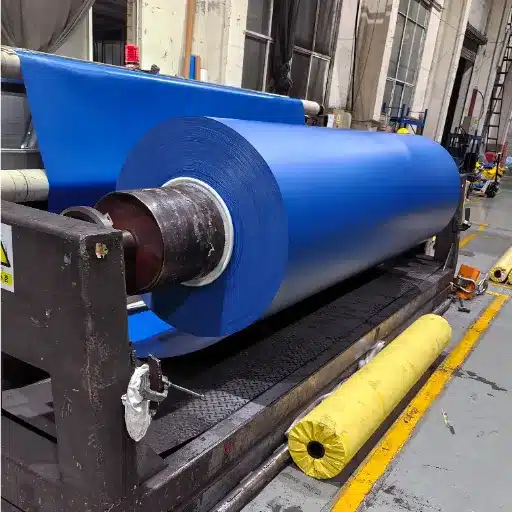
Many operations require non-standard specifications — custom colors, unusual widths, modified formulations, or certifications not offered on standard products. LY TRUSTLINK’s engineering team develops specifications from your application requirements. Prototype samples ship within 2-3 weeks for evaluation. Color matching typically requires 1,000-3,000 linear meter minimums. Production lead times run 4-6 weeks after sample approval.
Frequently Asked Questions
What is PVC coated fabric?
PVC coated fabric is a composite technical textile made by coating a woven base fabric (typically high-tenacity polyester) with polyvinyl chloride polymer. The result is waterproof, UV-resistant, and structurally strong for industrial, commercial, and architectural applications.
Is PVC coated fabric waterproof?
Yes. Properly manufactured PVC coated fabric achieves true waterproofing with hydrostatic head ratings exceeding 10,000 mm. The critical vulnerability is seams — specify welded seams for fully waterproof assemblies.
How long does PVC coated fabric last?
Untreated PVC lasts 3-5 years outdoors. UV-stabilized formulations extend to 7-10 years. PVDF topcoats provide 15-20 years. Indoor applications can exceed 20 years.
What is the difference between PVC coated and laminated fabric?
PVC coated fabric integrates polymer into the fabric structure through processes like knife-over-roll coating. Laminated fabric adheres separate PVC film layers to the surface with adhesive or heat. Coated fabric offers better adhesion, weldability, and flexing durability.
What GSM is heavy duty PVC fabric?
Heavy duty PVC coated fabric starts at 650 GSM. Truck curtains operate at 550-750 GSM. Permanent architectural membranes require 850-1,150+ GSM. Base fabric configuration matters as much as total weight.
Can PVC coated fabric be welded?
Yes. High-frequency (RF) welding creates molecular bonds for production manufacturing. Hot-air welding works for field repairs and on-site installation.
Is PVC coated fabric fire resistant?
Fire resistance requires specific additives and certification. Standard PVC is not inherently fire resistant — specify NFPA 701, EN 13501-1, or other required standards and request actual test reports.
Conclusion
Selecting the right PVC coated fabric specification is an engineering decision. Base fabric denier and weave count determine structural capacity. Coating weight maps to durability requirements. Surface treatments multiply service life. Certifications ensure regulatory compliance.
Total cost of ownership favors quality materials over lowest unit price. A specification that costs 30% more upfront but lasts three times as long reduces annualized cost by more than half while eliminating the disruption and liability of premature field failure.
For technical specifications or custom manufacturing inquiries, contact the LY TRUSTLINK team.