
Bounce House Drop Stitch Fabric Guide: How to Specify It Before You Order
Drop stitch fabric is a double-wall technical textile made from two woven face sheets joined by thousands of vertical spacer threads, which hold the walls at a fixed distance so an inflated panel stays flat and rigid instead of ballooning. That single structural decision is what makes high-pressure inflatable decks, docks, air floors and gym mats possible.
Here is the problem with how most of it gets bought. A specification sheet can list the correct denier, the correct space length and the correct pressure rating, and still describe a panel that separates at the thread bond after a few hundred inflation cycles. The number that predicts field life is usually missing from the sheet entirely.
If you already know that drop stitch panels hold high pressure, and that thicker panels are stiffer, you are right on both counts. What this guide adds is which specification actually controls rigidity, which one controls durability, and how to verify both before you commit to production.
Key Takeaways
- Drop stitch fabric is specified by three interacting numbers: base cloth denier, space length and stitch density. None predicts field life on its own.
- The bond between the spacer thread ends and the coating is the real load path. Calender-coated fabric typically reaches 40 to 55 N/5 cm peel strength. Knife-coated fabric applied at 180 to 200 degrees Celsius exceeds 80 N/5 cm.
- The dominant real-world failure is perimeter tape lifting off the panel edge, not thread breakage. Air migrates under the tape and internal pressure propagates the delamination.
- Rigidity per unit weight, not thickness, is the actual selection variable. A 6 cm panel at ultra-high density can outperform a 10 cm panel at standard density at the same inflation pressure.
- Glued joints should not exceed roughly 70 percent of base material strength, and that figure degrades further with UV and water exposure. Welded construction removes the ceiling.
What Is Drop Stitch Fabric?
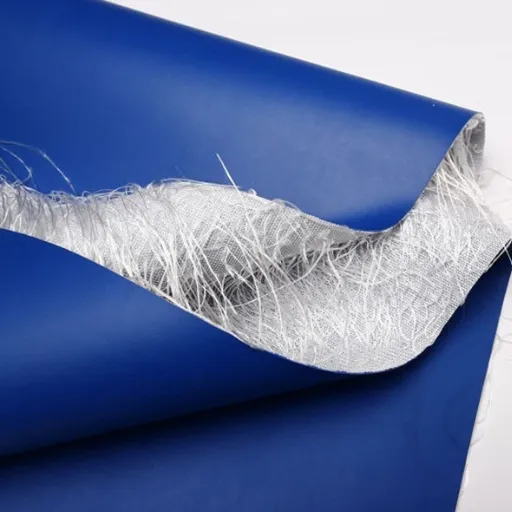
Drop stitch fabric is a three-dimensional woven textile in which two parallel woven face sheets are locked apart by a dense field of vertical spacer threads. The threads are woven into both faces on the loom, so the panel arrives as a single integrated structure with a fixed internal gap. Under inflation that gap becomes a pressurised chamber, and the panel holds a flat, load-bearing plane rather than curving into a tube.
The material also trades under the name double wall fabric, abbreviated DWF. Both terms describe the same construction, so treat them as interchangeable when comparing quotes. Suppliers list drop stitch material under one name or the other, and some list it under both.
Conventional inflatable fabric can’t do this. A single-skin coated fabric under pressure assumes a cylindrical or spherical shape, because that’s the only geometry a flexible membrane can hold. That’s fine for a bounce house wall, where curvature is the point. It’s useless for a paddleboard deck or a floating dock, where the buyer needs a flat surface that doesn’t sag underfoot.
The spacer threads override that geometry. Because the two faces are mechanically tied together, the panel can’t bow outward. Raise the pressure and it gets stiffer, not rounder.
That is also why the thread attachment points carry load in a way no other coated fabric does, which is where the next section begins.
How Drop Stitch Fabric Is Made, and Which Bond Fails First
Two operations build the material, and a defect introduced in either one will not surface until the panel is in the field.
3D Weaving: Two Face Sheets and a Field of Spacer Threads
The structural core is produced on a double-platen loom carrying two sets of warp yarns, interlaced through a bank of hundreds of needles. Each needle cycles between the two face sheets, drawing a spacer thread across the gap and locking it into both surfaces. The result is a single-piece 3D woven preform with no adhesive in the core at all.
Three parameters are set at this stage and cannot be changed afterwards, because they are built into the loom programme: base cloth denier, space length and stitch density.
Coating: Calendered Against Knife-Coated
Once off the loom the fabric must be sealed, because an uncoated woven structure is porous. The process chosen here is the most consequential decision on the entire specification sheet.
Calender coating presses a compounded PVC or TPU film into the weave through heated rollers at relatively low temperature. It’s fast and inexpensive, and it produces a coating that sits in and over the weave rather than fully anchoring to it. Typical peel strength lands between 40 and 55 N/5 cm.
Knife coating spreads a plastisol onto the fabric and fuses it at 180 to 200 degrees Celsius. That temperature drives the compound into the yarn structure before it gels, so the coating locks around the individual thread ends where they emerge from the face sheet. Peel strength on this route exceeds 80 N/5 cm on the same base cloth.
The Thread-to-Coating Bond Is the Load Path
Every time a drop stitch panel inflates, the two face sheets try to push apart. The force travels down each spacer thread and terminates where that thread is anchored into the coating on the opposite face.
That anchor is the load path. Not the thread, which is generally strong enough. Not the weave. The bond between the thread end and the coating.
A calender-coated panel still passes incoming inspection, because tensile strength is measured across the coated fabric and calender coating performs acceptably on that test. What it doesn’t survive is the repeated peel load that every inflation applies at every thread anchor.
A published material-selection guide puts the resulting service threshold at roughly 500 to 800 inflation cycles before delamination begins on calender-coated stock. Treat that as an order-of-magnitude failure indicator rather than a guaranteed service life, since it comes from a single source and has not been independently reproduced. The direction of the finding matches what we see in returned panels.
What this means for a buyer: peel strength is the first number to ask for, and it tells you more about field life than denier, weight or pressure rating combined. A supplier who cannot quote peel strength with a test method attached is telling you something.
Our page on drop stitch fabric specifications lists peel and adhesion values alongside the pressure ratings they support.
Drop Stitch Fabric Specifications: What Each Number Controls
A drop stitch spec sheet carries eight numbers that matter. They aren’t independent, and reading them in isolation is how buyers end up with a panel that measures correctly and performs badly.
| Specification | Typical range | What it actually controls |
|---|---|---|
| Base cloth denier | 500D standard; 1000D for heavier duty | Yarn thickness in each face sheet. Affects puncture resistance and weight far more than rigidity. |
| Space length (drop height) | 5, 8, 10, 12, 15, 18, 20, 25, 30 cm; 6 to 15 cm typical | Panel thickness, and therefore bending stiffness. The biggest single lever on rigidity. |
| Stitch density | Threads spaced 5 to 10 mm apart, roughly 100 to 400 per square inch | Load distribution across the panel. Sparse grids produce panels that bow underfoot. |
| Total weight | 2,600 to 3,200 g/m², plus or minus 200 | The weight budget your product has to carry. Rises with both denier and density. |
| Tensile strength, two layers | 4,100 x 2,800 to 4,800 x 5,600 N/5 cm | Face sheet strength. Measured per ISO 1421 on coated fabric. |
| Adhesion strength, two layers | 150 x 150 N/5 cm, plus or minus 20 | Coating-to-substrate bond across the face. Distinct from thread-end peel. |
| Recommended / maximum pressure | 15 PSI working, 30 PSI maximum on most sheets | Safe operating band. Suppliers disagree on the maximum, so confirm in writing. |
| Temperature range | PVC minus 30 to plus 70 C; TPU minus 60 to plus 70 C | Where the material stays flexible rather than becoming brittle or softening. |
Standard roll length is 50 metres and maximum width runs to 3 metres, which sets the largest panel you can produce without a seam.
Two cautions. Maximum pressure ratings vary between suppliers, with 20 PSI and 30 PSI both appearing on otherwise comparable stock, so ask which test produced the number. The answer will usually name a method from ASTM D751 or ISO 1421, and those methods do not return identical figures. Tensile and adhesion values are also usually stated as a pair, one per direction, because woven fabric does not behave identically along warp and weft. Confirm which value applies to your load direction.
For the shared measurement conventions across the whole coated-inflatable family, the PVC inflatable fabric specification guide covers them in depth.
Construction Variants Decoded: HDDS, DLT, MSL, SL ULT and DL ULT
Supplier catalogues use these codes as if the market already understands them. It does not, and the differences affect both weight and cost.
| Variant | Construction | Weight | Stiffness | Typical use |
|---|---|---|---|---|
| Standard (MSL) | Single-layer 3D weave, moderate stitch density | Baseline | Baseline | Entry-level boards and air floors |
| SL ULT | Single-layer, denser stitch grid, lighter face sheet | Lower | Higher | Performance paddleboards, lightweight decks |
| HDDS | High-density drop stitch, thread spacing at the tight end | Higher | Notably higher | Docks, platforms, high-load decks |
| DLT | Double-layer construction on one or both faces | Highest | High | Industrial access, structural panels |
| DL ULT | Double-layer with optimised spacing and denier | High | Highest | Where rigidity and weight both matter |
HDDS and DL ULT are not upgrades in the sense of better material. They are different positions on the rigidity-per-unit-weight curve, and paying for one when your application sits at the other end wastes both budget and payload.
The Thickness x Density Trade-Off: Choosing 5 cm, 10 cm or 15 cm
The instinct is that a thicker drop stitch panel is a stiffer panel, so you order up. That instinct is incomplete, and it is the most common specification error we see.
Thickness enters the bending stiffness calculation at a high exponent, so space length is powerful. What is less intuitive is that stiffness also scales with stitch density and face sheet denier, and those three parameters trade against each other. One mill guide notes, almost in passing, that a 10 cm panel at standard density delivers less rigidity per unit weight than a 6 cm panel at ultra-high density at the same inflation pressure. Thicker is not automatically stiffer per kilogram carried. A denser grid at a shorter length spreads load across more anchor points over a shorter span, and resists bending more efficiently.
The consequence: if your product has a weight budget, the question is not how thick you can go, but what the lightest drop stitch fabric is that meets your stiffness target.
Tomas and the 10 cm specification. Tomas runs product development at a paddleboard brand in northern Europe. For the 2025 line he specified 10 cm space length across the range, reasoning that the extra thickness would read as premium construction. He did not specify stitch density, and his supplier quoted standard density to hold the price.
Every board passed incoming measurement. Two seasons later, riders reported that the standing area was flexing underfoot and the rails were beginning to curve. The panels were not failing structurally. They were simply less rigid than the 8 cm ultra-high-density sample his own team had tested and set aside for being too firm. The fix cost a mid-cycle tooling change on four models.
A working decision sequence for drop stitch fabric:
- Start with the weight budget, not the stiffness target. Establish the maximum panel weight your product can carry and still meet its handling specification.
- Set the minimum stitch density that keeps the panel flat under the distributed load the deck will see, including point loads from a person standing on a small area.
- Increase space length only while the budget allows, re-checking density at each step, because a denser grid at a shorter length is often the more efficient answer.
- Confirm pressure rating against the working pressure you intend to run, which is rarely the maximum on the sheet.
| Space length | Rigidity character | Applications |
|---|---|---|
| 5 to 6 cm | Firm, low profile | Air floors, kayak floors, gym mats |
| 8 to 10 cm | Balanced | Paddleboards, exercise platforms, air tracks |
| 12 to 15 cm | High rigidity, higher weight | Floating docks, swim platforms, boat decks |
| 18 cm and above | Structural | Industrial access platforms, load-bearing structures |
Where a drop stitch fabric panel carries concentrated loads at a small contact area rather than a distributed one, step density up before you step space length up. You get the stiffness with less weight.
PVC or TPU in Drop Stitch Fabric?
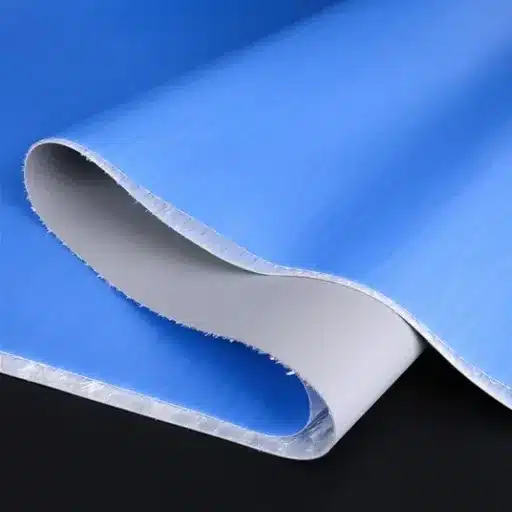
Both coatings are specified on drop stitch fabric, and the choice drives cost, cold-weather behaviour, weldability and end-of-life options. The full comparison across inflatable applications is in our guide to choosing between PVC and TPU for inflatables. The drop-stitch-specific points are these.
- Service life. TPU-coated drop stitch typically delivers 8 to 15 years or more in field conditions; PVC typically runs 5 to 10. UV exposure dominates in both cases, which is why the UV stabilisation package matters more than coating chemistry at the margin.
- Cold performance. PVC becomes brittle below roughly 0 degrees Celsius and rates to minus 30 C. TPU stays flexible to minus 40 C and rates to minus 60 C. In a cold climate this decides the question on its own.
- Welding. Radio-frequency welded TPU seams reach essentially 100 percent of base material strength. Hot-air welded PVC joints land around 90 to 95 percent. That gap matters more on a drop stitch panel, because seams sit in the primary load path.
- Weight. TPU constructions run 20 to 60 percent lighter for equivalent performance.
- Cost. PVC is 25 to 35 percent cheaper like-for-like. On a high-volume product with a short replacement cycle that is a legitimate reason to choose it, provided the working temperature range is respected.
- Recyclability. TPU is the more recyclable of the two, and the better fit where end-of-life handling is part of your own compliance obligations.
PVC wins on unit cost. TPU wins on cold performance, seam strength and lifespan. Neither is universally correct, and a supplier who says one is usually sells only that one.
Why Drop Stitch Panels Fail, and How They Are Joined
Four failure modes account for the overwhelming majority of warranty claims. Only one involves the spacer threads, which is not what most buyers expect.
Perimeter Tape Lift, the Dominant Real-World Failure
The most common failure by a wide margin is perimeter tape lifting away from the panel edge. That edge is where the two face sheets are brought together and sealed, normally reinforced with a tape strip bonded over the seam.
When the tape lifts, air migrates underneath it. Internal pressure then acts on the exposed bond line and propagates the delamination along the edge. The panel doesn’t burst. It develops a slow blister that grows with each inflation cycle until the edge seal is compromised.
Two things cause the lift. On cheaper decks the perimeter is glued rather than welded, and adhesive is a consumable that ages with heat, UV and flex, each accelerating the others. On welded decks the lift traces back to insufficient weld width or a contaminated bond surface during production.
Priya and the dock that bubbled. Priya manages fabrication for a marina systems contractor. In 2024 she delivered a run of floating dock modules built with drop stitch panels that met every incoming specification: correct denier, correct 12 cm space length, correct pressure test.
Eighteen months into service, three modules in a warm-weather installation developed soft blisters along one edge. The panels had not lost pressure. The perimeter tape had lifted and air was collecting under it.
Root cause: the edge seal was adhesive-bonded, and the adhesive had degraded faster than the panel because the installation saw sustained high surface temperatures. The specification sheet had not mentioned the joining method at all, which is why nobody questioned it at quotation stage.
This is the single most valuable question a buyer can ask. Which joining method is used on the perimeter, and what is the tested strength of that joint? Ask it before price, because it is the difference between a five-year deck and a two-year deck, and it doesn’t appear on a standard spec sheet.
Thread Detachment From the Coating
The second mode is the thread-bond failure described earlier, and it is the one coating method controls. The spacer thread pulls out of the coating at one or both anchor points, leaving the face sheet intact but no longer tied to the opposite wall. Locally the panel thins and softens; across a wide area the whole deck loses rigidity.
The signal is a gradual loss of stiffness rather than a sudden event, which is why it gets reported as a performance complaint rather than a failure. Panels that feel soft and spongy underfoot after a couple of seasons are usually showing early thread detachment, not a pressure loss.
Panels That Bend Like a Banana: Sparse Stitch Grids
The third mode is a rigidity failure rather than a structural one. Where the stitch grid is too sparse for the panel span, the panel bows under load and the deck takes on a curved set. This is the mechanism behind Tomas’s flexing paddleboards above, and it is a specification error rather than a manufacturing one. It can’t be corrected afterwards, only specified out at the loom programme stage.
The diagnostic is simple. If a panel bows under a distributed load that a denser panel of the same thickness handles flat, the space length is right and the density is wrong.
For stiffness modelling, the peer-reviewed study of bending behaviour in inflatable drop stitch fabric panels published in Composite Structures is the most useful published starting point. It is written for engineers rather than buyers, but the load cases transfer directly.
Welding and Seaming: Where Joint Quality Is Decided
Joining drop stitch fabric is harder than joining flat coated fabric, because the seam has to close a 5 to 30 centimetre gap at the edge without crushing the spacer threads doing the structural work.
Radio-frequency welding fuses coating layers by exciting polymer molecules in a high-frequency electric field. On TPU it produces a seam at essentially full base strength. On PVC the process window is narrower and the coating formulation has to be compatible.
Hot-air welding applies heated air and pressure, is the standard route on PVC drop stitch, and reaches roughly 90 to 95 percent of base strength. It’s more operator-dependent, so weld consistency becomes a quality-control question rather than a process guarantee. Adhesive bonding remains in use on low-pressure product and some edge finishing.
Glued joints on drop stitch should not be expected to exceed roughly 70 percent of base material strength, and that figure falls further as the adhesive ages under UV and water. Welded joints do not carry that ceiling. The commercial argument is not that adhesive is unusable. It is that adhesive has a service life independent of the panel’s, and that life is not disclosed on a quotation.
Three process controls decide whether a welded seam performs:
- Weld width. Narrow welds concentrate stress and fail early. Specify minimum width against working pressure, not maximum.
- Surface preparation. Coating surfaces must be clean and dry. Contamination from release agents or handling is a common and invisible cause of weak welds.
- Edge radius. Sharp transitions at the panel edge create stress concentrations. A radiused detail distributes load into the weld rather than into a line.
For product that inflates and deflates repeatedly, seam quality is the practical limit on cycle life, not the panel material. Our page on drop stitch panels for docks and platforms covers the application-side construction details.
Applications by Specification
Drop stitch fabric specifications map to applications consistently once you account for the rigidity-per-weight trade-off.
| Application | Space length | Density | Working pressure | Notes |
|---|---|---|---|---|
| Paddleboards and eFoils | 8 to 12 cm | Medium to high | 15 PSI | Weight matters; consider SL ULT |
| Air tracks and gym mats | 5 to 8 cm | High | 10 to 15 PSI | Impact absorption depends on density |
| Docks and platforms | 12 to 15 cm | High (HDDS) or double-layer | 15 PSI | Perimeter weld quality is decisive |
| Boat and kayak floors | 5 to 8 cm | Medium | 10 to 15 PSI | Low profile, tight space constraints |
| Industrial access platforms | 15 cm and above | Double-layer (DLT, DL ULT) | 15 to 20 PSI | Structural loads; confirm rating in writing |
The underlying drop stitch inflatable fabric is the same across all of these. What changes is where you sit on the rigidity curve and how much weight you will carry to get there. The technical fabric for inflatable applications range covers adjacent constructions if your product mixes panel types.
Sourcing Drop Stitch Fabric: A Verification Checklist
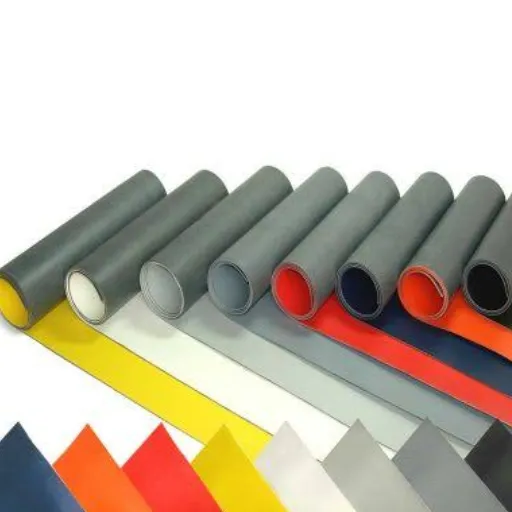
Send this checklist to any supplier before you accept a quotation on drop stitch fabric. The questions surface the specifications that do not appear on a standard sheet.
Ask for these numbers, with test methods:
- Peel strength at the thread bond, with the test method named. Below 60 N/5 cm on a high-pressure application, treat the panel as cycle-limited.
- Adhesion strength, stated separately from peel. These measure different bonds and are routinely conflated.
- Tensile strength in both directions, with the load direction on your product identified.
- Recommended working and maximum pressure, stated as two distinct figures.
- Stitch density, expressed as thread spacing and not only as a variant code.
Ask these process questions:
- Is the fabric calender-coated or knife-coated? If calender, ask for the peel figure and compare it against the 80 N/5 cm band.
- Is the perimeter welded or glued? If glued, ask for tested joint strength as a percentage of base material.
- What is the minimum weld width on a production seam?
- Can you supply a pre-production sample panel we can cycle-test to our own duty target?
Watch for these signals:
- A quotation specifying a variant code such as HDDS or DLT with no supporting numbers behind the code.
- Pressure ratings given as a single figure rather than a working and maximum pair.
- A refusal to quote peel strength on the grounds that it is a standard product.
A supplier who can answer all of these is one you can hold to a specification. One who can’t is likely reselling, and the reseller’s own supplier may not be answerable to you when a claim arises.
If you would like this checklist applied to your duty cycle, talk to our engineering team and we will work from your load case rather than from a catalogue number.
FAQ
What space length should I specify for drop stitch fabric?
Start from your weight budget rather than your stiffness target. Paddleboards and air tracks usually sit at 5 to 10 cm, docks at 12 to 15 cm, and structural platforms at 15 cm and above. Then raise stitch density before you raise space length, because a denser grid at a shorter length gives more rigidity per kilogram.
What peel strength should a drop stitch spec sheet show?
On a high-pressure application, look for a figure above 80 N/5 cm, which corresponds to knife-coated construction fused at 180 to 200 degrees Celsius. Calender-coated stock typically lands between 40 and 55 N/5 cm and is associated with delamination at the thread anchors within roughly 500 to 800 inflation cycles in published material-selection guidance.
Why do drop stitch panels blister at the edges?
Because the perimeter tape or edge seal has lifted, allowing air to migrate underneath. Internal pressure then acts on the exposed bond line and extends the delamination along the edge with each inflation cycle. It’s the most common failure mode on drop stitch product, and it usually traces back to an adhesive-bonded perimeter or an insufficient weld width.
Is glued or welded drop stitch construction better?
Welded, for anything holding sustained pressure. Glued joints should not be expected to exceed about 70 percent of base material strength, and that figure falls further as the adhesive ages under UV and water exposure. Welded joints do not carry that ceiling.
Should drop stitch fabric be 500D or 1000D?
500D high-tenacity polyester is the standard base cloth and is sufficient for most applications. Step up to 1000D where puncture resistance and abrasion resistance are the limiting requirements, and accept the weight increase. Denier has less effect on rigidity than most buyers assume.
How many inflation cycles should drop stitch fabric survive?
There is no single published test standard, which is why the answer has to be tied to peel strength. Calender-coated stock is associated with delamination beginning in the 500 to 800 cycle band, while knife-coated stock above 80 N/5 cm is not cycle-limited at that threshold. Cycle-test a pre-production sample against your own duty target rather than relying on a general figure.
Is PVC or TPU better for drop stitch fabric?
TPU for cold climates, long service life and full-strength welded seams. PVC where unit cost governs and the working temperature range is respected. TPU typically delivers 8 to 15 years of service life against 5 to 10 for PVC, stays flexible to minus 40 degrees Celsius and runs 20 to 60 percent lighter, at a cost premium of roughly 25 to 35 percent.
Conclusion
Drop stitch fabric is specified by a small number of numbers, and the ones on a standard quotation are not the ones that predict field life. Denier, space length and pressure rating tell you what the panel measures. Peel strength at the thread bond, the coating method behind it, and the joining method at the perimeter tell you how long it will last.
The sequence that works is straightforward:
-
- Establish the weight budget.
- Set stitch density against the real load case.
- Trade space length only within what the budget allows.
- Confirm the coating method and the peel figure.
- Confirm the perimeter is welded and ask for joint strength.
- Cycle-test a sample before committing to production.
Every one of those steps is a question a supplier can answer. The ones who cannot are telling you something useful.
If you are specifying drop stitch fabric for a new product or re-sourcing an existing one, request a specification review and we will assess your duty cycle against the numbers that matter, then quote to that specification rather than to a catalogue equivalent.