
What Are Bounce Houses Made Of? Materials & Safety
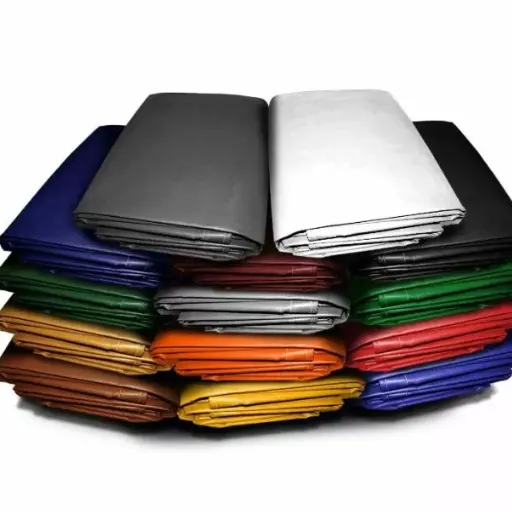
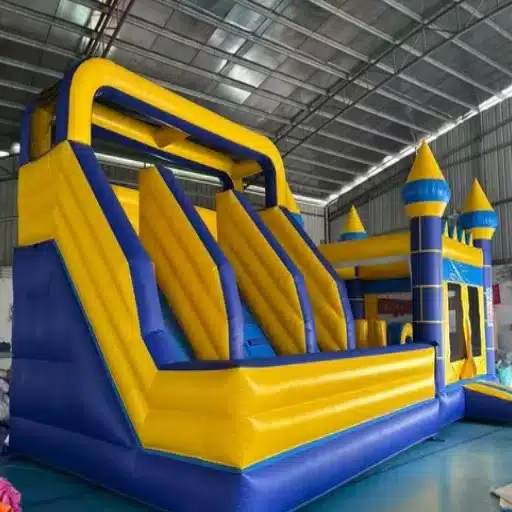
Commercial bounce houses are made of PVC tarpaulin: a woven polyester scrim sealed between two layers of PVC coating, typically 18 oz (0.55 mm, about 610 gsm). Residential units are made of lighter nylon or Oxford cloth. That single material difference decides how a unit holds air, how long it survives, whether it passes a fire test, and what a repair costs.
Nadia found out what that difference costs on a Saturday morning in April. She had rented a “commercial grade” castle for her daughter’s birthday from a local operator, and forty minutes into the party the jump floor went soft. The blower was running fine. The seams were not.
A welder who inspected the unit afterward said the fabric was closer to 15 oz than the 18 oz the invoice claimed.
The question of what are bounce houses made of sounds simple. The answer determines almost everything else about the unit in front of you.
We are a manufacturer of PVC-coated technical fabrics for inflatable makers, marine suppliers, and industrial buyers across more than a dozen countries. We do not sell finished bounce houses. That means we can explain the material from the inside, show you the numbers that separate a real commercial unit from a lookalike, and give you a way to check before you spend money. For the deep manufacturing specification behind this page, see our bounce house fabric guide.
Key Takeaways
- Commercial bounce houses are made of 18 oz (0.55 mm, ~610 gsm) PVC tarpaulin over a 1000D polyester scrim; residential units use nylon or Oxford cloth at 420D-840D.
- “PVC” means two different things: a thin coating on light Oxford cloth (residential) and a heavy coated composite over a woven scrim (commercial). Both get called PVC.
- ASTM F2374 is the voluntary US industry standard for inflatable amusement devices, not a federal requirement. Judge a supplier by whether they can produce the test report.
- Fire resistance comes from the coating formulation, not a surface spray, and NFPA 701 Test Method 2 is what most US fire codes require for indoor use.
- You can verify material grade in about two minutes with four numbers: weight, denier, weave count, and test values.
The Short Answer: Two Material Families, Three Layers
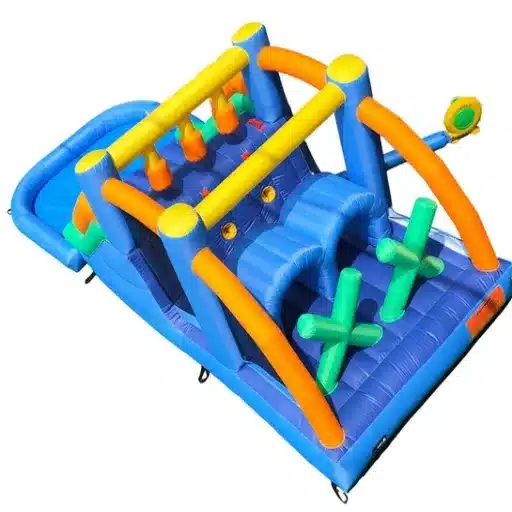
Every bounce house on the market is built from one of two material families, and the better family is a three-layer sandwich.
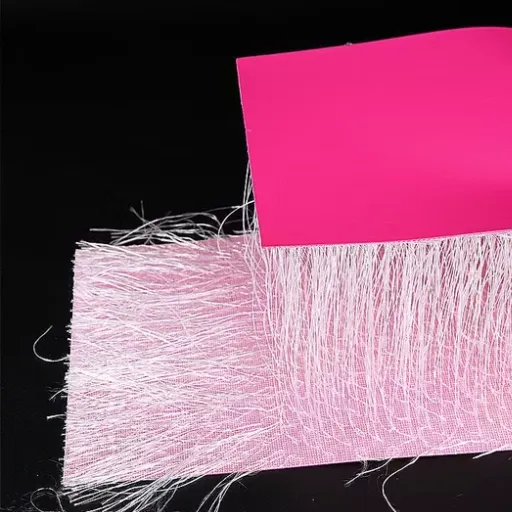
The commercial family is PVC tarpaulin. Picture a woven cloth core, then imagine it sealed inside PVC on both faces so completely that the cloth can no longer absorb water or pass air. The middle layer carries the load. The outer layers hold pressure and take the printing.
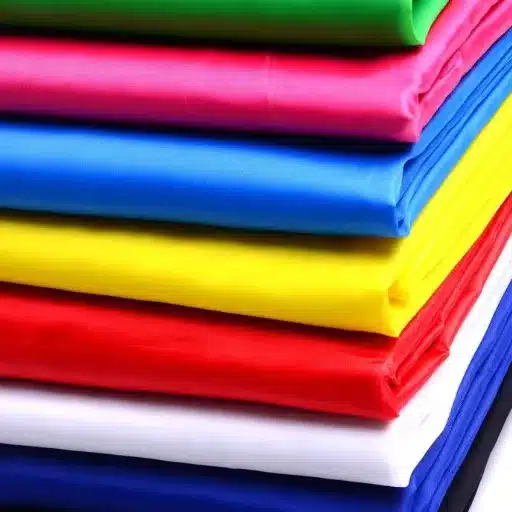
The residential family is nylon or Oxford cloth, usually with a light coating rather than a heavy sealed one. These fabrics are lighter and cheaper, and they behave very differently under load.
Understanding the three layers of commercial fabric matters because the total weight alone doesn’t tell you how a unit will perform.
Layer 1: The Polyester Scrim
The core is a woven polyester base cloth called the scrim. It is the load-bearing skeleton, and it is the reason a tear stops instead of running the length of the wall.
The scrim is specified by denier (yarn thickness) and weave count (yarns per inch in each direction). The commercial standard is 1000D with a 23 x 23 weave, with 1000D x 20 x 20 as a practical minimum. Premium water slides move up to 30 x 30.
Cheap units often use an asymmetric 1000D x 500D weave, where the load grid is strong in one direction and weak in the other. A supplier who can’t state the denier and weave count has told you something important.
Layer 2 and 3: The PVC Coatings
The two outer layers do four jobs at once: they hold air, they block water, they accept printed graphics, and they weld.
Airtightness is the one buyers underestimate. Air retention isn’t a property of the fabric’s weight. It’s a property of the coating and the seams.
Quality 18 oz fabric holds air permeability below 0.05 cm³/cm²/s at 20 mbar when welded correctly. Stitched-only seams leak no matter how good the coating is.
The coating also carries the plasticizer system. Standard tarpaulin PVC stiffens and cracks after repeated fold-and-inflate cycles in cold weather. Bounce house fabric uses cold-flexible formulations so the unit survives those cycles.
Why the Layers Matter More Than the Weight
Two fabrics can both be labeled 18 oz and behave completely differently. A heavy scrim with a thin coating tears differently than a light scrim with more coating, even at identical total weight. That is why the complete manufacturer’s guide to bounce house fabric pushes buyers to read the full construction, not just the headline number.
Want to see what a real specification sheet looks like? Our commercial-grade bounce house material breakdown walks through the numbers we publish with every roll.
What Bounce Houses Are Made Of at Every Price Point
The fastest way to understand what you are buying is to match the material to the price you were quoted. The table below maps the four materials to their construction, lifespan, and honest use case.
| Material | Construction | Lifespan | Typical Use | Cost Signal |
|---|---|---|---|---|
| Nylon / Oxford cloth | 420D-840D woven, light coating | 6-18 months | Backyard residential units | Lowest upfront, frequent replacement |
| 15 oz PVC | ~510 gsm, light scrim | 2-3 years | Light commercial, promotions | Low upfront, high repair rate |
| 18 oz PVC | 0.55 mm / ~610 gsm, 1000D scrim | 5-7 years | Standard commercial, industry baseline | Mid upfront, lowest total cost |
| 20 oz+ PVC | 0.60 mm+ / 650-1,000 gsm | 6-8 years | Water slides, obstacle courses | Highest upfront, heavy duty |
Residential: Nylon and Oxford Cloth
The cheapest bounce houses, the ones sold for backyard birthdays, are made of nylon or Oxford cloth. Both are lighter and cheaper than PVC, which keeps the unit easy to fold and the price low.
The tradeoff shows up under concentrated load. A six-inch tear in nylon cannot be welded, because there is no PVC coating to fuse a patch onto. It gets stitched, and stitching a torn woven cloth back together rarely holds at the point where children land on their knees.
Commercial: The 18 oz PVC Baseline
If you are renting, buying for a rental fleet, or buying for a school, 18 oz PVC tarpaulin over a 1000D scrim is the material you want. It sits at the point where durability, repairability, and unit weight intersect: heavy enough to shrug off years of abuse, light enough for two people to move.
Here is the practical rule. Commercial-grade PVC tarpaulin runs from about 550 to 1,100 g/m² (16-32 oz). Anything under 500 gsm is residential-grade material, even when the listing says “commercial” or “heavy duty.” Trust the number, not the label.
Premium: 20 oz and Up
Water slides, obstacle courses, and high-stress inflatables step up to 20 oz or heavier, reaching 30 oz for heavy-load slides. The extra weight buys tear resistance and costs you portability.
How to Tell PVC, Nylon, and Oxford Apart
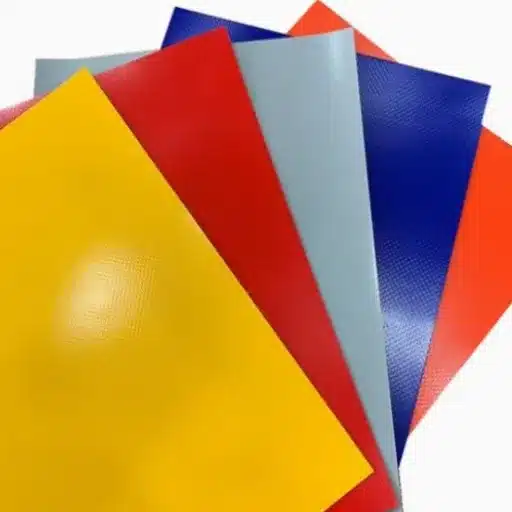
You won’t always have a spec sheet in front of you. These checks work on a unit that already exists.
- Feel the drape. PVC tarpaulin has a rubbery, heavy hand and holds a crease briefly when folded. Nylon and Oxford feel like a stiff fabric and spring back.
- Look at the cut edge. On PVC fabric the coating wraps the edge and you can’t easily separate the layers with a fingernail. On coated Oxford, the weave is visible and the coating looks thin.
- Check the seams. Welded seams look flat, slightly glossy, and continuous, with no thread. Stitched seams show a row of needle holes. If you see only thread on the air-retaining seams, expect air loss.
- Weigh the unit against its size. Compare the quoted weight of two same-size units. A meaningful difference usually means a different material.
- Ask for the number. A supplier who can state weight in gsm plus denier and weave count is a supplier who knows their own product.
That last point isn’t a formality. A first-time rental operator we worked with, Theo, bought five units from a marketplace seller at roughly half the going rate. Every listing said “commercial grade.” None of them carried a stated weight.
By the end of his second season, four had failed at the seams, and the fifth had gone soft enough that customers complained. He replaced the fleet with 18 oz units from a supplier who published test data, and those covered three full seasons without a single seam failure.
What “Safe Materials” Actually Means
Safety claims on bounce houses are where vague language does the most damage. Three questions separate a real safety position from a marketing one.
Is ASTM F2374 Required?
No, and this is widely misunderstood. The US Consumer Product Safety Commission has no mandatory performance standard for constant-air inflatable play devices. ASTM F2374 is the voluntary industry standard, and many state and local amusement-device and fire codes adopt it by reference. The current edition is ASTM F2374-22.
The practical consequence is that “meets ASTM F2374” is a claim worth exactly as much as the documentation behind it. Ask for the test report.
What Makes the Fabric Fire Resistant?
Fire resistance on a bounce house comes from the coating formulation, not a surface treatment applied afterward. A properly formulated PVC coating carries the flame-retardant chemistry through the material, so it survives abrasion, cleaning, and UV exposure. A sprayed-on treatment does not.
The relevant test is NFPA 701, the fire-retardancy standard for textiles. For inflatable amusement devices, the ICC International Fire Code requires NFPA 701 Test Method 2 specifically, and fire marshals in most US jurisdictions ask for the documentation before an indoor unit is installed. Ask for a certificate number you can verify.
Is the Material Safe for Children?
It is safe when the fabric meets chemical limits, and that is a documentation question rather than a material question.
CPSIA limits lead to 100 ppm in children’s products and restricts six phthalates to 0.1%: DEHP, DBP, and BBP permanently, plus DINP, DIDP, and DnOP on an interim basis. Constant-air inflatable play devices intended for children 12 and under also require a Children’s Product Certificate (CPC).
One detail matters here. PVC is not among the four plastics exempted from CPSIA third-party phthalate testing. The exemptions cover PP, PE, HIPS, and ABS. A PVC bounce house must be tested, and it is not compliant by material type.
This is not a theoretical concern. In 2010, the California Attorney General filed an action alleging children’s bounce house vinyl containing lead at 5,000-29,000 ppm, far above the 90 ppm limit that applied to painted surfaces at the time, with exposure occurring through ordinary hand-to-mouth contact. Lead-free, phthalate-free PVC should be the baseline, and the test report should be verifiable.
Need to confirm what a supplier’s test reports actually cover? Our PVC inflatable fabric specifications guide explains each spec number and test method so you can read a report the way an engineer does.
What Else Is Inside a Bounce House
A bounce house is not a sheet of fabric with a blower attached. It is a bill of materials, and each part is made from something chosen for its job.
- Bounce surface and walls: The same 18 oz PVC tarpaulin as the rest of the unit. The jump floor takes the most abuse, so some builders add a wear layer.
- Seams: Double-stitched lap seams, then hot-air welded and high-frequency welded. Welded seams fuse the two PVC coatings into one continuous material. Stitching alone leaves needle holes that leak air and pull apart under load.
- Internal baffles: The dividing walls inside the bounce chamber, made from the same 1000D material. They stop the unit from ballooning into one shape and keep it stable under load.
- Mesh windows: Ripstop netting that lets air escape and adults see in while keeping fingers out.
- Thread and webbing: TEX 90 or TEX 135 bonded polyester thread, chosen for UV and rot resistance. Anchor webbing is tested to a 6,000 lb break strength.
- D-rings and anchors: Welded stainless steel, each pull-tested to a 200 lb minimum, securing the unit against wind and tipping.
- Blower: Matched to the unit’s internal volume. The CFM rating sets inflation speed and how well it holds pressure.
How Bounce House Materials Are Made
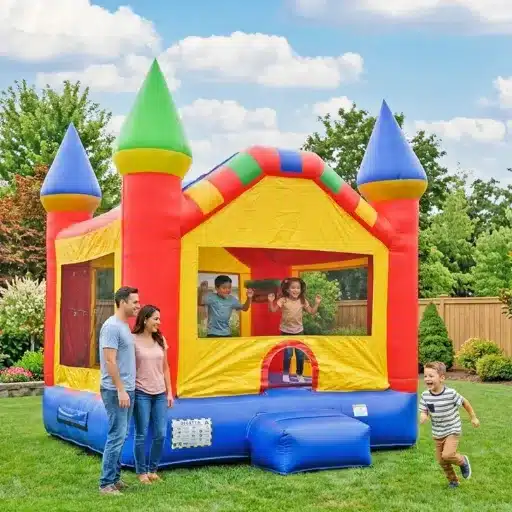
Understanding the build process explains why material grade is only half the story. Good fabric handled carelessly fails early.
- Coating and lamination: Polyester scrim is run through a coating line where PVC is applied to both faces, then the plasticizer and UV inhibitor systems are set.
- Testing: Incoming fabric is tested for tensile and tear strength, coating adhesion, and UV performance. Tensile on commercial 18 oz runs about 2,200-2,500 N/5cm per EN ISO 1421, with tear around 280-320 N per DIN 53363.
- CAD patterning and cutting: The design is broken into 40-60 panels for a standard unit. Large obstacle courses exceed 200. Panels are CNC cut to roughly ±1 mm so every piece fits its neighbor.
- Welding: Structural seams are hot-air welded, and air-retention seams are high-frequency welded at 27.12 MHz. This is the step that decides whether the unit holds pressure.
- Inflation testing: The finished unit is inflated and held. A properly built unit loses less than 10% pressure over 15 minutes with the blower off.
- Printing and QC: Graphics are printed, then a final inspection checks every seam, weld, and anchor.
Coating consistency is the quietly decisive variable. In one documented case, a batch specified at 610 gsm arrived between 585 and 632 gsm. The welds looked sealed, but the unit failed pressure testing at 18 PSI and the whole batch was scrapped. That is why the weight tolerance on a spec sheet is a real number, not paperwork.
[VIDEO EMBED HERE]
Embed a relevant video on bounce house materials or PVC welding. Preferred: LY TRUSTLINK production footage from the coating line, RF welding station, or QC testing. Alternative: an authoritative third-party explainer on how PVC inflatable fabric is welded. Use a descriptive YouTube title and enable captions.
FAQ: What Are Bounce Houses Made Of?
Are bounce houses made of PVC?
Commercial bounce houses are made of PVC tarpaulin, a polyester scrim coated on both sides with PVC, usually at 18 oz. Residential backyard units are more often made of nylon or Oxford cloth. Confusingly, some residential units are listed as “PVC-coated Oxford cloth,” which is a light Oxford weave with a thin PVC coating, not the same material.
What is the best material for a bounce house?
For commercial use, 18 oz PVC tarpaulin over a 1000D polyester scrim is the best all-around choice, balancing durability, repairability, and weight. For a low-cost backyard unit, heavier Oxford cloth is a reasonable budget option if you accept the shorter lifespan.
How long do bounce houses last?
Lifespan tracks material grade closely. 15 oz PVC lasts about 2-3 years, 18 oz PVC lasts 5-7 years, and 20 oz or heavier lasts 6-8 years. Residential nylon and Oxford units typically last 6-18 months of backyard use. We break down the grade-by-grade numbers in our guide to how long bounce houses last.
What makes a bounce house fire resistant?
Fire resistance comes from the flame-retardant chemistry built into the PVC coating during manufacturing, not from a surface spray. The relevant standard is NFPA 701, and for inflatable amusement devices the ICC International Fire Code requires NFPA 701 Test Method 2. Ask the supplier for the test report and a certificate number you can verify.
How are the seams joined in a bounce house?
Seams are double-stitched with bonded polyester thread, then sealed with hot-air welding and high-frequency welding at 27.12 MHz for air retention. Welding fuses the PVC coatings into one continuous material, which is why a welded seam outperforms a stitched-only seam on pressure retention.
Conclusion: What Are Bounce Houses Made Of?
What are bounce houses made of? Commercial units are made of 18 oz PVC tarpaulin over a 1000D polyester scrim, and residential units are made of lighter nylon or Oxford cloth. That material choice drives everything downstream: whether the unit holds air through a party, whether it passes a fire test, whether the chemical documentation exists, and whether a tear costs a patch or a replacement.
The good news is that this is checkable. Ask for the weight in gsm, the denier and weave count, and the test values. A supplier who can answer is a supplier worth using. A supplier who cannot has given you the answer already.
When you are ready to specify material for a unit, talk to an engineer rather than a sales page. Our team manufactures PVC inflatable fabric from 16 oz to 30 oz and will match the material to your actual duty cycle.
Start with our commercial PVC inflatable fabric range, or reach out about a custom tarpaulin manufacturing project. The right material, specified correctly, is the difference between a unit that earns for years and one that lets you down on a Saturday morning.