
UV-Resistant Truck Tarpaulin: Fleet Specification Guide
A UV resistant truck tarpaulin is a PVC-coated polyester cover with UV absorbers and hindered amine light stabilizers (HALS) compounded into the coating, verified by an accelerated weathering report rather than a label. For daily fleet duty, specify 600–900 GSM, a 1000D base fabric, and 1,000–2,000 hours of UV aging with at least 70–80% tensile retention.
A cover that fails in year two is rarely a bad cover. It is usually a cover specified for the wrong UV dose.
Most fleets already buy “UV-treated” tarps. Then the covers chalk, stiffen, and split at the grommets long before the promised replacement interval.
You’ll get a route model for UV exposure, the values that predict service life, a test-report checklist, and a cost test. For the wider procurement picture, see the complete truck tarpaulin fleet guide.
If you’re rewriting a fleet specification, send us the route, tarp type, and dimensions. We’ll review the UV requirement against the duty cycle. Request a specification review.
Key Takeaways
- UV resistance is a compound specification, not a surface coating. It depends on UV absorbers and HALS in the PVC, verified by retained tensile and tear values.
- Truck tarps see more UV than static covers because route dose, flex, tension, and abrasion all compound the exposure.
- For daily fleet duty, specify 600–900 GSM, 1000D base fabric, and 1,000–2,000 hours of UV aging at 70–80% retention or better.
- Test hours do not convert to outdoor years. Ask for the method, the original and aged values, and batch traceability.
- Stabilized PVC typically delivers 3–6 years under daily fleet duty and 5–10 years in occasional use. The UV upgrade pays back when it moves replacement from 1–2 years to 4–6.
What UV Resistance Actually Means on a Truck Tarp
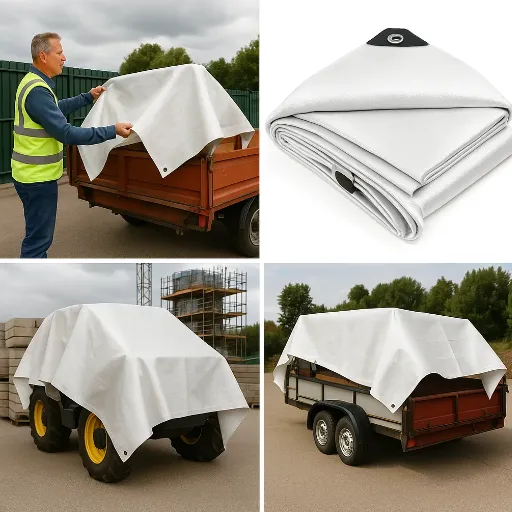
When a fleet manager specifies a UV resistant truck tarpaulin, the real question is not whether the cover has a UV label. It is how much of its tensile and tear strength it will retain after a defined exposure, and whether that evidence can be tied to the quoted batch.
UV resistance is the fabric’s ability to keep its mechanical properties after prolonged ultraviolet exposure. It isn’t a coating you can see, and it isn’t the same as waterproofing or weather resistance.
The damage mechanism
UV light in the 290–400 nm range carries enough energy to break polymer bonds. In PVC, the first visible sign is yellowing. That color shift comes from dehydrochlorination, which creates conjugated double bonds.
Behind the color change, two things happen. Polymer chains break, which reduces tensile and tear strength. Plasticizers migrate out, which makes the sheet stiff and brittle. The surface chalks, the coating thins, and the fabric eventually cracks at the points that flex.
Damage is not uniform. Edges, grommets, seams, and fold lines fail first because they carry stress and see more flex. A tarp can look sound mid-panel and still be close to failure at the perimeter.
UV-treated vs UV-stabilized vs UV-proof
The three terms are not interchangeable.
UV-treated usually means a surface treatment or an unspecified additive. In continuous sun, the protection may last 6–12 months. A light PE cover can become brittle inside that window.
UV-stabilized means UV absorbers and HALS are compounded into the polymer or coating. This is the only term with a meaningful technical basis. The additives are inside the material, so abrasion does not remove them the way it removes a topcoat.
UV-proof is a marketing term. It has no defined meaning and no test standard behind it. Ask for the report.
How the stabilizer package works
UV absorbers, such as benzophenone, benzotriazole, and triazine types, absorb UV energy and release it as heat. Supplier data puts benzotriazole loading at roughly 0.2–0.5% by weight.
HALS scavenge free radicals and regenerate, so they keep interrupting the degradation chain. Combined with absorbers, supplier data claims a 3–5× service-life extension versus unstabilized PVC. Treat that as a claim, not a guarantee.
Titanium dioxide in white grades scatters UV, and supplier data cites 5–15% loading. PVDF, acrylic, or lacquer topcoats add a sacrificial surface layer, but they do not replace a stabilized compound. A topcoat over an unstabilized sheet is a short delay, not a fix.
A label tells you what the supplier hopes you will assume. A test report tells you what the fabric retained.
Why UV Ages Truck Tarps Faster Than Static Covers
Two UV-resistant truck tarps can share a fabric and still age at different rates. The difference is the route and the duty cycle.
UV dose climbs as a route moves toward the equator and rises with season. It rises with altitude too, because there is less atmosphere to absorb it, as WHO’s UV guidance explains. Snow, sand, water, and light concrete reflect UV back onto the cover, so a winter route can deliver more exposure than the air temperature suggests.
Heat matters too. A dark surface in direct sun can reach 60–80°C. That heat accelerates oxidation and plasticizer loss, so a black cover in a desert fleet can fail before a light grey one.
A static cover mostly sees sun and weather. A truck cover sees sun plus motion.
Flatbed covers flap at highway speed, and every flutter flexes the coating and works the grommets. Side curtains are tensioned and handled daily, so buckles, rollers, and bottom hems take the wear. Dump and roll-off covers abrade against the load and the roller. Mesh covers load their grommets at the edges and fray where the weave is cut.
That’s why a fabric rated for 5–10 years on a static frame may last 3–6 years on a working trailer. Failures concentrate in four zones:
- Edges and hems: wind flutter, abrasion, and the highest UV exposure.
- Grommets and D-rings: point loading, elongation, and tear-out.
- Seams and welds: adhesion loss and contamination during repair.
- Fold lines and roller contact: flex fatigue, grit abrasion, and plasticizer loss.
An illustrative example: Marisol runs 40 flatbed trailers in southern Arizona. She bought “UV-treated” covers at 550 GSM and expected three years.
By month 18, six covers had split at the grommets and four more were chalky at the edges. The replacement order moved to 750 GSM, 1000D, with a documented UV package and reinforced grommet patches. The next inspection cycle found two edge repairs and no grommet failures.
Heavy-Duty UV Specifications and Test Reports
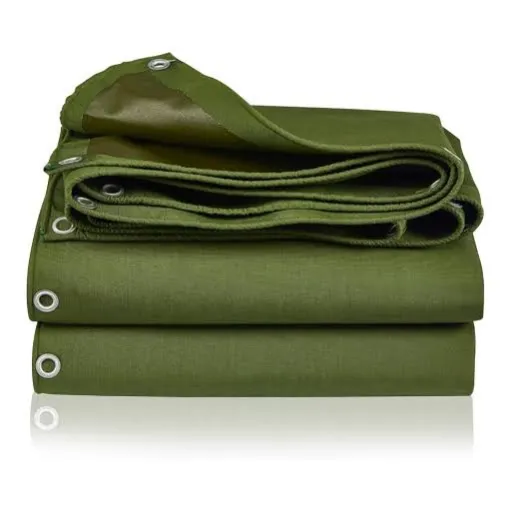
A UV resistant truck tarpaulin specification should force a number. A supplier can say “UV stabilized” without proving anything. The specification and the report are what make the claim comparable.
For UV-exposed fleet duty, start with 600–900 GSM and a 1000D × 1000D polyester base. Below 600 GSM, the coating is usually too thin to carry a meaningful UV package. Ask for the coating method, coating mass, and topcoat. Knife-coated fabric gives a more consistent bond than hot-laminated construction, which matters when a UV-aged seam needs repair.
| Property | Heavy-duty target | Severe-duty target |
|---|---|---|
| GSM | 600–900 | 900–1,100 |
| Base fabric | 1000D × 1000D | 1000D × 1300D or higher |
| Tensile strength | ≥2,800 N/5 cm | 3,500–4,500+ N/5 cm |
| Tear strength | ≥280 N | 400–600+ N |
| Coating adhesion | ≥100 N/5 cm | ≥120 N/5 cm |
| UV aging | 1,000–2,000 h at ≥70–80% retention | 3,000 h for high altitude |
| Cold crack | -30°C | -40°C for cold routes |
| Seam strength | ≥80% of parent fabric | ≥80% of parent fabric |
For the full specification, see heavy-duty truck tarpaulin specifications.
How to read a UV test report
Start with the method. ASTM G154 uses fluorescent UV lamps. ASTM G155 and ISO 4892-2 use xenon arc. The methods don’t produce interchangeable hours, so never compare a G154 result with a G155 result as if they were the same test.
Then check the conditions: irradiance, temperature, cycle, and duration. Next, check the property and the direction. Tensile, tear, elongation, adhesion, and color change (ΔE) are different measurements. Warp and weft can behave differently.
Finally, check traceability. The report should identify the specimen, the batch, and the TDS revision. If the tested sample cannot be tied to the quoted material, the report proves nothing about your order.
A QUV accelerated weathering tester in operation. The equipment matters less than the report fields: method, irradiance, cycle, duration, property, and original versus aged values.
Why test hours do not equal years
There’s no universal conversion from accelerated weathering hours to outdoor years. Climate, mounting angle, lamp spectrum, and stabilizer level all change it. A 2,000-hour report is evidence of a formulation, not a warranty of 2,000 outdoor hours.
That does not make the report useless. Two suppliers tested under the same method and conditions can be compared. A single supplier’s hours cannot be converted into a service life. For more on the test methods, see how UV resistance is tested and rated.
Ask for the aged value and the original value. A retention percentage without both is a marketing number.
Matching UV Resistance to Truck Type and Route
The right UV specification depends on how the cover is used, not just where it is parked.
UV-Resistant Flatbed and Steel Tarps
Flatbed covers see the highest wind flutter and edge abrasion. Specify 650–900 GSM, 1000D, reinforced hems, and grommets at 400–500 mm. A 1,500–2,000-hour UV target suits daily long-haul duty.
UV-Resistant Side Curtain Tarps
A UV-resistant side curtain tarp is tensioned daily and handled at every stop. Specify 680–720 GSM, knife-coated PVC, UV-stabilized PVC, and rated hardware.
Confirm the load-rating documentation separately from the UV report. A patch restores appearance; it does not restore a rated curtain’s rating. For the full specification, see truck side curtain specifications.
UV-Resistant Dump Truck Tarps
Abrasion and heat dominate this duty. A UV-resistant dump truck tarp still helps on the exposed top, but UV alone won’t fix a misaligned roller or a fold line that grinds grit every cycle. Specify 450–500 GSM with an abrasion-resistant topcoat, or 700–850 GSM for severe duty. Check the roller, cross-bar pocket, and fold lines at every service.
UV-Resistant Mesh Covers
Mesh covers load their grommets at the edges and fray where the weave is cut. Specify UV-stabilized yarn or coating, reinforced edges, and early repair. Mesh tears propagate quickly.
Color and Heat
Light colors reflect more sunlight and run cooler. White, light grey, and silver are common for trailer roofs and heat-sensitive cargo.
Reflective topcoats can reduce surface temperature further. Treat a 20–30°F reduction as indicative, not guaranteed, and confirm compatibility with the base fabric. For options, see tarpaulin color selection and reflective tarpaulin.
| Truck type | Dominant exposure | Recommended UV specification | First inspection point |
|---|---|---|---|
| Flatbed, lumber, steel | Wind flutter, edge abrasion, sun | 650–900 GSM; 1000D; 1,500–2,000 h UV | Grommets, corners, hems |
| Side curtain | Tension, handling, sun | 680–720 GSM; knife-coated; UV-stabilized | Buckles, rollers, bottom hem |
| Dump and roll-off | Abrasion, heat, fold fatigue | 450–500 GSM A/R, or 700–850 GSM heavy | Roller, fold lines, cross-bar pocket |
| Mesh | Edge load, UV, fray | UV-stabilized yarn; reinforced edges | Grommets, cut edges |
How Long a UV-Resistant Truck Tarp Lasts
A UV-resistant PVC truck tarp lasts 3–6 years under daily fleet duty and 5–10 years in occasional or static use. Climate and duty move that range more than the label.
| Application or climate | Typical lifespan | Qualifier |
|---|---|---|
| Daily fleet duty | 3–6 years | Tension, abrasion, and route severity |
| Occasional or static use | 5–10 years | Less flex and handling |
| Tropical or desert | 3–5 years | High UV dose and heat |
| Temperate | 5–10 years | Seasonal variation |
| Cool northern | 8–15 years | Lower UV dose, but cold-crack risk |
Material-level ranges are covered in tarpaulin lifespan by material.
Replace when any of these appear:
- Coating worn to the scrim
- A chalky surface that stays chalky after cleaning
- Fine cracks at the folds
- Fabric that feels stiff or tacky
- Seams lifting across panels
- Elongated grommets
- The same zone failing twice in one season
Repair works on a clean tear, a small puncture, local abrasion, or a torn grommet in sound fabric. It doesn’t work on a UV-embrittled panel, widespread seam failure, coating worn to the scrim, or a lost load rating.
Specifying, Verifying, and Paying for UV Performance
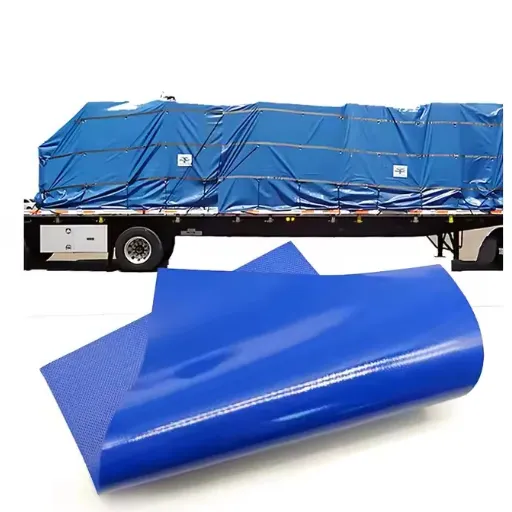
Every UV resistant truck tarpaulin order should survive the quotation process with its evidence intact.
The RFQ checklist
| RFQ item | What to state |
|---|---|
| Duty | Application, route, climate, and expected service interval |
| Form | Tarp type, dimensions, and hardware layout |
| Fabric | GSM, base fabric, coating method, coating mass, and topcoat |
| UV evidence | UV aging method, hours, and retained-property targets |
| Cold | Cold-crack target if the route requires it |
| Color | Color and heat requirements |
| Traceability | Test report, TDS revision, and batch reference |
| Commercial | Warranty terms and field-reference list |
Ask for the TDS with a revision date, the full UV report rather than a summary line, the acceptance criteria, how the tested specimen relates to the quoted product, sample traceability, and the warranty terms. If a supplier cannot connect the report to the batch, the report is a brochure.
The cost test
Compare quotes on cost per year, not price per square meter.
Cost per year = (purchase price + labor + downtime) ÷ expected service years.
A standard cover at a lower price with a two-year life can cost more per year than a UV-stabilized cover with a five-year life, especially when changing covers takes a crew and a bay. The premium usually pays back when the replacement interval moves from 1–2 years to 4–6 years. For current ranges, see truck tarpaulin cost analysis.
An illustrative example: Curtis manages a 25-truck dump fleet in Texas. He compared a 450 GSM cover at a lower unit price with a 500 GSM abrasion-resistant cover at a 20% premium. The cheaper cover lasted about 14 months; the upgraded cover reached 40 months. Even with the same labor rate, the cost per year fell by roughly a third.
Keeping a UV-Resistant Tarp in Service
UV damage cannot be reversed, but it can be slowed. Keep the surface clean with pH-neutral soap and a soft brush, avoid solvents and strong alkalis, and dry both sides before storage.
Run a pre-trip visual check, a monthly detailed inspection, a quarterly wash and hardware check, and an annual retirement review. Roll rather than fold, and store dry, ventilated, and off the floor.
Sprays and topcoats may add temporary UV protection, but they can’t restore a depleted compound. Once the panel is chalky, cracked, or stiff, the useful life is over. For the full schedule, see truck tarpaulin maintenance.
Frequently Asked Questions
How long does a UV-resistant truck tarp last?
Typically 3–6 years under daily fleet duty and 5–10 years in occasional or static use. Tropical and desert routes trend toward 3–5 years; cool northern routes can reach 8–15 years. GSM, stabilizer package, tension, and abrasion all move the number.
Does UV resistance wear off?
Yes. UV absorbers and HALS are consumed as they protect the polymer. Once the package is depleted, degradation accelerates. It can’t be restored by a coating, spray, or patch.
What is the difference between UV-treated and UV-stabilized?
“UV-treated” usually means a surface treatment or an unspecified additive, often with 6–12 months of protection. “UV-stabilized” means UV absorbers and HALS are compounded into the material. “UV-proof” has no defined meaning.
How can you tell if a truck tarp is UV stabilized?
Ask for:
- The TDS revision
- The UV test method
- Original and aged tensile and tear values
- The specimen reference
- The batch
A label alone is not proof.
Is PVC or PE better for UV exposure?
Stabilized PVC typically delivers 5–10 years outdoors, while PE delivers 1–3 years. PVC is the default for daily fleet duty. PE suits temporary or short-trip use where weight and cost matter more than service life.
What color truck tarp lasts longest?
Light colors reflect more sunlight and run cooler, which can slow heat-related aging. White, light grey, and silver are common for roofs and heat-sensitive cargo. The stabilizer package matters more than color alone.
Does higher GSM mean better UV resistance?
No. GSM describes mass, not stabilization. A heavy-duty UV-resistant tarp with a weak package can fail before a lighter sheet with a documented one. Use GSM as a durability baseline, then verify the UV report.
Do I need a cold-crack rating too?
Yes, if the route drops below the plasticizer system’s limit. UV stabilization and cold-crack resistance are separate specifications. A UV-stabilized cover isn’t automatically rated for -30°C.
Conclusion
UV-resistant truck tarpaulin selection comes down to four decisions. Define the route dose. Specify the compound, coating, and GSM.
Verify the report against the batch. Calculate cost per year instead of price per square meter.
The test report, the retention values, and the traceability are what tell you whether the cover will still be in service in year four.
If you’re specifying covers for a fleet, send us the route, tarp type, dimensions, and current replacement interval. We’ll recommend a UV specification and a report checklist you can use to compare suppliers. Request a custom truck tarp quote.