
Bounce House Fabric: The Complete Manufacturer’s Guide
Commercial bounce house fabric is 18 oz (0.55 mm, roughly 610 gsm) PVC tarpaulin laminated over a 1000D polyester scrim, and it’s the industry baseline for any inflatable designed to survive a rental duty cycle. Every other grade, from lightweight residential nylon to premium 20 oz water-slide material, is a deliberate tradeoff against that standard. This guide, written from the fabric manufacturer’s perspective, explains exactly how to specify, verify, and source bounce house material that will not fail your operation.
Here is the reality most buyers discover too late: the cheapest fabric saves a few dollars per yard, and that saving can cost a rental operator thousands in repairs, replacement units, and missed bookings. When a seam splits on a Saturday morning at a child’s birthday party, the material that failed was chosen months earlier by someone trying to keep the upfront cost down.
We have spent years manufacturing PVC-coated technical fabrics for inflatable manufacturers, marine equipment producers, and industrial buyers across more than a dozen countries. This guide is the sourcing document we wish every operator had before their first order. It covers the three-layer composite construction, the specification numbers that actually matter, the certifications you should demand, the repair economics that determine whether a unit earns its keep, and the sourcing checklist that protects you from under-spec material dressed up as “commercial grade.”
Need reliable fabric for inflatable castles and bounce houses? Send us your specifications and let our team recommend a suitable tarpaulin solution.
Key Takeaways
- Commercial bounce house fabric should meet a minimum of 18 oz (0.55 mm / ~610 gsm) with a 1000D polyester scrim; anything under 500 gsm labeled “commercial” is residential-grade material.
- The fabric weight is only half the story: seam construction, plasticizer system, and UV resistance determine whether a unit lasts 2 years or 7.
- PVC tarpaulin outperforms nylon and Oxford cloth for commercial use on tear strength, waterproofing, repairability, and total cost of ownership.
- Look for ASTM F2374, EN 14960, NFPA 701, CPSIA, and REACH compliance documentation, and learn to verify a test report before you trust a claim.
- Upgrading from 15 oz to 18 oz material typically adds about $180 per unit upfront while cutting repair costs and replacement cycles enough to save thousands over three years.
What Is Bounce House Fabric?
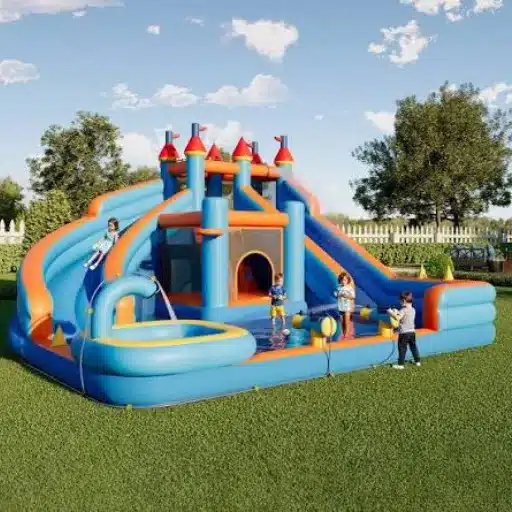
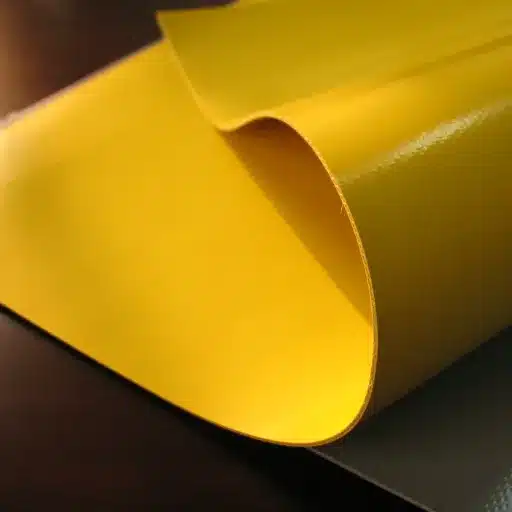
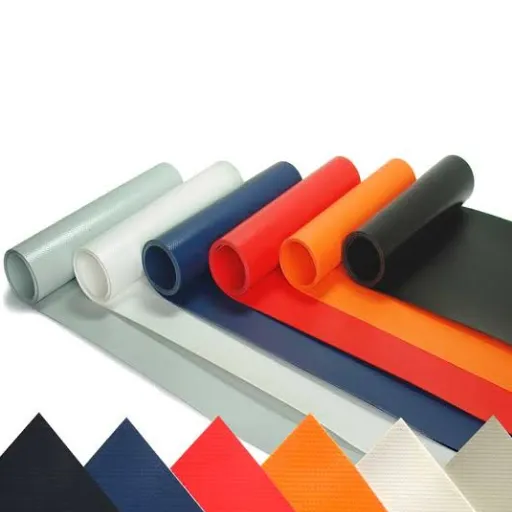
Bounce house fabric is a composite material: a woven polyester base cloth, known as the scrim, sandwiched between two layers of PVC coating. This three-layer construction gives the material its strength, its airtightness, and its ability to hold a shape under constant inflation pressure. The polyester scrim carries the mechanical load, while the PVC layers provide the waterproof barrier, the welded seam surface, and the printed graphics.
The material differs from a standard tarpaulin in two important ways. First, airtightness. A bounce house is not a sealed balloon; it depends on continuous airflow from a blower. But the fabric still needs to hold pressure efficiently, and that requires a dense coating with low air permeability.
Second, flex resistance. An inflatable is folded, transported, and inflated hundreds of times over its life. Standard tarpaulin PVC can crack under that repeated flexing, especially in cold weather. Bounce house fabric uses formulations designed to survive thousands of fold-and-inflate cycles.
The base cloth is specified by denier and weave count. Denier measures the thickness of the individual yarns, and the weave count measures how many yarns run per inch in each direction. A common commercial spec is 1000D with a 20 x 20 or 23 x 23 weave. Higher numbers mean heavier yarns and a tighter grid, which translates directly into tear resistance. We will break down what these numbers mean for your specific application next. Need inflatable castle tarpaulin fabric in custom specifications? Share your required width, weight, coating, and quantity with us for a project-specific quotation.
Bounce House Material Specifications: Weight, Thickness & Strength
Fabric weight is the first number buyers ask about, and for good reason. Weight correlates with durability more consistently than any other single specification. In the inflatable industry, weight is quoted three ways: ounces per square yard (oz), grams per square meter (gsm), and millimeters of thickness (mm). These are interchangeable descriptions of the same physical property, and the confusion between them is one of the most common sourcing mistakes we see.
| Fabric Weight | Thickness | GSM | Typical Application |
|---|---|---|---|
| 8-12 oz | 0.25-0.35 mm | 270-410 gsm | Residential / backyard units |
| 15 oz | 0.45 mm | ~510 gsm | Light commercial, promotional |
| 18 oz | 0.55 mm | ~610 gsm | Standard commercial, industry baseline |
| 20 oz | 0.60 mm | ~650 gsm | Premium commercial, water slides |
| 25-30 oz | 0.75-0.90 mm | 850-1,000 gsm | Obstacle courses, heavy-load slides |
What Does “18 oz” Actually Mean?
Eighteen ounces refers to the total weight of one square yard of the finished fabric, including both the scrim and the PVC coating. It’s the most common commercial grade in the industry because it hits the sweet spot between durability and manageability. A 15 oz fabric is noticeably lighter and easier to handle, but it sacrifices tear strength and lifespan. A 20 oz fabric adds durability for heavy-traffic applications but makes units heavier to transport and set up.
The important thing to understand is that the weight is a result of both the scrim and the coating. Two fabrics can both be labeled 18 oz while performing very differently. A 1000D scrim with a thinner coating will tear more easily than a lighter scrim with more coating, even at the same total weight. This is why you should never spec a fabric by weight alone. Ask for the full construction details, or work from our complete PVC inflatable fabric specifications guide, which walks through weight, denier, and test-method requirements in depth.
Denier and Scrim Construction: The Hidden Load-Bearing Layer
The scrim is the structural backbone of bounce house fabric. When a tear starts, it is the scrim that stops it from propagating. A higher denier means thicker yarns, and a tighter weave count means the yarns are packed closer together. Both factors improve tear resistance.
For commercial bounce houses, the minimum we recommend is a 1000D scrim with a 20 x 20 weave. The industry standard for most commercial units is 1000D with a 23 x 23 weave, which provides a denser load grid. Water slides, obstacle courses, and other high-stress applications typically move up to 1000D x 30 x 30 or 1100D x 30 x 30. If a supplier cannot tell you the denier and weave count of the scrim, that is a red flag.
Strength Numbers You Should Demand
Weight and denier tell you what the fabric is made of. Strength testing tells you how it will perform. The three numbers that matter most are tensile strength, tear strength, and peel strength.
Tensile strength measures how much force the fabric can withstand before it ruptures. For commercial bounce house fabric, look for tensile values in the range of 1,500 to 4,500 N/5cm depending on grade. Tear strength measures resistance to a propagating tear, and commercial material should deliver at least 240 to 280N. Peel strength, tested to DIN 53357, measures how well the PVC coating bonds to the scrim, and 70 to 100N is a strong result. If a supplier can’t provide test reports with actual measured values, treat their durability claims as unverified.
Commercial vs Residential Bounce House Materials
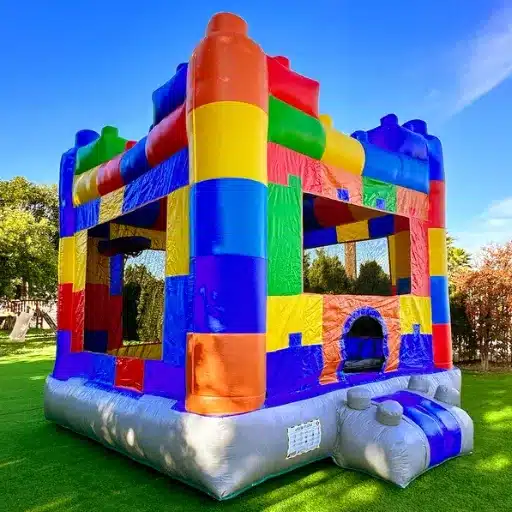
The single biggest mistake in the inflatable market is buying a residential-grade unit that is being marketed as commercial bounce house fabric. The difference is not a label. It is a set of measurable material properties that determine whether a unit survives a season of weekend rentals or a single backyard birthday.
| Property | Residential (Nylon / Oxford) | Light Commercial (15 oz PVC) | Commercial (18 oz PVC) |
|---|---|---|---|
| Typical lifespan | 6-18 months | 2-3 years | 5-7 years |
| Weight capacity | 300-500 lbs | 500-900 lbs | 900-1,500+ lbs |
| Water resistance | Water-resistant, degrades with wet use | Waterproof | Fully waterproof |
| Seam type | Stitched | Heat-welded | Heat-welded + reinforced stitching |
| Repairability | Difficult | Easy with patch kits | Easy with patch kits |
| Approx. cost | Lowest | Mid | 15-25% above 15 oz |
Residential units are built from lighter materials such as 420D or 600D nylon Oxford cloth. They are cheaper, lighter, and easier to set up, which makes them attractive for occasional backyard use. But nylon absorbs moisture, degrades quickly under UV exposure, and relies on stitched seams that create perforation points. The first place a nylon unit fails is almost always at a seam.
What Is Commercial Bounce House Material?
The term “commercial grade” is marketing language, not a specification. In practice, a unit deserves the commercial label when it meets a minimum set of measurable criteria: 18 oz PVC tarpaulin or heavier, a 1000D scrim, tear strength of at least 240N, heat-welded seams at primary stress points, and verifiable compliance documentation. If a quote comes in under 500 gsm and still claims commercial durability, the material is residential grade wearing a commercial label. We have seen this mislabeling across the market, and it is the most common source of premature unit failure among first-time rental operators.
When you evaluate a unit or a fabric supplier, ask for the specification sheet in writing. A legitimate manufacturer will provide denier, weave count, weight, strength test values, and certification documents without hesitation. A supplier who avoids the question is telling you what they are hiding. Need inflatable castle tarpaulin fabric in custom specifications? Share your required width, weight, coating, and quantity with us for a project-specific quotation.
PVC vs Oxford vs Nylon: Bounce House Fabric Comparison
PVC tarpaulin dominates commercial inflatables for a reason. It offers the best combination of strength, waterproofing, UV resistance, and repairability. But the alternatives still appear in the market, mostly at the residential end, and it helps to understand the tradeoffs.
| Factor | PVC Tarpaulin | Oxford Cloth | Nylon |
|---|---|---|---|
| Tear strength | Highest | Moderate | Moderate |
| Water resistance | Fully waterproof | Water-resistant | Absorbs moisture |
| UV resistance | Excellent with stabilizers | Moderate | Poor over time |
| Seams | Heat-welded, strongest | Stitched | Stitched |
| Cold behavior | Stiffens below ~4°C (grade-dependent) | Flexible | Flexible |
| Weight (15×15 unit) | 250-350 lbs | 150-220 lbs | 150-220 lbs |
| Typical lifespan (commercial use) | 5-7 years | 2-3 years | 2-3 years |
Why PVC Dominates Commercial Use
For a rental business, the decision is largely settled. PVC tarpaulin is roughly five times stronger than residential nylon at the point of tear, it is fully waterproof, and it can be welded with high-frequency or hot-air equipment to create seams that are often stronger than the material itself. Nylon and Oxford units rely on stitched seams, and every stitch is a perforation that weakens the fabric and provides an entry point for moisture.
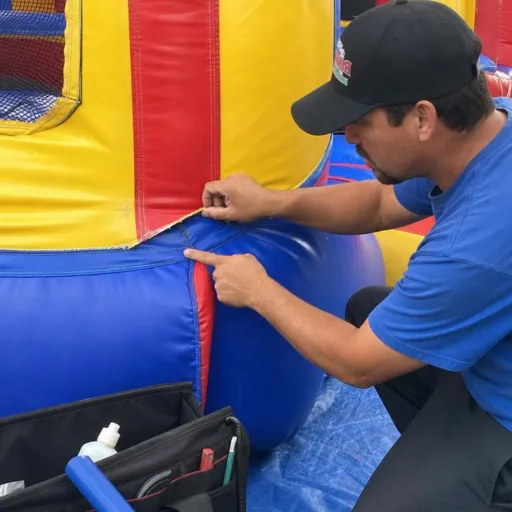
The repairability difference is just as important. A puncture in a PVC unit is fixed in minutes with a vinyl patch kit. A tear in nylon is harder to patch cleanly, and a damaged Oxford panel often cannot be repaired at all. For an operator who runs a fleet of units, the ability to patch a small tear and keep the unit in service is a direct contributor to the bottom line.
When TPU or Nylon Makes Sense
There are legitimate niches for other materials. TPU (thermoplastic polyurethane) is softer, more flexible in extreme cold, and free of PVC plasticizers, which makes it attractive for premium lightweight inflatables and for buyers with strict environmental or chemical preferences. The tradeoff is cost; TPU is significantly more expensive and is rarely used for large commercial units. If you are comparing coating polymers for an inflatable application, our guide to choosing between PVC and TPU for inflatables walks through the technical differences.
Nylon and Oxford cloth remain reasonable choices only for residential units used occasionally and stored dry. For any unit that will face regular use, outdoor exposure, or commercial rental, PVC tarpaulin is the dependable choice. Send us your specifications and let our team recommend a suitable tarpaulin solution.
Safety Standards & Compliance for Bounce House Fabric
Compliance is not paperwork for its own sake. The standards that govern inflatable materials exist because a fabric failure in this application has real safety consequences. A seam that bursts under load, a material that ignites, or a coating that contains unsafe levels of lead or phthalates can injure a child and end a business.
The most relevant standards are:
- ASTM F2374: The primary US standard for commercial inflatables, covering fabric strength, anchoring, occupancy, and labeling requirements.
- EN 14960: The European standard for inflatable play equipment, covering similar structural and safety requirements.
- NFPA 701: The US standard for flame propagation of textiles, and the fire-retardancy benchmark most US buyers should demand.
- CPAI-84: A fire-resistance standard for tents and other temporary structures, also relevant to inflatable materials.
- EN 71 / ASTM F963: Toy safety standards that cover the chemical and mechanical properties of products intended for children.
Each of these standards tests specific properties. ASTM F2374, for example, includes tensile strength requirements that the fabric must meet under test. NFPA 701 tests how quickly a material ignites and propagates flame. When a supplier tells you a product is “safety certified,” ask which standard, and ask to see the certificate. A genuine certification always comes with documentation.
Chemical Compliance: CPSIA, REACH & Phthalate-Free PVC
For any inflatable that children will touch, chemical compliance matters as much as mechanical strength. The US Consumer Product Safety Improvement Act (CPSIA) restricts lead content and regulates phthalates in children’s products. For European export, the REACH regulation imposes similar chemical limits. Buyers sourcing for the US or EU market should request PVC formulations that are lead-free and phthalate-free, and they should verify the claim with third-party test reports rather than a brochure line.
Virgin-grade PVC with a proper plasticizer system delivers two benefits at once. It meets the chemical limits that compliance-savvy buyers and regulators require, and it performs better in the field. Recycled or heavily filled PVC is more prone to early degradation, so the compliance conversation and the durability conversation lead to the same material decision.
How to Read a Test Report
A test report tells you what was tested, by which method, and what value was measured. When you request documentation from a fabric supplier, check three things. First, the test method, which should be named, such as ASTM D751 or EN ISO 1421 for tensile and tear. Second, the measured value, not just a pass or fail note. Third, the date and the issuing laboratory. A report from an accredited third-party laboratory carries far more weight than an internal quality sheet. If a claim of “commercial grade” isn’t backed by a readable test report, assume it’s marketing. Contact us for tailored fabric options→
The Economics of Material Choice: Cost, Repairs & ROI
Diane runs a rental fleet in Austin, Texas, with 14 commercial bounce houses and combo units. When she started the business in 2022, she ordered three units from a supplier who quoted her a bargain on “commercial grade” material. The price was right, and the units looked identical to the premium units she had priced elsewhere.
Within six months, Diane was patching her units every few weekends. A seam on the slide bed split during a July rental. The jumping area of another unit began to feel soft as the fabric stretched. By the end of the first season, she had paid for a professional seam repair, replaced a full panel on one unit, and turned down bookings while two of the three units sat out of rotation. The material in those units was 15 oz at best, and it failed at the exact moment she needed the units most.
Diane replaced the fleet with 18 oz units the following spring. The upfront cost was higher by roughly $180 per unit. Three years later, those 18 oz units have required a fraction of the repairs, and her total cost per rental has dropped by more than a third. Need inflatable castle tarpaulin fabric in custom specifications? Share your required width, weight, coating, and quantity with us for a project-specific quotation.
The Hidden Cost of Under-Spec Fabric
Diane’s experience is not an outlier. Across the industry, repair incident data shows a clear pattern by material grade. A 15 oz fabric averages 12 to 16 repair incidents per 10 units per year. An 18 oz fabric averages 3 to 5. A 20 oz fabric averages 2 to 4.
The gap compounds: every repair takes a unit out of service, every out-of-service unit is lost revenue, and every premature replacement resets the capital cost.
| Material Grade | Typical Lifespan | Repair Incidents (per 10 units/yr) | 3-Year Cost Position |
|---|---|---|---|
| 15 oz PVC | 2-3 years | 12-16 | Higher total cost |
| 18 oz PVC | 5-7 years | 3-5 | Lowest total cost |
| 20 oz PVC | 6-8 years | 2-4 | Low total cost, heavier units |
The reason 18 oz bounce house fabric often wins on total cost of ownership is that it sits at the intersection of durability and practicality. It survives a commercial duty cycle without requiring a two-person crew to set up every unit. When we work with rental operators and OEM manufacturers, we consistently recommend running the full cost math rather than comparing unit prices. A $180 upfront difference per unit is routinely dwarfed by the repair, replacement, and downtime costs it avoids.
Construction Quality: Seams, Stitching & Reinforcement
Fabric quality sets the ceiling, but construction quality determines whether a unit reaches it. The seams are the most stressed points on any inflatable, and the way they are joined is a direct predictor of unit lifespan.
Heat-welded seams are the commercial standard for bounce house fabric. High-frequency (RF) welding and hot-air welding fuse the PVC coatings together at a molecular level, creating a bond that is often stronger than the surrounding material. Stitched seams, by contrast, perforate the fabric, and the thread itself becomes the weak point. This is why nylon and Oxford units, which rely on stitching, fail at the seams far more often than welded PVC units.
High-stress areas need reinforcement beyond the primary seam. The bottom mattress seam, the entrance ramp, and the bases of columns and baffles all take concentrated load. Commercial units typically add quadruple stitching at these points over the welded seam, and they use the same 1000D material for internal baffles as for the exterior shell. When you inspect a unit, check whether the baffles are made of real fabric and whether the high-stress seams show visible reinforcement.
What to Inspect Before You Buy
Before you commit to a unit or a fabric order, run a quick inspection. Ask for a specification sheet that includes denier, weave count, weight, and test values. Check that the seams are welded, not only stitched, and that high-stress points are reinforced. Confirm the material is lead-free and phthalate-free with documentation. Verify the fire-retardancy standard and request the certificate. A supplier that can answer every one of these questions is a supplier worth keeping. Contact us for tailored fabric options→
Specialty Applications: Water Slides & High-Traffic Inflatables
Not every inflatable faces the same duty cycle. Water slides, wet/dry combos, and obstacle courses demand heavier material than a standard bounce house because they combine constant water exposure with high-traffic loading.
For water slides, the recommended material is 20 oz PVC or heavier, and we typically recommend 850 to 1,000 gsm for commercial obstacle courses. The heavier coating provides the abrasion resistance that wet surfaces demand, and the anti-mildew formulation prevents the fungal growth that can take hold when a unit is packed wet after a weekend of use. Seam construction matters even more in this environment; a welded seam that would last for years on a dry unit can fail quickly if it is exposed to constant moisture and chlorine.
If you operate water slides, also think about the coating surface. A smooth, low-friction surface improves slide performance, while a slightly textured surface on the jumping areas improves traction and safety. These are the kind of application-specific choices a fabric manufacturer can help you make. For facilities running pool-side or water-park inflatables, the same engineering principles apply, including UV resistance and waterproofing built for constant exposure.
Sourcing Bounce House Fabric: A Buyer’s Checklist
Whether you are a rental operator buying finished units or an OEM manufacturer buying material by the roll, the sourcing process follows the same logic. Specify the material clearly, verify the claims, and protect yourself with documentation.
Here is the checklist we give every buyer:
- Specify the full construction, not just the weight. Write down the target weight (18 oz / ~610 gsm), the scrim denier (1000D minimum), and the weave count (23 x 23 for standard commercial).
- Request test reports for tensile strength, tear strength, and peel strength, with the test method named.
- Confirm the plasticizer system is lead-free and phthalate-free, and request the CPSIA or REACH documentation for export markets.
- Verify fire-retardancy compliance with the specific standard you need, such as NFPA 701 or CPAI-84.
- Ask about minimum order quantities. For roll goods, MOQs commonly range from 1,000 to 3,000 square meters, and a smaller MOQ for prototyping is a signal of manufacturing flexibility.
- Confirm lead times. Standard production runs typically take 7 to 40 days depending on customization, and reliable delivery windows matter more than the fastest quote.
- Get a written specification sheet before you commit, and compare the numbers, not just the price.
The 500 gsm Red Line
We use a simple heuristic with buyers: any material quoted for commercial use at under 500 gsm is residential grade, a line commercial inflatable spec-sheet guides draw at the same point. There are no exceptions that make a 450 gsm fabric a commercial product, regardless of how the marketing copy reads. If a supplier is unwilling to state the fabric weight, or gives you a range instead of a number, treat the quote with suspicion. A legitimate manufacturer knows exactly what they are selling.
This sourcing discipline is exactly the kind of question we handle every day as a custom tarpaulin manufacturer. Our engineering team works with buyers from the specification stage through certified delivery, and we provide prototype samples so you can test the material before you commit to production. Whether you need standard 18 oz bounce house fabric by the roll or a custom weight, coating, and certification package, the process starts with a conversation about your actual duty cycle.
FAQ
What is bounce house fabric made of?
Commercial bounce house fabric is a three-layer composite: a woven polyester scrim sandwiched between two layers of PVC coating. The polyester carries the mechanical load, and the PVC provides the waterproof barrier, the welded seam surface, and the printed graphics.
What is the best material for a commercial bounce house?
PVC tarpaulin is the best material for commercial bounce houses. The industry baseline is 18 oz (0.55 mm, ~610 gsm) with a 1000D polyester scrim, which delivers the right balance of durability, repairability, and manageable unit weight for rental operations.
What oz PVC is used for bounce houses?
Commercial bounce houses typically use 18 oz (0.55 mm) PVC tarpaulin as the standard. Residential units use lighter material, while water slides and obstacle courses use 20 oz or heavier.
What denier is bounce house fabric?
Commercial bounce house fabric uses a 1000D polyester scrim as the minimum, with a 23 x 23 weave count as the industry standard. Heavier applications move up to 1000D x 30 x 30 or 1100D scrims.
How long does a commercial bounce house last?
A commercial 18 oz PVC bounce house lasts 5 to 7 years with proper care, and up to 10 years with light use and consistent maintenance. Residential units typically last 6 to 18 months.
Is 15 oz or 18 oz better for bounce houses?
For commercial rental use, 18 oz is better. It lasts roughly twice as long as 15 oz material and requires a fraction of the repairs, which lowers total cost of ownership despite the higher upfront price.
Is bounce house PVC safe for kids?
Yes, when the material is lead-free and phthalate-free and complies with applicable standards such as ASTM F2374, EN 71, CPSIA, and REACH. Always request the certification documentation from your supplier.
What certifications should bounce house fabric have?
Look for ASTM F2374 for commercial inflatables, EN 14960 for European markets, NFPA 701 or CPAI-84 for fire retardancy, and CPSIA or REACH documentation for chemical compliance.
Can you repair a tear in bounce house fabric?
Yes. Punctures and small tears in PVC bounce house fabric are repaired with vinyl patch kits, and a well-done patch does not affect safety or lifespan. Damaged seams may require professional heat welding.
Conclusion
Bounce house fabric is a specification decision, not a shopping decision. The 18 oz PVC tarpaulin with a 1000D polyester scrim that we have walked through here is the commercial baseline for a reason: it survives the duty cycle, it can be repaired in minutes, and it delivers the lowest total cost of ownership across a rental operation’s life. The material you choose today determines how many units you are buying in three years and how many of them are out of service on the weekends that matter.
Start by writing down your specification, not your budget. Weight, denier, weave count, strength test values, and certification documents give you a defensible standard against any supplier. Verify every claim with a test report, and walk away from any quote that won’t put its numbers in writing.
When you are ready to specify bounce house material for your operation, talk to our engineering team. We will help you match the fabric to your duty cycle, provide samples for testing, and support your project from specification to certified delivery.