
Sustainable Coated Fabrics: Recyclable & Low-VOC Options
A sustainable coated fabric is not one material. It is four independently verifiable claims: what the polymer is made from, what the coating system emits, how long it performs in service, and what happens at end of life. Most specifications survive the sales meeting and fail the first audit.
The number that should frame every one of those conversations comes from the sector itself. According to RETAIN, an EU Horizon Europe programme coordinated by the coated-textile manufacturer SIOEN, over 99% of used tarpaulins in Europe are landfilled or incinerated because recycling options are limited. That programme targets 90% of tarpaulins reused, remanufactured or recycled by 2036. We manufacture PVC-coated fabric, and we are stating that figure in our own opening paragraphs, because a sustainability claim you cannot verify is not a specification.
Priya runs procurement for an event-rental company in the Netherlands and put 6,000 square metres of coated fabric out to tender last autumn. Every bidder said “fully recyclable.” She chose on durability and price. What none of the four suppliers could give her was the name of a single facility that would accept the material when the panels came out of service, or the tonnage that facility had processed. The word “recyclable” had appeared in four quotes and described nothing in any of them.
This guide covers what a sustainability line on a data sheet actually has to prove, what happens to sustainable coated fabrics at end of life, which regulations now carry dates, and how to verify a recycled-content or bio-based claim without taking a supplier’s word for it. For base construction, the PVC coated fabric specifications guide is the hub. If the polymer family is still open, PU vs PVC vs silicone vs PTFE coating options settles that first.
Key Takeaways
- Four independent routes set a sustainable coated fabric’s footprint: feedstock, coating system, service life, and end-of-life. A claim about one says nothing about the other three.
- Over 99% of used tarpaulins in Europe are landfilled or incinerated, because a PVC coating bonded to a polyester scrim is a composite and separation is the whole problem. Five real end-of-life routes exist; commercial scale does not yet.
- “Recyclable” means a route exists in principle. “Recycled content” is a measured percentage with a chain of custody. “Bio-attributed” is a mass-balance allocation of renewable feedstock, not a physically renewable polymer. These are three different documents.
- Durability is the first sustainability specification. A fabric replaced once in 15 years outperforms one that degrades in 12 to 24 months and is replaced five times, whatever happens at disposal.
- PFAS is the fastest-moving restriction in the category, and the exposure is the water-repellent finish rather than the polymer. Specify a total-fluorine test, not a declaration.
Working on a compliance-sensitive specification? Send the application, the destination market and the required service life, and our engineering team will return the compound options and the document list for that combination. Talk to an engineer.
Four Routes to Sustainable Coated Fabrics
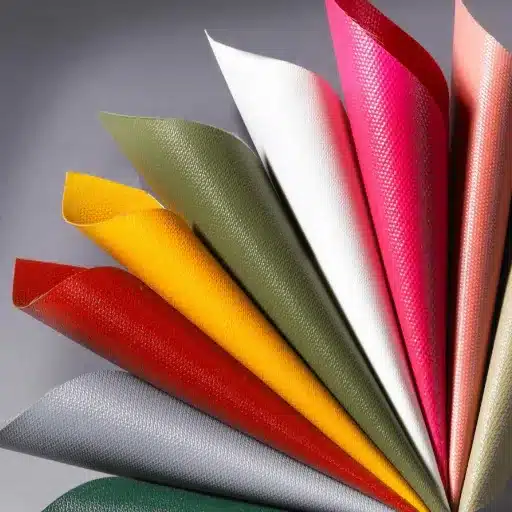
A sustainable coated fabric’s environmental profile is fixed at four points that move independently of each other. That independence is the single most useful thing to understand about this subject, because it explains why the phrase means so little on its own.
| Route | What changes | The question it answers |
|---|---|---|
| Feedstock | Recycled or bio-attributed polymer | What is it made from? |
| Coating system | Water-based, solvent-free, phthalate-free, PFAS-free chemistry | What does the process emit, and what leaches? |
| Service life | Tensile, adhesion, UV, flex and weld performance | How many times will it be replaced? |
| End-of-life | Reuse, remanufacture, recycling, take-back | Where does it go when it fails? |
A supplier can improve one route and market the result as though it covered all four. A mono-material PP fabric genuinely wins on routes one and four and can be materially weaker on route three. A water-based topcoat improves route two and may shift route three if nobody re-tests adhesion.
Neither is dishonesty by itself. Treating one route as a proxy for the whole picture is where specifications go wrong.
Route one: feedstock
Two options exist, and they are not equivalent. Recycled polyester (rPET) places recycled content in the scrim, which is typically the larger mass fraction of the composite, making it the most readily specifiable route and the easiest to document. Bio-attributed PVC replaces fossil feedstock at the polymer level.
The reference material is BIOVYN, the first commercially available bio-attributed PVC, launched by INEOS Inovyn in 2019. It is produced from crude tall oil, a by-product of coniferous wood pulping, and certified under a mass-balance approach by the Roundtable on Sustainable Biomaterials. Reported carbon footprint reductions run above 70% for a fully renewable formulation, with some sources citing up to 90%. It is already used in PVC-coated fabric, tarpaulins, pool liners and membranes.
The distinction that matters commercially: bio-attributed is not bio-based. Mass balance allocates a renewable share across total output, so the polymer delivered to your line is chemically identical to conventional PVC. Ask for the mass-balance certificate and the physical bio-based content figure. One without the other tells you only half the answer.
Route two: coating system and low-VOC coated fabric
This is where most of the near-term gains sit, because a low-VOC coated fabric is a chemistry change rather than an architecture change. Removing solvent-based topcoats, moving off ortho-phthalate and phosphate plasticizers to non-phthalate plasticizer systems such as DOTP, and switching to calcium-zinc stabilizers all reduce what the coating releases during production and in service.
The evidence base is credible. Waterborne polyurethane systems are reported to use no solvents and to cut water consumption by around 95% and energy use by about 50% against conventional equivalents. A published environmental product declaration for a PVC-coated polyester technical textile documents solvent vapours evaporated and treated by post-combustion, paired with a 15-year average service lifetime and no hazards in normal use (Sioen).
The gaps are narrow. Those figures cover specific chemistries, not the category.
The caveat is a testing one. Plasticizer and topcoat chemistry drive coating adhesion, flex behaviour and low-temperature performance. Changing the plasticizer system without re-testing coating adhesion and flex-crack resistance is how a lower-emission formulation becomes a warranty claim. Our coated fabric testing guide covers the procedures.
Route three: service life
This route is routinely ignored, and it usually decides the answer. A coated fabric that performs for 15 years and is replaced once carries a smaller footprint than one that degrades in three years and is replaced five times, regardless of which is more recyclable or more biodegradable.
Longevity is not a soft claim. It is the product of UV resistance, coating adhesion retention, flex and cold-crack behaviour, and weld integrity. How long a coated fabric lasts is a test result rather than a marketing position.
Those properties are specified in the purchase order, and they are the same ones that keep a fleet curtain out of a skip. The published EPD lifetime noted above is a data point of this kind, and it sits awkwardly beside the 12-to-24-month biodegradability figures promoted for alternative tarpaulin materials, which are attractive in a brochure and unsuitable for a load-bearing, UV-exposed, weld-critical application.
Route four: end-of-life
Reuse and remanufacture rank above recycling, and a supplier should be able to say which route it can actually arrange. Design decides this before the fabric is even coated: mono-material build-ups, removable hardware and a single polymer family make separation possible, while a bonded composite with mixed buckles and eyelets makes it expensive.
Our tarpaulin take-back and recycling service covers our own route in detail. The question to put to any supplier is narrow: is there a take-back route, who is the named acceptor, and what tonnage has that acceptor processed. If the answer is a word rather than a number, the claim has not been tested.
Is PVC Coated Fabric Recyclable? The Honest Answer
A recyclable coated fabric is technically possible and commercially rare. The barrier is construction rather than chemistry. A PVC coating bonded to a polyester scrim is a composite, and separating the two is the entire difficulty. The Vinyl Council of Australia puts it plainly: combining two plastics as a coated woven fabric is what makes recycling difficult.
Five end-of-life routes are in commercial or near-commercial use. They are not equal.
| Route | How it works | Output |
|---|---|---|
| Mechanical | Buckles removed, fabric shredded and extruded | PES/PVC mixture into mats, greenhouse flooring, construction liners |
| Dissolution | Solvent dissolves the PVC off the fibre | Separated PVC and polyester |
| Swelling / delamination | Polar solvent swells the coating for physical separation | Separated fractions, highest stated future potential |
| Pyrolysis | Polymers converted under heat | Syngas, hydrocarbons, hydrogen chloride |
| Energy recovery | Incineration with HCl recovery | Heat plus recovered HCl |
Scale is where the honesty has to sit. VinylPlus and Recovinyl report roughly 765,972 tonnes of PVC recycled in Europe in 2025, up 5.7% from 724,638 tonnes in 2024, with about 10.3 million tonnes cumulatively since 2000.
Coated fabric’s share of that system is small: around 9,573 tonnes in 2018 through the EPCoat stream, and between 3,449 and 6,364 tonnes a year across 2011 to 2013. The VinyLoop dissolution process produces recycled PVC with 46% lower primary energy demand than virgin production. The technology works. The collection infrastructure does not yet.
In Australia, TexBack’s PVC separation technology remains in pilot phase and cannot process commercial quantities. That is the honest state of the category, and any supplier telling you otherwise should be asked for the tonnage.
“Recyclable,” “recycled” and “bio-attributed” are three different documents
Most procurement confusion traces to one habit: treating these three words as synonyms.
Recyclable is a statement about possibility. A route exists in principle. No volume, no acceptor and no scale is implied, which is why Priya’s four bidders could all use the word truthfully while offering her nothing actionable.
Recycled content is a measured quantity: a percentage by weight in the delivered product, supported by a chain-of-custody certificate. Two details decide whether the figure is meaningful. First, is the percentage of the whole composite or only the coating? A “30% recycled” claim can describe a fraction of the coating alone. Second, is it post-consumer or pre-consumer, because the two carry very different environmental weight.
Bio-attributed is a mass-balance allocation, as described above. It is a legitimate and audited accounting method. It is not a statement about what the polymer physically contains.
Each claim sits on a different evidence base. Teams that accept the weakest one routinely discover the gap at the point where it costs the most. The full instrument-by-instrument picture is in our coated fabric standards and certifications guide.
The Regulations Coated Fabric Buyers Now Have to Meet
Two regulatory programmes changed this subject from a preference into a deadline. Neither is fully settled, and the current status of each matters as much as the date.
EU ESPR and the Digital Product Passport
The Ecodesign for Sustainable Products Regulation, Regulation (EU) 2024/1781, entered into force on 18 July 2024. It creates a horizontal framework plus the Digital Product Passport, and textiles are a priority product group under its 2025 to 2030 working plan. Key dates: the central DPP registry opened for organisation enrolment on 16 July 2026, and the ban on destroying unsold goods for large companies began on 19 July 2026. The textile delegated act is expected in late 2026 or 2027, with DPP compliance realistically landing in 2028 to 2029 after a transition period.
One scope detail is consistently reported wrongly. The JRC’s preparatory study on DPP content covers products with at least 80% textile fibres by weight, and it excludes fabrics and yarns as such, along with PPE, medical devices and toys. Whether a coated technical fabric is caught therefore depends on its fibre fraction and on the end product it becomes.
Mandatory minimum recycled content is enabled under ESPR, with industry anticipating thresholds of 20 to 30% for polyester-containing products. None of that is final, and no supplier should be presenting it as settled.
PFAS-free coated fabric: the fastest-moving restriction in the category
The exposure is not the polymer. It is the water-repellent and soil-release finish, and that is precisely what the EU’s July 2025 Action Plan pushes into technical textiles.
| Jurisdiction | Instrument | Coverage | Timing |
|---|---|---|---|
| France | Law no. 2025-188 | PFAS in clothing, footwear, waterproofing agents | From January 2026; all textiles 2030 |
| Denmark | Executive Order BEK no. 4649 | Total fluorine at or above 50 mg F/kg | Existing stock saleable to 1 January 2027 |
| EU | REACH | C9 to C14 PFCAs and PFHxA restricted in consumer textiles; PFAS listed as SVHC | In force; extension to technical textiles under the 2025 Action Plan |
| United States | TSCA, EPA PFAS Action Plan, state bans | Federal oversight plus California, New York | Ongoing |
| China | Highly Restricted Toxic Chemicals list | PFAS | In force |
| Japan | Class I Specified Chemical Substances | PFAS | In force |
Anja leads compliance at a German tent and temporary-structure fabricator. Her supplier shipped a coated fabric with a fluorine-based water-repellent finish and a certificate that said “environmentally friendly.” A total-fluorine screen ahead of a French order returned a result above the Danish threshold, and the finish had to be reformulated on a compressed timeline. The certificate had never mentioned fluorine, because nobody had asked it to.
What fluorine-free alternatives cost in performance
Fluorine-free chemistry is available today, in five families: silicone-based, hydrocarbon and paraffin, polyurethane, organosilicon, and nanostructured silica, with bio-based systems emerging. Silicone chemistry with C16 to C18 long alkyl chains is the most promising, combining low surface energy in the 20 to 24 mN/m range with thermal stability.
The performance evidence is real but bounded. A C18 to C16 organosilicon complex reached a contact angle of 131.3 degrees and an ISO 4920 spray rating of 90 on polyester, holding roughly 130.5 degrees and a spray rating of 80 after five simulated home launderings. The limits are equally real: paraffin-based repellents are temporary with poor wash fastness, and urethane systems often stay below a 120-degree contact angle. The EU-funded ZeroF project is targeting PFAS-free coatings with a 25% environmental impact reduction and consumer cost increase under 20%.
None of this is a reason to avoid the change. It is a reason to specify the finish and test the result rather than assume the substitution is drop-in. Where fire-retardant performance is also required, the interaction between FR chemistry and a fluorine-free finish needs testing together, not separately.
Chemical compliance alongside sustainability
Sustainability claims do not replace chemical compliance, and a lower-impact compound still has to clear lead-free and phthalate-free PVC requirements where CPSIA or REACH applies. Our batch documentation and certification guide covers the declarations that travel with a batch.
PVC vs PVC-Free vs Bio-Attributed: The Honest Trade-Off
Mono-material PVC-free constructions are genuinely easier to recycle, typically lighter, and avoid halogen and plasticizer concerns. They also generally trade away tensile strength, coating adhesion and weld window, and need higher flame-retardant additive loading to reach the same fire classification. PVC-coated fabric remains the reference where weld strength, fire performance and service life dominate the requirement, while a laminated construction trades weldability for a different build-up at a higher cost.
| Route | Recyclability | Strength / adhesion | Weldability | FR performance | Service life | Relative cost |
|---|---|---|---|---|---|---|
| Conventional PVC | Difficult; composite | Reference standard | Excellent | Achievable at moderate loading | Long, documented to 15 years | Baseline |
| Recycled-content PVC | Difficult; composite | Near-equivalent, verify per batch | Excellent | As conventional | As conventional | Slight premium |
| Bio-attributed PVC | Difficult; composite | Equivalent | Excellent | As conventional | As conventional | Premium |
| PVC-free mono-material PP/PE | Best; single polymer | Generally lower | Narrower window | Higher additive loading needed | Application-dependent | Competitive |
| TPU-coated | Moderate | Good, lower temperature range | Good | Additive-dependent | Moderate to long | Higher |
| Laminated construction | Difficult; delamination route | High | Different process | As specified | Long | Higher |
Tomás specifies fabric for a Spanish haulage fleet and priced two curtain options. The cheaper one carried a three-year expected life at roughly 60% of the cost. Over a 15-year horizon he would buy five of them, five sets of fitting labour, and five disposal events.
The higher-specification option cost more once and delivered better UV and adhesion retention. The purchase price comparison had been the wrong calculation, and the environmental comparison followed the same arithmetic.
Specify by application, not by ideology. Where a mono-material fabric meets the mechanical and fire requirement, it is the better environmental answer. Where it does not, the durable composite is.
How to Verify a Sustainable Coated Fabric Claim
Every sustainable coated fabric claim on this page has a matching document. Ask for the document, not the label.
- Recycled content, percentage by weight of the delivered composite, and whether the figure covers the coating or the whole construction; pre-consumer or post-consumer; chain-of-custody certificate; and whether the number is measured or design-intent.
- Bio-attributed content, the mass-balance certificate and the physical bio-based content figure, both. A certificate alone does not describe the polymer.
- “Recyclable”, which route, at what scale, with a named acceptor, and at what material condition. A route without an acceptor is a statement of possibility.
- Low-VOC or water-based, which coating layer, which VOC species, tested to what method and what limit.
- PFAS-free, a total-fluorine test result. A declaration of absence is not a measurement.
- Phthalate-free, which plasticizer system, supported by a vinyl-specific phthalate test.
- Always, batch identity, test method and edition, the accredited laboratory and its scope, and a validity date.
Our programme covers recyclable options, water-based coatings, and zero-waste-to-landfill achieved in 2023. Those are capabilities, documented per batch and available on request through our quality control and traceability process. They are not certifications, and we will not present them as such.
Frequently Asked Questions
Is PVC coated fabric recyclable? Technically yes, through mechanical, dissolution, swelling and pyrolysis routes, and VinyLoop dissolution produces recycled PVC with 46% lower primary energy demand than virgin material. Commercially, very little is recycled today: over 99% of European tarpaulins are landfilled or incinerated, because separating a PVC coating from a polyester scrim is difficult at scale.
Is “recyclable” the same as “recycled”? No. Recyclable means a route exists in principle, with no volume implied. Recycled content is a measured percentage by weight in the delivered product, supported by a chain of custody. A product can be fully recyclable and contain no recycled material at all.
What does “bio-attributed” PVC mean? It means a renewable feedstock share has been allocated to the material under a mass-balance accounting method, certified by a body such as the Roundtable on Sustainable Biomaterials. The delivered polymer is chemically identical to conventional PVC. Ask for the mass-balance certificate and the physical bio-based content figure.
Is bio-based PVC greenwashing? Not when it is audited and reported honestly. Mass balance is a recognised and certified method, and bio-attributed PVC from crude tall oil is reported to cut carbon footprint by more than 70% for a fully renewable formulation. It becomes greenwashing when the certificate is presented as evidence that the polymer itself is renewable.
Does PFAS regulation affect coated fabrics? Yes, and the exposure is the water-repellent finish rather than the polymer. France has banned PFAS in waterproofing agents from January 2026, Denmark restricts total fluorine at or above 50 mg F/kg, and the EU’s 2025 Action Plan extends restrictions to technical textiles. Specify a fluorine-free finish and ask for a total-fluorine test.
Are PVC-free coated fabrics as strong as PVC? Generally not, though the gap varies by construction. Mono-material PP and PE fabrics are lighter and far easier to recycle, and typically give up tensile strength, coating adhesion and weld window, while needing more flame-retardant additive to reach the same fire classification. Specify according to the load, fire and weld requirement of the application.
How do I verify a recycled-content claim? Request the chain-of-custody certificate, confirm whether the percentage applies to the coating or the whole composite, establish pre-consumer versus post-consumer origin, and check whether the figure is measured or design-intent. Confirm the batch it relates to, the laboratory, and the test edition.
The Bottom Line
Sustainable coated fabrics come down to four routes that move independently, three claims that are not synonyms, and one piece of arithmetic about service life that most specifications never run. What separates a sustainable tarpaulin manufacturer from a supplier using the word is which of those the buyer can actually evidence.
- Feedstock, coating system, service life and end-of-life each require their own evidence.
- Over 99% of European tarpaulins are landfilled or incinerated. Five end-of-life routes exist; commercial collection does not yet match them.
- “Recyclable,” “recycled” and “bio-attributed” are three different documents. Ask for the document.
- Durability is the first sustainability specification. Replacements per decade beats recyclability percentage on almost every calculation.
- PFAS regulation is dated and moving. Specify fluorine-free and test for total fluorine.
- ESPR and the Digital Product Passport will formalise recycled content and substances-of-concern reporting for textiles through 2028. The delegated act is not final, so build the documentation habit now.
Sustainability in coated fabrics is a documentation exercise before it is a materials exercise. Teams that can produce the batch record, the chain of custody and the test report will clear compliance reviews and pass procurement audits without renegotiating. Teams that built a specification on the word “recyclable” will go back to their suppliers.
Ready to specify it properly? Send us the application, the destination market and the required service life. We will return the compound options, the documentation available per batch, and a prototype sample where the formulation changes. Request a technical consultation and we will tell you plainly which claims we can evidence for your specification, and which we cannot.